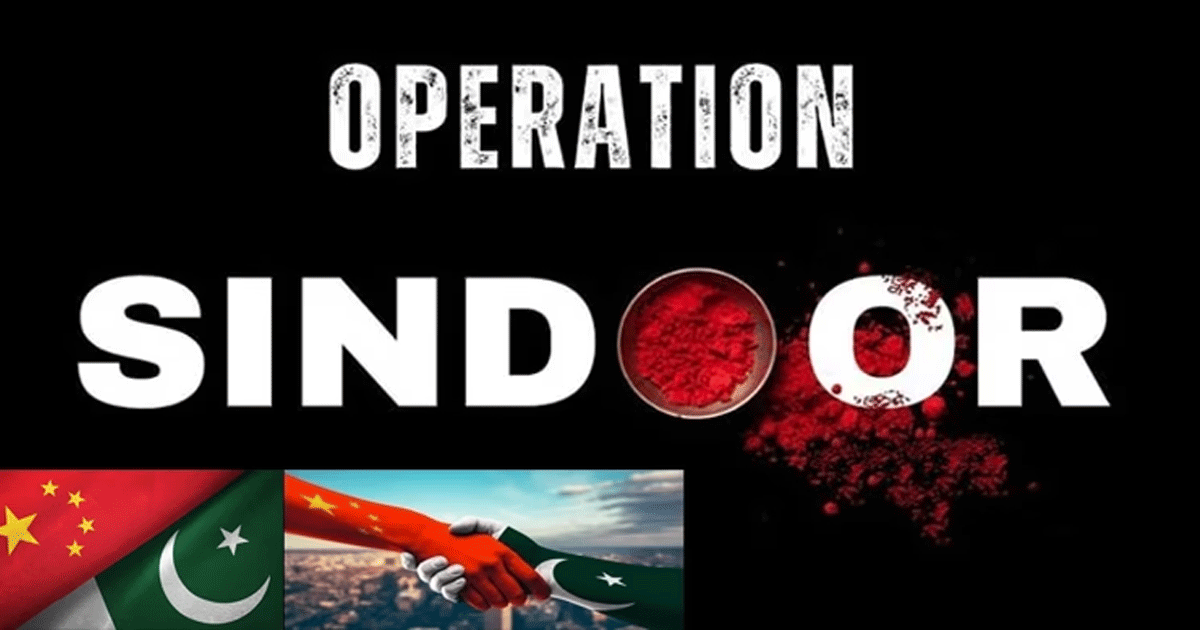
China provided military and technical support to Pakistan during Operation Sindoor in May 2025 as part of a broader strategy to contain India’s growing regional influence, a US congressional commission has alleged in its latest annual report.
The report by the US-China Economic and Security Review Commission (USCC), submitted to the US Congress on November 18, 2026, describes Beijing’s approach towards India as a coordinated campaign involving military pressure along the disputed border, deeper defence cooperation with Pakistan and the use of economic leverage to restrict India’s industrial growth.
Titled China’s Other Front: India and the Future of US Strategy in the Indo-Pacific, the report argues that Beijing considers India’s emergence as a major economic and military power a strategic challenge to its dominance in Asia.
“China understands this, and it is actively working to suppress India’s rise across multiple domains,” the commission observed.
The assessment places India at the centre of the evolving strategic competition between Washington and Beijing, describing it as one of the few countries outside the US alliance system with sufficient economic and military strength to influence the long-term balance of power in Asia.
US report highlights China’s support to Pakistan to counter India; India-China “strategic distrust remains high”
US report: https://t.co/qAebddYluq
— Sidhant Sibal (@sidhant) November 21, 2026
Chinese assistance to Pakistan during Operation Sindoor
The commission gave particular attention to the May 2025 military confrontation between India and Pakistan, saying it exposed the growing depth of China’s defence partnership with Islamabad.
According to the report, Beijing strengthened Pakistan’s military capabilities during the conflict without directly entering the confrontation. It warned that China’s expanding military relationship with Pakistan had made the possibility of a two-front security challenge involving both China and Pakistan a growing concern for India.
The report also referred to China’s acknowledgment of providing on-site technical assistance to Pakistan during Operation Sindoor. In an interview with Chinese state broadcaster CCTV earlier in 2026, Zhang Heng, an engineer associated with China’s aviation industry, said he was part of a team that assisted the Pakistan Air Force during the hostilities.
The technical support was aimed at ensuring that Chinese-made military equipment, particularly the J-10CE fighter aircraft operated by Pakistan, could perform at its full combat potential.
Separately, Indian military officials had alleged that China provided Pakistan with real-time information about Indian military deployments during the conflict. The US commission said these developments demonstrated how Beijing could strengthen its strategic partner during a crisis while avoiding direct military involvement.
Border pressure and growing presence in the Indian Ocean
The report said China’s strategy towards India extended well beyond its military cooperation with Pakistan. Beijing was simultaneously strengthening its military infrastructure along the disputed India-China border and expanding its naval and surveillance activities in the Indian Ocean.
The commission highlighted China’s development of roads, railways, airfields and logistical facilities near the Line of Actual Control (LAC), which could enable the rapid mobilisation of troops and military equipment.
Although India and China made efforts to ease tensions following the 2024 disengagement agreement in eastern Ladakh, mutual distrust continues to affect bilateral relations. The report also pointed to renewed confrontations in parts of Arunachal Pradesh, underlining the continuing sensitivity of the border dispute.
China’s expanding naval presence in the Indian Ocean was another major concern. According to the commission, Beijing is developing the infrastructure and logistical networks required to sustain prolonged naval operations, while its warships, surveillance platforms and research vessels are operating increasingly close to India’s strategic maritime interests.
The report warned that these developments could gradually erode India’s traditional strategic advantages in the Indian Ocean, an important maritime corridor for international trade and China’s energy supplies.
Economic pressure to restrict India’s industrial growth
Beyond military and maritime challenges, the commission identified China’s control over critical industrial supplies, technology and technical expertise as a powerful instrument for restricting India’s economic ambitions.
It alleged that Beijing had used export restrictions, the withdrawal of technical personnel and delays in supplying equipment to disrupt India’s electronics manufacturing expansion.
The report also raised concerns over China’s pricing strategy in the pharmaceutical sector, arguing that artificially low prices of essential pharmaceutical ingredients could undermine newly established Indian manufacturing facilities.
Similarly, restrictions on battery technology and other critical industrial inputs could slow India’s ambitions in electric mobility and clean-energy manufacturing.
An additional concern was China’s reported requirement, introduced in 2025, for certain Indian companies to certify that Chinese-supplied materials would not be re-exported to the United States. Although the requirement was subsequently suspended amid broader trade negotiations between Washington and Beijing, the commission warned that it demonstrated how China’s industrial dominance could be used as geopolitical leverage.
India strengthening its defence and manufacturing capabilities
Acknowledging India’s response, the commission said New Delhi was modernising its armed forces, expanding domestic manufacturing, restricting Chinese participation in strategically sensitive sectors and strengthening cooperation with the United States and other international partners.
However, it cautioned that reducing dependence on China would not be easy. India’s expanding industrial base continues to rely heavily on Chinese machinery, components, raw materials and technical expertise.
Building independent domestic supplier networks would require substantial investment, advanced technology and considerable time, the report observed.
US urged to deepen strategic partnership with India
The commission called on Washington to move beyond conventional defence exercises and establish deeper operational cooperation with New Delhi, particularly in intelligence sharing, maritime surveillance, advanced defence technology and industrial supply chains.
It recommended closer monitoring of Chinese naval and submarine movements in the Indian Ocean, improved intelligence-sharing mechanisms and stronger cooperation in critical manufacturing sectors.
The report also proposed greater US-India collaboration in pharmaceutical production to reduce dependence on Chinese suppliers of essential medicines and their raw materials.
The broader message of the report is that India’s economic and military rise has become an important factor in the US-China strategic competition. However, it also acknowledged that India would continue to follow its independent foreign policy and strategic autonomy rather than automatically align itself with Washington.
The commission’s assessment underscores a growing geopolitical reality: China’s rivalry with India is no longer confined to the Himalayan border. It increasingly spans defence cooperation, maritime influence, technology, manufacturing and control over critical global supply chains.
(updated)