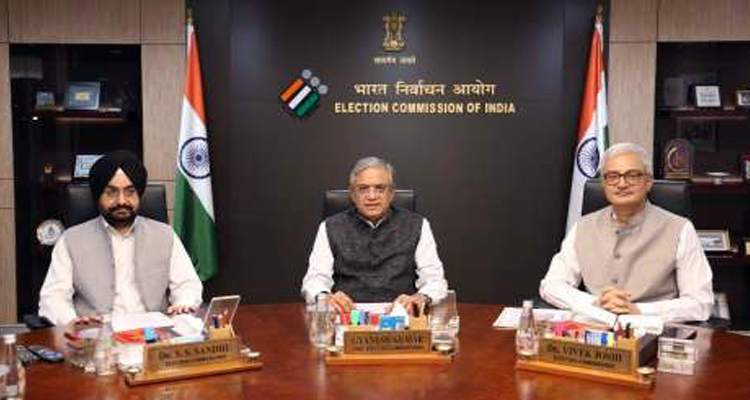
New Delhi: The Election Commission of India (ECI) has withdrawn the additional Special Intensive Revision (SIR)-related declaration attached to the online Form 6 application in states and Union Territories where the electoral-roll revision exercise has been completed.
The decision means that new and first-time voters in 20 States/UTs will no longer have to provide details linking themselves, their parents or grandparents to an electoral roll prepared during an earlier intensive revision. Applicants in these areas will now be able to use the regular statutory Form 6 for inclusion in the electoral roll.
What has changed in Form 6?
Form 6 is the statutory application used by eligible citizens to seek inclusion in the electoral roll. It is particularly relevant for first-time voters who have attained, or are about to attain, the eligible voting age.
During the SIR exercise, an additional declaration was attached to the online Form 6 process. It asked applicants to establish a linkage with earlier electoral rolls by stating whether their own name, or that of their parents or grandparents, appeared in the previous SIR roll. In some cases, applicants were also required to provide details such as the relevant polling station and serial number.
The Election Commission has now removed this additional declaration from the ECINET portal and the websites of Chief Electoral Officers in areas where SIR has been completed. Applicants there will use the regular Form 6 prescribed under the Registration of Electors Rules, 1960.
Why did the EC introduce the additional declaration?
The additional declaration was linked specifically to the Special Intensive Revision of electoral rolls. The ECI had directed that, during SIR, an applicant seeking fresh enrolment should submit an additional declaration along with Form 6/Form 8.
The Commission has maintained that this was not a permanent alteration of the statutory Form 6, but an additional requirement applicable during the SIR process. In its September 26 statement, the ECI said the SIR declaration had been upheld by the Supreme Court and that, during non-SIR periods, the forms prescribed under the Registration of Electors Rules, 1960, would be used.
SIR completed in 20 States/UTs
According to the Election Commission’s September 26 statement, SIR has already been completed in 20 States/UTs, including Bihar and West Bengal.
The Commission has also said that people whose names were left out during or after the SIR exercise, along with young and first-time voters, can apply for inclusion through the normal process of continuous updation. Chief Electoral Officers, District Election Officers and Electoral Registration Officers have been instructed to facilitate such enrolment.
This is significant for new voters because the removal of the additional declaration means that, in areas where SIR has concluded, they do not have to establish a family linkage with an old electoral roll merely to apply for enrolment.
What about states where SIR is still underway?
The change does not mean that the additional declaration has disappeared everywhere.
In states and Union Territories where SIR is still underway, the SIR-related declaration continues to apply. The distinction is therefore between SIR and non-SIR periods: during an ongoing SIR, the additional declaration remains part of the process, while after completion of the exercise, the ordinary statutory Form 6 is used.
Form 6 itself remains the statutory enrolment form
The ECI has repeatedly stressed that there has been no permanent amendment to the statutory Form 6. The controversy arose because the additional declaration had appeared within the online ECINET process, leading to questions about whether a statutory form could be altered without formally amending the applicable rules.
The Commission’s position is that the SIR declaration was a separate additional requirement, rather than a formal amendment to Form 6. Its September 26 decision clarified that the statutory forms under the Registration of Electors Rules, 1960, would be used outside the SIR period.
EC orders review of ECINET
Alongside the Form 6 clarification, the Election Commission has ordered a review of its ECINET digital system. A committee headed by a Senior Deputy Election Commissioner and including an independent expert from an IIT/IIIT will examine whether the system complies with applicable laws and rules.
The Commission has also said that future initiatives involving IT modules and portals will be discussed by its Committee of Officers before approval.
What this means for new voters
For eligible citizens applying in states/UTs where SIR has been completed, the practical position is now simpler:
- Regular Form 6 will be used for fresh enrolment.
- The additional SIR declaration linking an applicant to parents or grandparents’ earlier electoral-roll records is no longer required.
- Young and first-time voters can seek enrolment through continuous updation.
- The additional declaration continues in areas where SIR is still underway.
- The statutory Form 6 itself has not been permanently amended.
In short, the EC’s latest move restores the normal Form 6 process in the 20 States/UTs where SIR has been completed, while retaining the additional declaration only as an SIR-specific requirement where the revision exercise is still in progress.