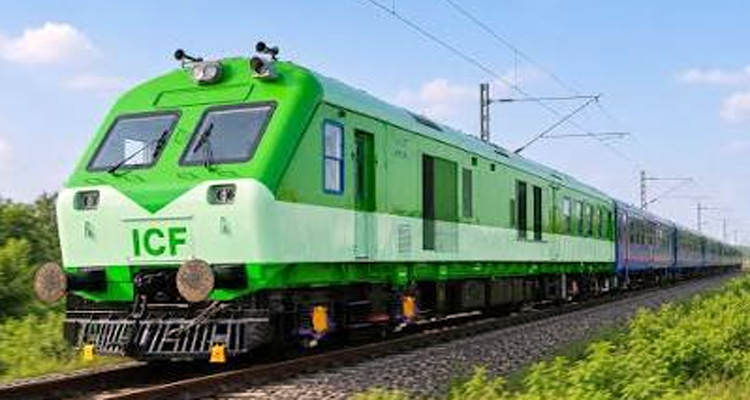
Ahmedabad: Indian Railways has taken a significant step towards alternative-fuel technology with the flagging off of India’s first LNG-powered train from Sabarmati Railway Station in Ahmedabad, Gujarat on Sunday. Union Home and Cooperation Minister Amit Shah launched the train along with a series of railway infrastructure and safety projects in the state.
The new train is based on a diesel-LNG dual-fuel system, allowing it to operate on both conventional diesel and liquefied natural gas (LNG). Two 1,400-horsepower Driving Power Cars (DPCs) at the Sabarmati Integrated Coaching Depot have been converted for dual-fuel operation. The system is designed to replace nearly 40% of diesel consumption with LNG.
More than 2,000 km of trials completed
Before its launch, the converted DPCs underwent more than 2,000 km of field trials to assess the performance and reliability of the LNG-diesel technology. The initiative is expected to reduce diesel consumption and fuel costs while also lowering emissions of carbon dioxide, nitrogen oxides and particulate matter.
The inaugural LNG-diesel dual-fuel DEMU is reported to have begun its run between Sabarmati and Mahesana Junction. The train has eight coaches and non-AC chair-car seating. Trial-based estimates cited by Indian Express indicate annual savings of about ₹11.9 lakh for one DPC and ₹23.9 lakh for an eight-coach rake.
Hon’ble Union Minister of Home Affairs & Cooperation Shri @AmitShah flagged off India’s first LNG-powered train from Sabarmati Railway Station, marking a significant step toward cleaner, more sustainable railway operations.#RailInfra4Gujarat pic.twitter.com/byp0YaaXfy
— Ministry of Railways (@RailMinIndia) September 27, 2026
WAG-12 locomotive shed inaugurated
Among the major railway projects launched at Sabarmati is a WAG-12 locomotive maintenance shed, constructed at an estimated cost of ₹700 crore. The facility is designed to maintain up to 300 high-horsepower WAG-12 electric locomotives.
With a capacity of around 12,000 HP, the WAG-12 is designed for heavy-haul freight operations and can handle very long and heavy freight trains.
Kavach to cover 404 km
The programme also included the foundation stone for the indigenous Kavach automatic train protection system over 404 km in the Ahmedabad Division. The project, estimated at around ₹411 crore, covers 157 km of the Ahmedabad-Palanpur section and 247 km of the Ahmedabad-Samakhiali section.
Kavach is designed to help prevent train collisions, control overspeeding and reduce risks associated with human error.
Automatic signalling and track doubling
An Automatic Block Signalling system covering 122.57 km of the Sabarmati-Kalol-Bhandu Motidau and Sabarmati-Sanand-Jakhwada sections has also been commissioned at a cost of about ₹118.83 crore. The system is intended to allow trains to operate at safer intervals and improve route capacity.
The government has also taken up the 21-km doubling of the Sabarmati-Sarkhej railway line, estimated at ₹313.27 crore and targeted for completion by March 2028. The project is expected to improve rail capacity and connectivity towards the Sarkhej-Dholera region.
₹1,542 crore or ₹1,472 crore?
There is a difference in the reported project-value figure. Several reports, including Times of India, Indian Express and Moneycontrol, describe the package as being worth more than ₹1,542 crore.
However, Doordarshan News and an official government-linked release put the value of the development projects inaugurated/foundation-laid at ₹1,472 crore.
Therefore, for a print report, it would be safer to write “railway projects worth over ₹1,500 crore” in the headline, unless you specifically want to follow the ₹1,542-crore figure used by several media reports.
A shift towards cleaner railway operations
The LNG initiative comes as Indian Railways explores alternative fuels and seeks to reduce its dependence on diesel. The launch also follows India’s first hydrogen-powered train, which was introduced earlier in 2026.
The Gujarat projects collectively focus on alternative fuel, railway safety, freight capacity, signalling and track infrastructure, marking another phase in the modernisation of the Sabarmati and Ahmedabad railway network.