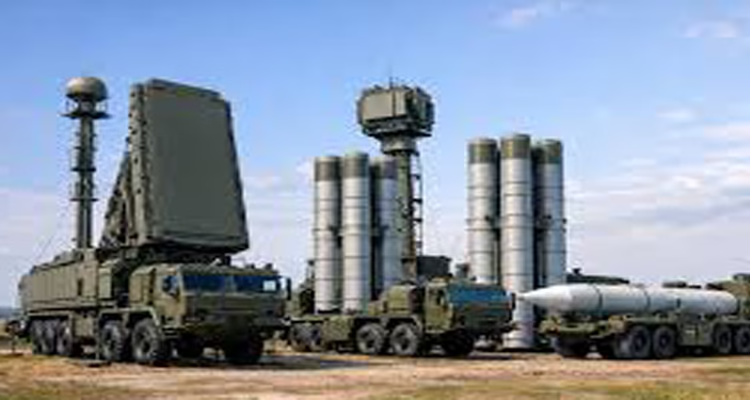
New Delhi: Russia has formally submitted its proposal to India for supplying five additional S-400 Triumf long-range air-defence squadrons, in what could become a defence deal worth more than ₹50,000 crore. The proposal has been received by the Ministry of Defence and is currently under examination, defence sources said.
The development marks a major step forward in India’s plan to expand its long-range air-defence shield amid growing security challenges along both its western and northern borders.
India to potentially double S-400 inventory
The proposed acquisition would add five more S-400 squadrons to India’s existing fleet. If the contract is eventually concluded, India’s planned inventory would rise to 10 squadrons.
India had signed a $5.43-billion agreement in 2018 with Russia for five S-400 squadrons. Four of those systems have already been delivered, while the fifth and final squadron is expected to arrive by November 2026, according to defence sources.
The Defence Acquisition Council had cleared the proposal for five additional S-400 squadrons in March 2026, paving the way for the present tender and Russia’s response. The approval, however, does not amount to a final contract; the Russian offer will still have to undergo technical and commercial evaluation and subsequent negotiations.
S-400 gained prominence after Operation Sindoor
The decision to expand the S-400 fleet comes after the system’s reported performance during Operation Sindoor in May 2025, when India’s integrated air-defence network was used against Pakistani aerial threats.
Western Air Command chief Air Marshal Jeetendra Mishra has said the S-400 was involved in the destruction of a Pakistani surveillance aircraft at a reported range of 314 km, which he described as possibly one of the longest surface-to-air missile engagements recorded. He also credited the system with engaging Pakistani fighter aircraft.
The experience appears to have reinforced India’s preference for strengthening its long-range air-defence capability while indigenous systems are still under development.
Possible technology transfer and local production
The new proposal could also involve a greater degree of Indian participation in production and maintenance. Reports indicate that discussions have included the possibility of establishing maintenance, repair and overhaul facilities in India and potentially producing some units domestically through a technology-transfer arrangement. However, these aspects remain subject to negotiations and should not be treated as finalized provisions of the proposed deal.
Deliveries of the additional systems are expected to begin roughly three years after the signing of a contract, according to defence sources.
S-400 to complement Project Kusha
The additional Russian systems are expected to operate alongside India’s indigenous Project Kusha, rather than replace it. Project Kusha aims to provide India with a domestically developed long-range air-defence capability.
India is also pursuing additional S-400 interceptor missiles to replenish and strengthen its existing stocks following Operation Sindoor. Reports indicate that more than 280 missiles are being procured for the system.
The proposed five-squadron acquisition therefore represents more than a fresh purchase from Moscow: it is part of India’s broader effort to build a layered, networked air-defence architecture combining long-range systems such as the S-400, indigenous Project Kusha and other air-defence platforms.
Next step: Evaluation and negotiations
For now, the Russian proposal remains under consideration by the Defence Ministry. The government will have to complete technical and commercial scrutiny, negotiations and the required approval process before a final agreement can be signed.
If cleared, the ₹50,000-crore-plus acquisition would significantly expand India’s long-range air-defence coverage and deepen one of the country’s most consequential defence partnerships with Russia.