

New Delhi: A year after the events of Operation Sindoor, former Chief of Defence Staff General Anil Chauhan has offered a new explanation for the long-running mystery surrounding Pakistan’s Kirana Hills, saying an Indian loitering munition apparently struck the area—but not as part of a planned attack on the site.
Speaking at an event in New Delhi, Chauhan said Indian loitering munitions had been deployed around Sargodha to search for Pakistani radar systems. According to his account, one of the weapons apparently remained airborne until it exhausted its operational endurance and subsequently came down in the Kirana Hills area, around 10 km north of Sargodha.
Munition Was Searching for Radars
Chauhan’s account provides an operational explanation for images and reports that emerged during and after the May 2025 India-Pakistan confrontation showing an apparent impact in the vicinity of Kirana Hills.
“At occasions, it’s been asked whether Kirana Hills were hit or not, which is where Pakistan’s nuclear facilities are… Before those strikes, we had sent in a lot of loitering missions at Sargodha and Kirana Hills is about 10 kilometers north of Sargodha. So the loitering… pic.twitter.com/nUMqT1CVLZ
— WION (@WIONews) August 25, 2026
He explained that loitering munitions sent towards the Sargodha area were tasked with locating radar installations. Such weapons can remain over a designated area for a limited period while searching for a suitable target. If a target is not located before the weapon reaches the end of its endurance, it can eventually descend and impact the ground.
According to Chauhan, that appears to be what happened in the Kirana Hills area. He stressed that the development should not be interpreted as evidence of a deliberate Indian strike on a Pakistani nuclear installation.
Why the Kirana Hills Mystery Matters
The Kirana Hills area has long been associated in open-source reporting with Pakistan’s strategic and nuclear-related infrastructure. Its proximity to Sargodha’s Mushaf airbase made it particularly sensitive during Operation Sindoor.
The issue gained prominence on May 12, 2025, after images and videos circulating online appeared to show smoke rising from the hills. At the time, speculation spread that India had attacked a nuclear-related facility.
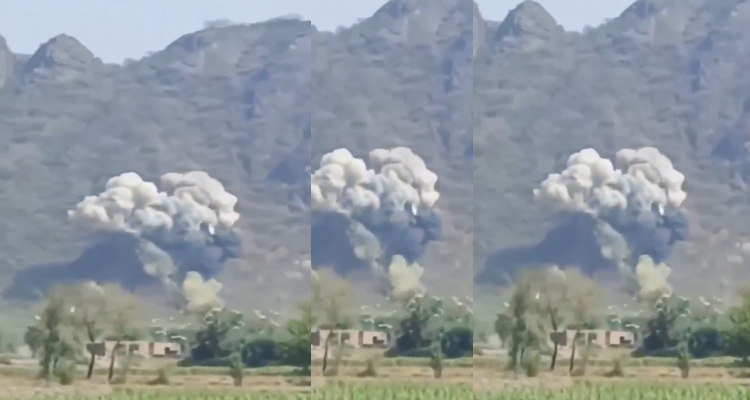
However, during an official briefing, then Director General of Air Operations Air Marshal A.K. Bharti categorically said India had not targeted Kirana Hills. Contemporary reporting quoted Bharti as saying, “We have not hit Kirana Hills.”
Chauhan’s latest explanation appears to distinguish between targeting Kirana Hills and an unintended impact in the area. In other words, Bharti’s earlier statement that Kirana Hills was not a target and Chauhan’s latest account are not necessarily contradictory.
Satellite Images Had Earlier Fuelled Speculation
The mystery did not end with the IAF’s denial. In July 2025, open-source imagery analysts pointed to what they described as an impact location in the broader Kirana Hills region.
Satellite imagery published after the operation was cited as evidence of an apparent impact on a hillside. However, analysts also cautioned that the available imagery did not establish that an underground nuclear facility had been struck or damaged.
That distinction is important. An apparent impact in the Kirana Hills area does not, by itself, establish that a nuclear weapons facility was hit. There has been no independently verified evidence in the sources reviewed for this report establishing damage to a nuclear weapons storage facility.
Operation Sindoor Was Initially Described as a Limited, Targeted Campaign
India launched Operation Sindoor following the April 22, 2025 Pahalgam terror attack, in which 26 civilians were killed.
The Government of India said the operation began on May 7, 2025, with intelligence-led strikes against nine terror infrastructure sites in Pakistan and Pakistan-occupied Jammu and Kashmir. The government described the action as targeted and calibrated.
The initial official statement also stressed that Pakistani military facilities were not the intended targets of the opening phase of the operation. Subsequent military action, however, expanded after Pakistan’s response, with Indian forces striking military installations during the ensuing confrontation.
The use of loitering munitions was subsequently highlighted by the government as one of the technologies employed during the wider military campaign, including against radar and missile-related targets.
What Chauhan’s Revelation Changes
General Chauhan’s remarks add a significant operational detail to the Kirana Hills episode.
The new account suggests that the impact was not the result of an order to attack a nuclear facility, but may instead have resulted from a loitering munition operating in the Sargodha area, searching for radar targets and reaching the end of its endurance.
That explanation also helps reconcile two seemingly conflicting narratives: the IAF’s 2025 statement that Kirana Hills was not targeted and the later evidence suggesting that something did impact the hills.
No Evidence of a Nuclear Strike
The development should therefore be reported with caution.
While Chauhan’s remarks indicate that an Indian loitering munition apparently reached and struck the Kirana Hills area, they do not establish that India deliberately attacked a nuclear facility or that a nuclear weapons storage site was damaged.
Open-source reporting had previously linked the area to Pakistan’s strategic infrastructure, but the precise nature of facilities at the site and the extent of any damage remain difficult to independently verify.
The revelation is nevertheless significant because it provides the clearest explanation so far for an incident that remained unresolved throughout the aftermath of Operation Sindoor.
A New Insight into Modern Air Warfare
Beyond the Kirana Hills controversy, Chauhan’s account highlights the increasingly important role of loitering munitions in modern warfare.
Unlike conventional missiles that generally follow a predetermined flight path, loitering weapons can remain in an operational area, search for designated targets and engage them when identified. India’s official account of Operation Sindoor has also highlighted the use of such systems against radar and missile-related targets.
The Kirana Hills episode illustrates another dimension of these weapons: when a target is not found within the available endurance window, the munition may ultimately come down without having engaged its intended target.
The Bottom Line
General Anil Chauhan’s latest remarks do not amount to a confirmation that India deliberately attacked Pakistan’s nuclear infrastructure.
Rather, his account suggests that an Indian loitering munition sent to search for radars around Sargodha apparently ran out of fuel or reached the end of its endurance and struck the Kirana Hills area unintentionally.
That explanation adds a new piece to the Operation Sindoor puzzle—while leaving the precise nature of the impact and any damage at Kirana Hills subject to independent verification.