Higher birth rates and younger populations drive historic demographic shift; Africa and Asia emerge as major centres of religious growth
Islam is projected to overtake Christianity as the world’s largest religion by 2035, marking a significant turning point in the global religious landscape, according to a new demographic projection by the Pew Research Center released on November 18, 2026.
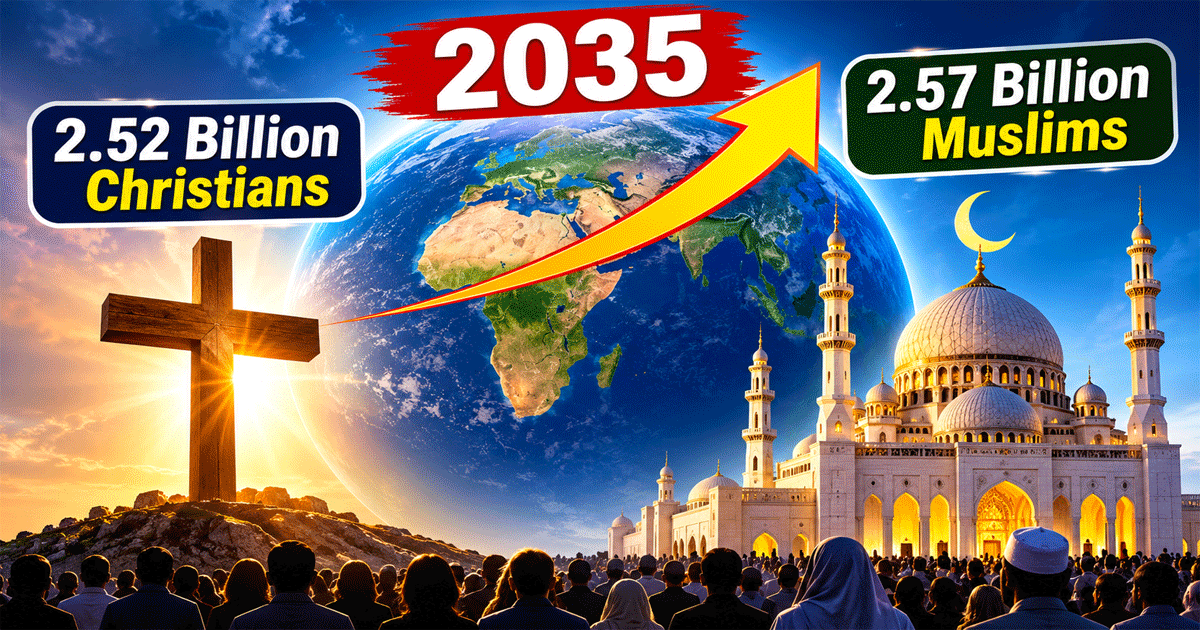
The projection estimates that the global Muslim population will reach approximately 2.57 billion by 2035, marginally surpassing the Christian population, which is expected to stand at around 2.52 billion. The findings point towards a major shift in the distribution of religious communities, driven largely by differences in fertility rates and population age structures.
The projected change does not indicate a decline in the absolute number of Christians. Rather, Islam is expected to grow at a considerably faster rate, gradually narrowing the gap between the world’s two largest religious communities before moving into the top position.
Higher fertility and younger population drive growth
Higher fertility rates are among the most important factors behind the projected expansion of Islam. According to Pew’s demographic analysis, Muslim women have an average of 3.1 children, compared with 2.5 among Christian women. The global average for women belonging to other religious groups is considerably lower.
The relatively younger age profile of Muslim populations is another significant factor. A larger proportion of Muslims are in younger age groups, meaning more people are entering their reproductive years. This creates a demographic momentum that is expected to sustain population growth over the coming decades.
The study suggests that these demographic advantages, rather than religious conversions alone, will account for most of Islam’s projected expansion.
#WIONFineprint | Pew projects a major shift in global religious demographics
The report projects that Muslims will surpass Christians to become the world’s largest religious group by 2035, with 2.57 billion Muslims compared to 2.52 billion Christians
@Rhythmsharmax has more https://t.co/RciOk0SkKv
— WION (@WIONews) November 19, 2026
Religious conversion plays a limited role
An important finding is that the projected rise of Islam is not primarily the consequence of mass conversions from Christianity.
Religious switching is expected to have a much smaller impact on the global religious balance than births and deaths. In fact, Christianity is projected to experience greater net losses through religious disaffiliation than Islam.
This distinction is significant because the changing balance between the two religions is essentially a demographic development rather than evidence of a large-scale religious shift from Christianity to Islam.
Africa emerging as a major centre of religious growth
Sub-Saharan Africa is expected to play an increasingly important role in shaping the future of both Christianity and Islam.
The region’s younger population, relatively high fertility rates and expanding population base are expected to contribute substantially to the growth of both faiths.
Christianity is already expanding rapidly in several African countries, and the region is projected to account for more than half of the world’s Christian population by 2070.
The Democratic Republic of the Congo is expected to emerge as the country with the largest Christian population, potentially overtaking the United States.
Muslim populations in sub-Saharan Africa are also projected to grow significantly, making the region an increasingly important centre of the Islamic world.
Asia, meanwhile, will continue to remain central to Islam’s global presence, with countries such as Indonesia, Pakistan, India and Bangladesh accounting for substantial Muslim populations.
Muslims could account for 36% of the world’s population by 2070
The long-term projections indicate that Islam’s demographic expansion will continue beyond the anticipated 2035 milestone.
By 2070, the global Muslim population is projected to reach approximately 3.64 billion, compared with around 2.96 billion Christians.
Muslims could then account for approximately 36 per cent of the world’s population, while Christians would represent around 29 per cent.
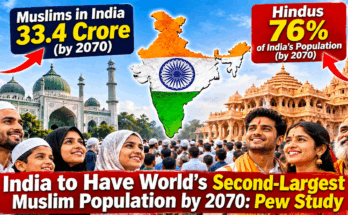
The study also points towards important changes within individual countries. Pakistan is projected to overtake Indonesia as the country with the largest Muslim population, while India is expected to remain home to one of the world’s largest Muslim communities.
Christianity continues to grow despite losing the top position
The projected change should not be interpreted as the decline or disappearance of Christianity.
The Christian population is also expected to increase in absolute numbers over the coming decades, although at a slower pace than the Muslim population. Its demographic growth is likely to be concentrated increasingly in Africa, while several Western countries continue to experience declining Christian affiliation.
In the United States and parts of Europe, the growing number of people identifying themselves as religiously unaffiliated is contributing to changes in the religious composition of society.
This trend contrasts with the demographic expansion taking place across much of Africa and parts of Asia.
A changing global religious balance
The projected crossover in 2035 could have far-reaching implications for discussions about global culture, identity, education, social policy and international relations.
However, population size alone does not determine a religion’s political, economic or geopolitical influence. Nor does demographic growth necessarily translate into greater social or political cohesion.
The projections are based on existing demographic trends and assumptions about fertility, mortality, migration and religious affiliation. Actual outcomes could differ if these factors change significantly.
Nevertheless, the anticipated shift represents a landmark development in global religious demography. Christianity, which has held the position of the world’s largest religious community for centuries, could be overtaken by Islam within the next decade.
The larger story is not simply about one religion replacing another at the top of the global population ranking. It reflects a broader transformation in the world’s demographic centre of gravity, with younger populations in Africa and Asia increasingly shaping the future of humanity’s religious landscape.