
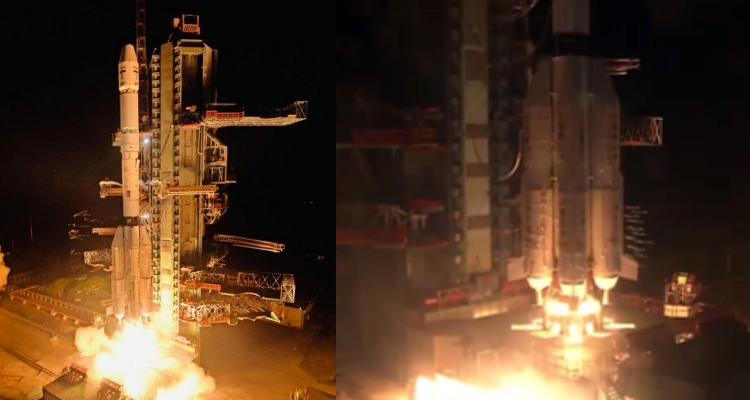
Sriharikota: India has achieved another milestone in space technology with the successful launch of its next-generation navigation satellite, NVS-03, by the Indian Space Research Organisation (ISRO). The mission is expected to strengthen India’s independent satellite navigation system, Navigation with Indian Constellation (NavIC), and enhance the country’s strategic capabilities in positioning, navigation and timing services.
The satellite was launched aboard the Geosynchronous Satellite Launch Vehicle (GSLV-F18) from the Satish Dhawan Space Centre in Sriharikota, Andhra Pradesh, at 11:51 pm on October 30. It was successfully injected into its intended Geosynchronous Transfer Orbit (GTO).
The launch marks the 20th flight of the GSLV rocket and represents another important step in India’s efforts to reduce dependence on foreign satellite navigation systems such as the US-operated Global Positioning System (GPS).
NVS-03 is the third satellite in ISRO’s second-generation navigation satellite series, developed to improve the reliability, coverage and performance of NavIC.
Indigenous Atomic Clock Strengthens Navigation Technology
One of the most significant features of NVS-03 is its indigenous atomic clock, highlighting India’s progress towards developing critical space technologies domestically.
Atomic clocks play a crucial role in satellite navigation by providing highly accurate time measurements. Navigation satellites use precise timing signals to help receivers calculate their geographical positions.
The satellite carries an indigenously developed atomic clock alongside other atomic clocks. The development is particularly important because failures of imported atomic clocks had affected the operational capability of some earlier NavIC satellites.
The availability of indigenous technology is expected to reduce dependence on foreign suppliers and strengthen India’s ability to maintain its navigation infrastructure independently.
L1 Frequency to Expand NavIC Applications
NVS-03 introduces the L1 frequency band alongside the existing L5 and S-band signals used by NavIC.
The addition of the L1 frequency is a major development because it is widely supported by navigation receivers, including those used in smartphones and other consumer devices. This could facilitate wider adoption of NavIC services, subject to compatible hardware and signal availability.
The satellite is designed to provide navigation coverage across India and approximately 1,500 kilometres beyond the country’s geographical boundaries.
The expanded signal capability is expected to support civilian, commercial and strategic applications, including transportation, telecommunications, maritime operations and national security.
Why India Needs Its Own Navigation System
NavIC, earlier known as the Indian Regional Navigation Satellite System (IRNSS), is India’s independent regional satellite navigation system developed by ISRO.
The initiative reflects India’s determination to establish its own reliable navigation infrastructure rather than depend entirely on foreign systems.
The strategic importance of independent navigation capabilities became particularly evident during the 1999 Kargil conflict, when India faced limitations in accessing GPS information from the United States.
Since then, India has steadily developed its own satellite navigation network to ensure greater control over critical positioning and timing services.
NavIC has applications across several sectors, including railway operations, road transportation, aviation, maritime navigation, disaster management, fisheries, telecommunications and defence.
For instance, it can support vehicle tracking, train monitoring, emergency response, fishermen’s navigation and precision location-based services. Its timing capabilities are also important for synchronising telecommunications networks and other critical infrastructure.
NavIC Constellation Gets a Major Boost
The launch of NVS-03 comes amid efforts to strengthen the operational capability of India’s navigation satellite constellation.
The earlier generation of NavIC satellites experienced challenges, particularly involving imported atomic clocks, affecting the availability of navigation services.
With NVS-03, ISRO has strengthened the constellation and restored it to its minimum operational configuration of four satellites, according to the space agency.
India’s broader objective is to maintain a seven-satellite navigation constellation to ensure reliable regional coverage and continuity of services.
The latest mission is therefore an important step towards improving the resilience and long-term sustainability of the indigenous navigation network.
GSLV Completes Another Milestone
The successful mission also marks progress in India’s GSLV launch programme.
The GSLV-F18 was the 20th flight of the Geosynchronous Satellite Launch Vehicle. The mission was completed with a turnaround time of just 56 days between two successive GSLV launches, setting a new operational milestone for the launch vehicle programme.
Weighing approximately 2,232 kg, NVS-03 was successfully placed into its designated transfer orbit, demonstrating ISRO’s growing capabilities in satellite deployment and launch operations.
A Strategic Step Towards Space Self-Reliance
Satellite navigation has become an essential component of modern infrastructure. Beyond helping people find locations, it supports defence operations, transportation, logistics, financial systems, telecommunications, disaster management and several other critical services.
For a country like India, having an independent navigation system is particularly important from the perspectives of national security, technological sovereignty and economic development.
The NVS-03 mission represents more than another successful satellite launch. It reflects India’s efforts to develop indigenous technologies, strengthen its space infrastructure and reduce dependence on foreign navigation networks.
However, the larger challenge will be to ensure the long-term reliability of the satellite constellation, complete its planned expansion and encourage the integration of NavIC into smartphones, vehicles and other consumer and industrial devices.
With NVS-03, India has taken another significant step towards establishing itself as a technologically self-reliant space power.