
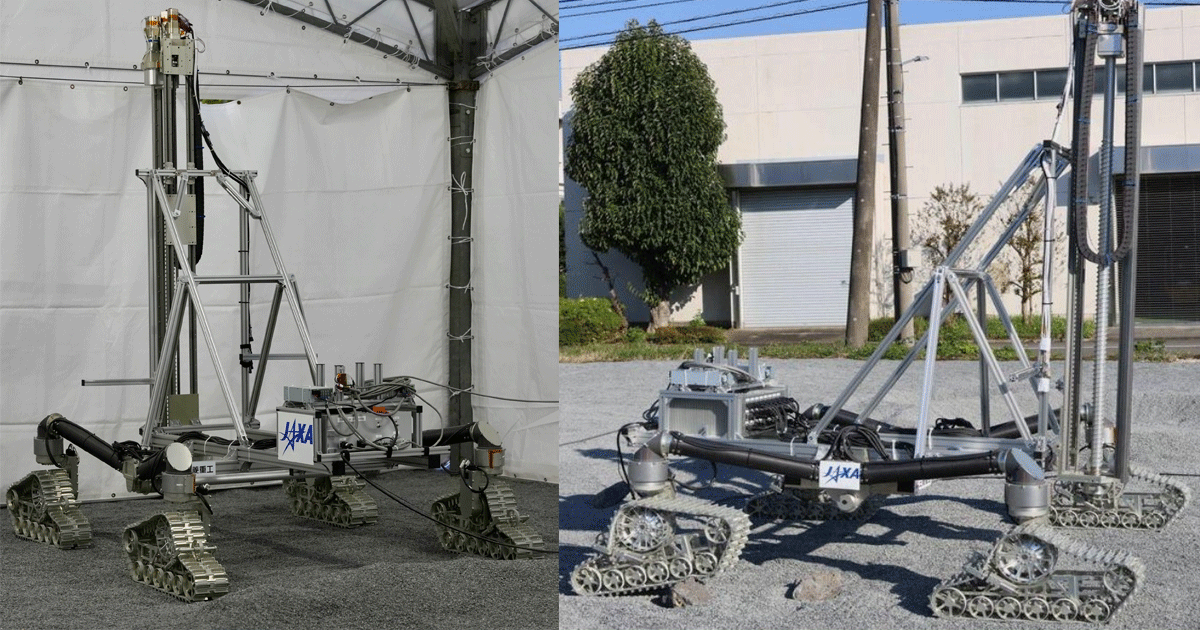
Chandrayaan-5 Mission: Japan Develops Advanced Rover for Moon’s Water Exploration
Tokyo/New Delhi: Japan has unveiled a prototype of a 350-kg lunar rover being developed for the upcoming Chandrayaan-5 mission, marking a significant milestone in the joint space exploration programme between India and Japan. The rover, designed to explore the Moon’s south polar region, will play a crucial role in the search for water and water ice beneath the lunar surface.
The Japan Aerospace Exploration Agency (JAXA) showcased the rover during a media demonstration at its Chofu Aerospace Centre in Tokyo on November 25. The demonstration highlighted the vehicle’s ability to navigate uneven terrain, negotiate obstacles and move across surfaces designed to simulate the challenging conditions of the lunar landscape.
The mission, officially known as the Lunar Polar Exploration (LUPEX), is a joint undertaking of JAXA and the Indian Space Research Organisation (ISRO). Japan is responsible for developing the rover and providing the launch vehicle, while India is developing the lunar lander that will carry the rover to the Moon.
Four-legged crawler designed for difficult lunar terrain
Unlike conventional lunar rovers that primarily use wheels, the LUPEX rover features a four-legged crawler configuration equipped with belt-like tracks. This design is intended to improve mobility across the Moon’s rugged terrain, including rocky surfaces, depressions and areas covered with fine lunar dust, known as regolith.
During the Tokyo demonstration, the rover successfully negotiated simulated lunar obstacles, demonstrating the mobility technology being developed for the mission.
The approximately 350-kg rover will carry seven scientific instruments to investigate the lunar environment. Its observations will focus on surface temperatures, geological characteristics and the presence and distribution of water resources.
Japan unveils rover prototype for moon water mission: Japan’s space agency unveiled Wednesday a test model of a rover that will travel to the moon’s south pole in a search… japantoday.com/category/tech/japan-unveils-rover-prototype-for-moon-water-mission #japannews #japantoday https://t.co/EwVm6GT3V2
— Japan Today News (@JapanToday) November 26, 2026
Drilling up to 1.5 metres beneath the lunar surface
One of the most important objectives of Chandrayaan-5 will be to determine whether water ice exists beneath the Moon’s surface and assess its potential availability.
The rover will undertake two levels of exploration. Initially, it will conduct broader surveys of the surrounding terrain to identify scientifically significant locations and suitable drilling sites. It will subsequently carry out detailed investigations, collecting lunar soil samples from depths of up to 1.5 metres.
The samples will be analysed using specialised scientific instruments to establish the quantity, distribution and physical characteristics of water and ice in the lunar soil.
The findings could prove particularly important for future human missions. Water on the Moon could potentially be used for drinking, oxygen production and the generation of hydrogen-based rocket fuel, reducing the need to transport essential resources from Earth.
JAXA testing LUPEX rover’s purpose-built mobility system.
Tracked treads for enhanced surface grip.
4 independently driven and steered wheels for high maneuverability.
Built to tackle the challenges in lunar south pole. https://t.co/jn04V0LPMM— CNSPACE (@CNSpaceflight) November 25, 2026
India-Japan mission targeted for 2028
Chandrayaan-5 is currently targeted for launch in 2028 aboard Japan’s H3 rocket from the Tanegashima Space Centre. The spacecraft is expected to have a launch mass of approximately 6.5 tonnes.
The mission is designed for an operational period of around three-and-a-half months following landing, with the possibility of extending its operations up to one year, depending on conditions and system performance.
The international scientific collaboration also includes the European Space Agency (ESA) and the United States’ National Aeronautics and Space Administration (NASA). NASA is contributing neutron spectrometers to detect hydrogen beneath the lunar surface, an important indicator of possible water-ice deposits. ESA is also contributing scientific instrumentation.
According to JAXA, the mission will combine measurements from different instruments to develop a more comprehensive understanding of lunar water resources.
A new chapter in India’s lunar exploration
The Chandrayaan-5 mission represents an important expansion of India’s lunar exploration programme and its growing partnership with Japan.
While Chandrayaan-3 demonstrated India’s ability to achieve a controlled landing near the Moon’s south polar region, Chandrayaan-5 aims to take lunar exploration further by undertaking detailed surface mobility, drilling and resource investigations.
The mission is expected to generate valuable scientific data for future lunar exploration programmes, including international efforts to establish a sustained human presence on the Moon.
For India and Japan, the project is not merely another lunar mission. It is an attempt to understand whether the Moon contains resources that could eventually support long-term human exploration beyond Earth.