
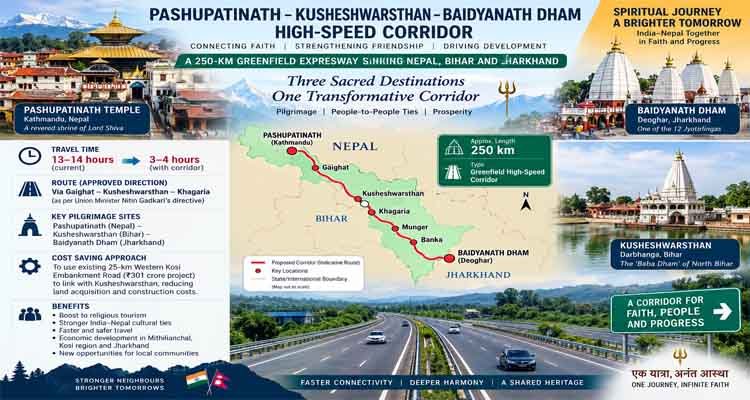
Nitin Gadkari Clears Kusheshwarsthan Route for Pashupatinath-Baidyanath Corridor; Kathmandu-Deoghar Journey May Take Just 4 Hours
Darbhanga/Patna: The proposed Pashupatinath–Baidyanath Dham High-Speed Corridor, envisioned as a major road link between Nepal and eastern India, has received a significant route development with Kusheshwarsthan in Bihar’s Darbhanga district set to be connected through the corridor via Khagaria.
The latest development follows an initiative by Darbhanga MP Dr Gopal Ji Thakur, who approached Union Road Transport and Highways Minister Nitin Gadkari seeking that the corridor be routed through Bhega–Jandol–Kusheshwarsthan and Khagaria. According to the MP, Gadkari has now directed the ministry to take the proposal forward.
The proposed corridor is intended to connect Pashupatinath Temple in Kathmandu, Nepal, with Baba Baidyanath Dham in Deoghar, Jharkhand, creating a potentially important religious-tourism and economic corridor linking Nepal, Bihar and Jharkhand.
Kusheshwarsthan enters the corridor plan
When the project was first announced in February 2026, the Bihar government proposed a roughly 250-km high-speed corridor connecting Pashupatinath with Baidyanath Dham. The initial route announced by Bihar Road Construction Minister Dilip Kumar Jaiswal was to enter India through the Supaul region and pass through areas including Madhepura, Saharsa, Khagaria, Munger and Banka, before reaching Deoghar. The detailed proposal was sent to the Centre for approval.
The latest development potentially changes the emphasis of the Bihar alignment by bringing Kusheshwarsthan, an important pilgrimage centre in the Mithila region, into the proposed route.
According to Hindustan, Dr Thakur said he had submitted a letter to Gadkari on April 3, 2026, requesting that the corridor be constructed via Kusheshwarsthan and Khagaria. The Union minister subsequently directed the department to proceed with the route.
This is particularly significant for northern Bihar because it could give the relatively under-connected Mithila and Kosi regions a direct link to a major inter-state and international highway corridor.
🔱 जय बाबा पशुपतिनाथ!
🔱 जय बाबा बैद्यनाथ!
🔱 जय बाबा कुशेश्वरनाथ!दरभंगा–मिथिला के लिए विकास की एक और ऐतिहासिक पहल!
माननीय प्रधानमंत्री श्री नरेंद्र मोदी जी के नेतृत्व में देश में मजबूत हो रहे सड़क एवं राजमार्ग नेटवर्क के बीच पशुपतिनाथ धाम से बैद्यनाथ धाम तक प्रस्तावित… pic.twitter.com/4JsBWScGsz
— Gopal Jee Thakur (@gopaljeebjp) September 9, 2026
From Pashupatinath to Baidyanath Dham
The central idea behind the project is to create a faster road connection between two of the region’s most prominent Shiva pilgrimage centres.
At one end is Pashupatinath Temple in Kathmandu, one of Nepal’s most important Hindu pilgrimage destinations. At the other is Baba Baidyanath Dham in Deoghar, home to one of the 12 Jyotirlingas traditionally revered by Hindus.
With Kusheshwarsthan now proposed as an important stop/link, the corridor could create a broader pilgrimage circuit connecting Pashupatinath–Kusheshwarsthan–Baidyanath Dham.
This would give the project an importance beyond conventional road infrastructure, potentially turning it into a major India-Nepal religious-tourism corridor.
Kathmandu–Deoghar travel time could fall sharply
One of the most attractive features being associated with the proposed corridor is the expected reduction in travel time.
Current road journeys between Kathmandu and Deoghar can take roughly 13–14 hours or more, depending on the route, traffic, border procedures and road conditions. Reports on the proposed corridor have said that the journey could eventually be reduced to around 3–4 hours once a high-speed connection is available.
However, the 3–4-hour figure should currently be treated as a projected travel time rather than an officially guaranteed operating time. The final route, engineering standards, access controls, border arrangements and actual length of the completed corridor will determine the eventual journey time.
The project has been described as a greenfield high-speed corridor, meaning substantial sections would be developed as new road infrastructure rather than simply upgrading an existing highway.
Why Kusheshwarsthan matters
The inclusion of Kusheshwarsthan could significantly increase the cultural importance of the corridor.
Located in the Darbhanga region, Kusheshwarsthan/Kusheshwar Nath is an important Shiva pilgrimage centre and is widely regarded as a major religious destination of Mithila.
Its inclusion would mean that the proposed road could connect three important Shiva pilgrimage destinations across national and state boundaries.
The resulting circuit could potentially be:
Pashupatinath, Kathmandu → Kusheshwarsthan, Bihar → Khagaria → Baidyanath Dham, Deoghar
For pilgrims, this could make it considerably easier to visit multiple sacred destinations during a single journey.
For Bihar, meanwhile, it could bring a major national-level infrastructure project closer to the religious and cultural heartland of Mithila.
Existing Western Kosi embankment road could reduce costs
Another important suggestion put forward by Dr Thakur relates to the Western Kosi embankment road.
A road project of approximately 25 km between Neema and Gandaul on the Western Kosi embankment is being developed at a reported cost of around ₹301 crore. The project involves widening, raising and strengthening the road, with a planned road width of around 5.5 metres, according to earlier reporting.
The latest report says that this existing/upgraded road infrastructure could potentially be used to connect the proposed high-speed corridor with Kusheshwarsthan.
This approach could have an important financial and logistical advantage.
Instead of constructing an entirely new 25-km road alignment, the proposed corridor could potentially make use of the existing road infrastructure along the Western Kosi embankment, subject to technical feasibility and approval.
That could reduce fresh land-acquisition requirements, construction duplication and project costs, while potentially speeding up implementation.
It is important to note, however, that this is currently a proposal/technical suggestion, and it should not be interpreted as confirmation that the entire 25-km stretch has already been incorporated into the final high-speed corridor design.
Major boost for Mithila’s cultural connectivity
The Kusheshwarsthan route could give a new dimension to the cultural geography of the project.
Mithila has historically maintained close cultural, linguistic and religious links across present-day India and Nepal. A modern high-speed road connecting the region with Kathmandu could strengthen these ties by making travel significantly easier.
The corridor could therefore serve three purposes simultaneously:
religious connectivity, regional economic development and India-Nepal cultural exchange.
Improved road connectivity could encourage pilgrims from Nepal to visit religious destinations in Bihar and Jharkhand, while devotees from eastern India could have easier access to Pashupatinath.
Economic benefits beyond pilgrimage
Although religious tourism is one of the project’s primary objectives, its economic significance could be much broader.
A high-speed road linking Nepal with Bihar and Jharkhand could improve the movement of people and goods, strengthen access to markets and create new opportunities for businesses located along the alignment.
Areas around Kusheshwarsthan, Khagaria and other parts of northern Bihar could benefit from improved connectivity with larger markets.
The tourism sector could also receive a boost, particularly in accommodation, restaurants, local transport, pilgrimage services, retail and other visitor-related businesses.
The Bihar government had earlier said the corridor would strengthen regional connectivity and stimulate economic activity in Bihar and Jharkhand.
Part of a wider India-Nepal connectivity push
The corridor is emerging against the backdrop of a broader expansion of road connectivity between India and Nepal.
When announcing the project in February, the Bihar government said 554.08 km of roads were being constructed in the state under the India-Nepal Border Road Project. The government linked the infrastructure expansion to trade, tourism and security benefits in border areas.
The Pashupatinath–Baidyanath project could consequently become another important component of this larger connectivity network.
Its significance is also not restricted to roads. A March 2026 Ministry of Railways response listed several railway projects in Bihar and adjoining areas, including Khagaria–Kusheshwarsthan, Darbhanga–Kusheshwarasthan, and the Raxaul–Kathmandu new railway line, demonstrating the wider importance of improving connectivity across northern Bihar and towards Nepal.
Route is still evolving
The latest development also shows why the project should not yet be described as having a completely finalised alignment.
The February announcement identified one route through Supaul, Madhepura, Saharsa, Khagaria, Munger and Banka, while the subsequent proposal backed by the Darbhanga MP seeks to bring Kusheshwarsthan and Khagaria into the corridor.
The Ministry’s technical assessment and final alignment will therefore be crucial.
Issues such as land acquisition, flood-prone terrain, bridges over rivers and waterways, environmental clearances, international-border connectivity and the engineering requirements of a high-speed road will all have to be addressed.
A potential new pilgrimage circuit
If implemented along the proposed Kusheshwarsthan alignment, the project could create a distinctive religious highway connecting three major Shiva destinations:
Pashupatinath — Kathmandu, Nepal
Kusheshwar Nath — Darbhanga, Bihar
Baba Baidyanath Dham — Deoghar, Jharkhand
Such a corridor could potentially transform eastern India’s religious-tourism map.
For Nepal, it would provide a faster road connection towards an important Jyotirlinga in Jharkhand. For Bihar, it could integrate Mithila and northern Bihar more strongly into an international religious-tourism network. For Jharkhand, it could bring more visitors to Deoghar and strengthen the state’s position as a major pilgrimage destination.
What happens next?
The immediate focus will be on finalising the alignment, technical feasibility and implementation framework.
The latest directive from Nitin Gadkari regarding the Kusheshwarsthan–Khagaria route is an important development, but construction of the entire corridor should not yet be presented as completed or fully underway across its full length. The original proposal itself was sent to the Centre for approval, and the latest route intervention indicates that alignment discussions have continued.
If the proposed alignment receives the necessary approvals and the technical and financial hurdles are resolved, the Pashupatinath–Baidyanath Dham High-Speed Corridor could emerge as one of the most strategically important road projects for Nepal, Bihar and Jharkhand.
More importantly, it could turn a centuries-old network of religious and cultural links into a modern high-speed connectivity corridor—bringing Kathmandu, Mithila and Deoghar significantly closer.
Key facts at a glance
| Feature | Latest position |
|---|---|
| Project | Pashupatinath–Baidyanath Dham High-Speed Corridor |
| Proposed length | Around 250 km |
| Starting point | Pashupatinath, Kathmandu, Nepal |
| Destination | Baidyanath Dham, Deoghar, Jharkhand |
| New route development | Via Kusheshwarsthan–Khagaria |
| Key intervention | Union Minister Nitin Gadkari directed officials regarding the route |
| Proposed nature | Greenfield high-speed corridor |
| Main objective | Religious tourism, cultural exchange and regional connectivity |
| Current status | Proposed/under development; alignment and implementation being worked out |
| Potential travel-time reduction | Reports project roughly 3–4 hours, versus around 13–14 hours currently |
| Cost-saving proposal | Potential use of Western Kosi embankment road infrastructure |
| Western Kosi stretch | About 25 km; reported project cost around ₹301 crore |