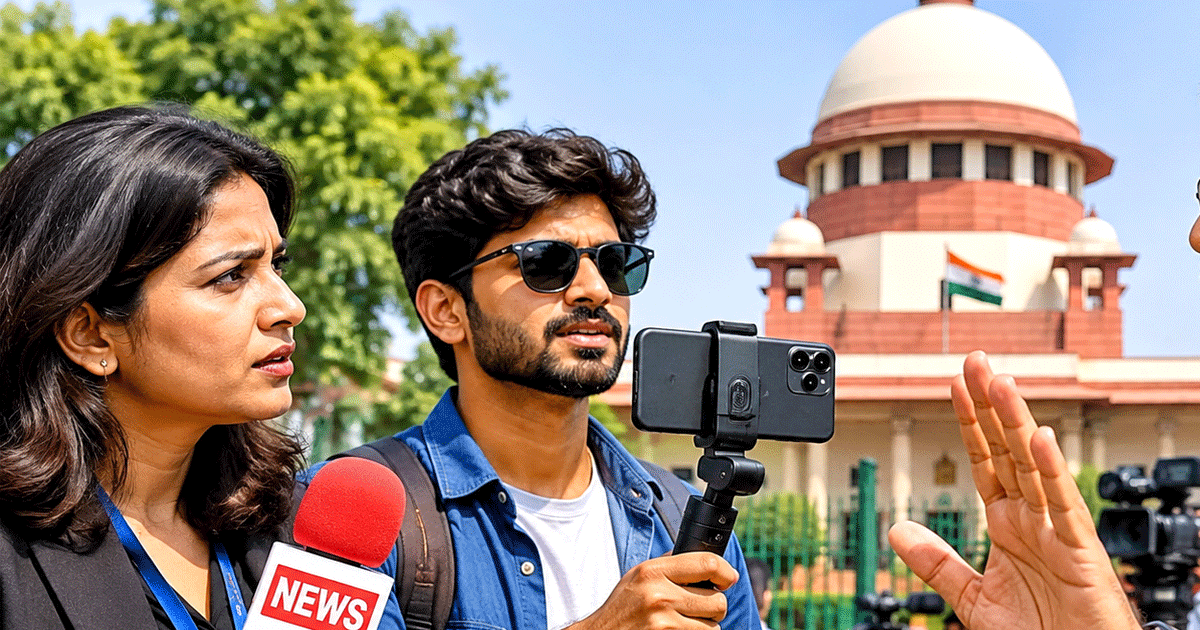
Drawing a clear distinction between professional journalists and social media content creators, the Delhi Police has told the Supreme Court that reel-makers, social media influencers and other individuals carrying cameras and microphones cannot automatically be treated as bona fide journalists or claim the protections extended to media professionals covering protests.
In an affidavit filed before the Supreme Court, the Delhi Police has argued that merely carrying a camera or microphone does not establish journalistic credentials. It maintained that individuals creating reels and social media content, particularly for commercial exploitation, cannot automatically claim the same privileges and protections as journalists discharging professional reporting duties.
However, in an important clarification, the police has also stated that Press Information Bureau (PIB) accreditation is not mandatory for recognising someone as a journalist. An identity card issued by the journalist’s employer or media organisation is an equally acceptable form of identification, the affidavit said.
The affidavit was filed by Joint Commissioner of Police Surender Kumar on behalf of the Delhi Police Commissioner in response to petitions alleging that journalists were manhandled, harassed and detained while covering the October protests against Chief Election Commissioner Gyanesh Kumar in the national capital.
The petitions have been filed by several media organisations, including the Network of Women in Media, India (NWMI), Free Speech Collective, Delhi Union of Journalists and Kerala Union of Working Journalists.
Police defend action during protests
Defending its handling of the protests, the Delhi Police said the presence of numerous content creators and individuals posing as media personnel had created practical difficulties for police officers deployed at the protest sites.
According to the affidavit, some individuals carrying cameras and microphones were allegedly participating in demonstrations, raising slogans alongside protesters rather than performing journalistic duties. The police cited videos circulating on social media in which certain individuals identifying themselves as media personnel were allegedly seen joining protest slogans.
The police maintained that such circumstances made it difficult for personnel on the ground to distinguish professional journalists from protesters and social media content creators, particularly amid large crowds and rapidly changing law-and-order situations.
It denied deliberately obstructing or interfering with journalists. The affidavit further claimed that whenever anyone was apprehended due to mistaken identity, the person was immediately released after verification. It also rejected allegations of unlawful detention and confiscation of journalists’ equipment.
Reel-makers can’t claim benefit of Supreme Court order protecting journalists during protests: Delhi Police
report by @DebayonRoy
https://t.co/j1jfQOaK41
— Bar and Bench (@barandbench) November 18, 2026
PIB accreditation not compulsory
An important aspect of the police submission concerns the identification of journalists. The Delhi Police said its October 5, 2026, guidelines were intended to facilitate the identification and protection of genuine media professionals rather than restrict press freedom.
Under the guidelines, journalists are required to carry valid identity cards, display them visibly, avoid obstructing police operations and maintain a reasonable and safe distance from sensitive operational areas.
The police clarified that journalists without PIB accreditation could establish their professional identity through identity cards issued by their respective media organisations or employers.
This clarification is significant for journalists working with regional newspapers, independent publications, digital news platforms and smaller media organisations, many of whose working professionals may not possess government accreditation cards.
Supreme Court’s intervention
The controversy follows the Supreme Court’s October 11 intervention after petitions raised allegations of police excesses against journalists and other professionals covering the protests.
The apex court had directed that lawyers, journalists and other professionals should not be hindered in discharging their professional duties.
The Delhi Police has argued that the court’s protection was intended for journalists performing legitimate professional responsibilities and should not be interpreted as providing immunity to social media influencers, reel-makers or other individuals from lawful police directions at prohibited assembly sites.
The petitions have raised broader concerns about the alleged harassment, detention and treatment of journalists, particularly women media professionals, during the protests.
The Supreme Court’s November 3 proceedings listed the petitions concerning journalists for further consideration on November 26, 2026.
A larger debate over journalism in the digital age
The Delhi Police’s affidavit has brought an increasingly important question in contemporary journalism into focus: who qualifies as a journalist in an era when almost anyone with a smartphone, camera and microphone can publish information to a potentially unlimited audience?
The distinction between professional journalism and social media content creation is not always straightforward. Independent digital journalists, freelancers, citizen reporters and small online news organisations also operate outside traditional media structures. The absence of PIB accreditation or employment with a large media house cannot, by itself, determine whether someone is engaged in genuine journalism.
At the same time, simply carrying recording equipment or describing oneself as a journalist cannot automatically establish professional credentials or exempt an individual from lawful restrictions during a protest.
The central issue, therefore, is not merely the difference between journalists and reel-makers, but how authorities identify bona fide media professionals without creating arbitrary barriers to independent reporting.
The Supreme Court’s consideration of the petitions could have wider implications for press freedom, journalists’ safety and the evolving relationship between traditional media, independent digital journalism and social media content creators.