
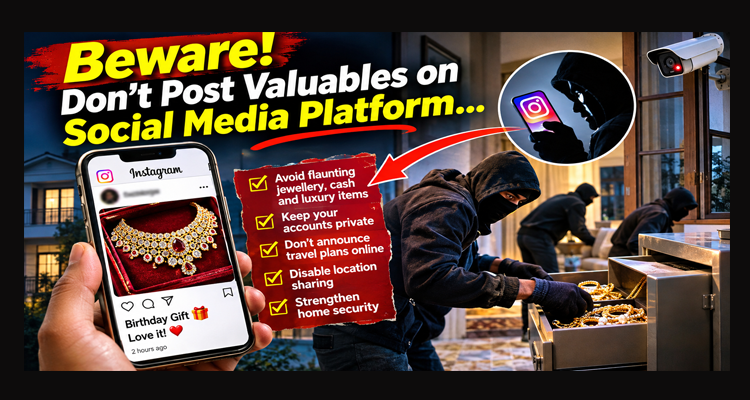
From expensive jewellery and luxury gifts to cash, shopping sprees and holiday photographs, sharing too much personal information online can turn into a security risk. Recent burglaries in Kolkata and Tamil Nadu have raised concerns over how criminals may use social media to identify wealthy households, track people’s movements and plan thefts.

Social media platforms have become an integral part of modern life. Millions of people regularly share photographs of celebrations, expensive gifts, jewellery, new purchases, holidays and other personal achievements. However, what appears to be a harmless display of happiness or lifestyle can sometimes provide valuable information to criminals searching for their next target.
Two recent burglary incidents in West Bengal and Tamil Nadu have brought this growing concern into sharp focus, highlighting the potential dangers of publicly displaying wealth and personal activities on Instagram, YouTube, Facebook and other social media platforms.
In the latest incident, a Kolkata-based businessman’s residence in Garia was allegedly burgled just hours after his wife shared an Instagram photograph showing a necklace worth Rs 5 lakh, gifted to her by her husband on her birthday.
According to reports, burglars broke into the house and escaped with cash, jewellery and three bottles of imported liquor, collectively valued at approximately Rs 9 lakh. Interestingly, neither the family nor the expensive necklace featured in the photograph was present at the house when the burglary took place.
Police suspect that the social media post might have alerted the criminals to the family’s valuables and possibly influenced their decision to target the property.
The incident is particularly alarming because the house was equipped with CCTV cameras, yet the burglars reportedly managed to enter the premises and search for valuables.
CCTV Cameras Could Not Stop the Burglars
CCTV footage reportedly captured three men, dressed in smart clothes and wearing smartwatches, moving around the house and searching for valuables.
In an unusual attempt to obstruct surveillance, the burglars allegedly opened the refrigerator, took out leftover birthday cake and smeared it over the CCTV camera lenses to conceal their activities.
The businessman, Prithviraj Roy, said the intruders vandalised the house, damaging even his son’s telescope. He also suspected that the accused were familiar with the property’s layout and the locations of electrical switches and surveillance cameras.
According to him, this was the third such burglary in the locality since 2025.
Baruipur Police Superintendent Arvind Kumar Anand cautioned people against sharing too much personal information on social media.
“People should be cautious about what they post on social media. Personal moments on social media can alert criminals,” he was quoted as saying.
Police have reportedly obtained some leads and are hopeful of a breakthrough. However, no arrests had been made at the time of reporting.
The case raises an important question: Can a photograph uploaded for friends and followers inadvertently become an invitation to criminals?
Tamil Nadu YouTuber Loses 118 Sovereigns of Gold
A similar incident in Tamil Nadu’s Kanyakumari district has further highlighted the risks associated with displaying wealth on social media.
In September, YouTuber Vinoth Kumar, who reportedly showcased gold jewellery and bundles of cash through his social media content, became the victim of a burglary at his residence near Nagercoil.
Burglars allegedly broke open the rear door of his house at VIP Garden in Thammathukonam and escaped with 118 sovereigns of gold jewellery and cash.
Vinoth Kumar lives with his wife, Madhumitha. According to police, unidentified persons entered the house during the night and stole the valuables.
The incident raised concerns over whether regularly displaying expensive jewellery and cash online could expose individuals and their families to criminal targeting.
Although the precise connection between social media posts and the burglary remains a matter for investigation, the incident highlights the importance of maintaining privacy while sharing personal information online.
Social Media: A Digital Window into Your Private Life
Security concerns surrounding social media oversharing are not new. Criminals do not necessarily need to hack an account to gather information about a potential target. Public photographs, videos, comments, location tags and everyday updates can collectively reveal details about someone’s lifestyle and routine.
For instance, a photograph showing newly purchased jewellery may indicate the presence of expensive possessions. A holiday photograph uploaded in real time can reveal that a house is unoccupied. Videos showing the interiors of a home may inadvertently expose entry points, security arrangements, valuable belongings and even the layout of the property.
Similarly, regular posts about shopping, expensive gadgets, luxury vehicles, birthday celebrations and family outings can help strangers build a picture of an individual’s financial circumstances and movements.
The concern is not limited to celebrities, influencers or wealthy business families. Ordinary households can also become vulnerable when personal information is publicly accessible.
India’s national cybersecurity agency, CERT-In, has repeatedly advised internet users to exercise caution while sharing personal information online, protect their social media accounts and review privacy settings.
The risks go beyond burglary. Oversharing can also expose users to identity theft, online fraud, impersonation, stalking and targeted scams.
Dhanteras and Diwali: Why Extra Caution Is Necessary
The warning assumes greater significance as India approaches the festive shopping season.
Dhanteras, which falls on November 6 this year, is traditionally associated with purchasing gold, silver, jewellery and other valuables. During this period, households often bring expensive ornaments and other purchases home.
While sharing photographs of new purchases and festive celebrations has become a popular social media trend, people should exercise restraint.
Posting photographs of newly purchased gold, jewellery or expensive gifts, particularly with identifiable backgrounds or location details, could unnecessarily expose personal information.
It is equally important to avoid announcing travel plans or revealing that the entire family will be away from home.
How to Protect Yourself: Seven Essential Precautions1. Avoid flaunting expensive possessions
Do not publicly display expensive jewellery, cash, luxury purchases or valuable collections. Celebrate privately rather than advertising your wealth. 2. Restrict your social media audience
Keep personal accounts private and share photographs only with trusted friends and family. Remember that even followers can take screenshots or forward your content. 3. Never announce travel plans in advance
Avoid posting real-time holiday updates, travel itineraries or information indicating that your home is empty. Share holiday photographs after returning. 4. Disable unnecessary location sharing
Avoid publicly tagging your home address, frequently visited places, children’s schools or your real-time location. 5. Strengthen home security
Install reliable locks, CCTV cameras and alarm systems. Ensure cameras are properly positioned and regularly checked. Inform trusted neighbours when travelling. 6. Keep valuables in secure locations
Avoid storing large quantities of cash and jewellery at home. Use bank lockers for valuable ornaments that are not required regularly. 7. Secure your digital accounts |
A Little Privacy Can Prevent a Big Loss
Social media is designed to encourage people to share their lives, achievements and experiences. However, the growing misuse of publicly available information calls for greater awareness and responsible digital behaviour.
The Kolkata and Tamil Nadu burglary cases serve as reminders that criminals may be watching more closely than ordinary followers. A photograph of an expensive necklace, a video displaying bundles of cash or a casual announcement about an upcoming vacation may reveal more than intended.
Not every burglary is connected to social media, and investigators must establish the actual motive in each case. Nevertheless, limiting the information available to strangers can reduce avoidable security risks.
The message is simple: Enjoy your wealth, celebrate your achievements and share your happiness, but do not turn your social media profile into a catalogue of your valuables or a timetable of your movements. Your privacy is also your protection.