

New Delhi: Indian scientists have achieved a major scientific breakthrough by developing the world’s first supercomputer-powered simulation that successfully captures the Mpemba effect—the long-debated phenomenon in which hot water freezes faster than cold water under certain conditions.
The achievement was announced by the Ministry of Science and Technology, which said the paradox had puzzled scientists for decades due to the complexity of tracking molecular behaviour during freezing.
According to the Ministry, the breakthrough has been achieved by researchers at the Jawaharlal Nehru Centre for Advanced Scientific Research, who used high-performance supercomputing systems to simulate the microscopic process of ice formation. The simulation provides clear computational evidence explaining how and why the Mpemba effect can occur.
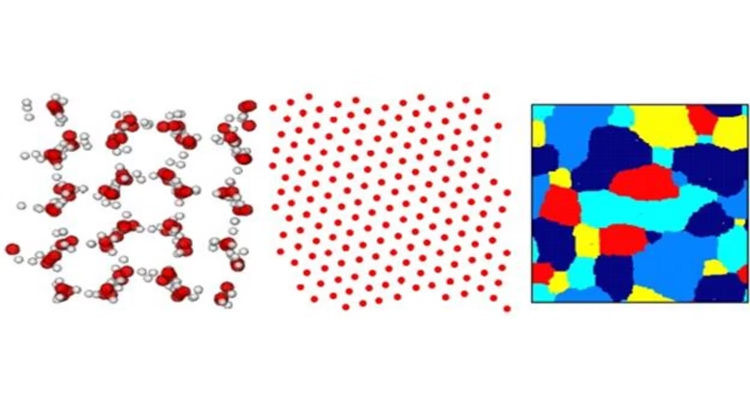
Scientists involved in the study explained that the model tracks energy flow, molecular motion and structural changes in water as it transitions from a liquid to a solid state. Crucially, the simulation shows that under specific thermal conditions, initially hotter systems can reorganise faster at the molecular level, allowing them to freeze more quickly than cooler ones.
The researchers also found that the Mpemba effect is not unique to water. The simulation demonstrates that similar behaviour can occur during fluid-to-solid phase transitions in other materials, opening new avenues in the study of non-equilibrium thermodynamics and material science.
The findings have been published in the peer-reviewed Journal of Communication Physics, marking a significant contribution to global physics research.
Experts say the breakthrough not only resolves a centuries-old scientific mystery—first noted by Aristotle and later named after Tanzanian physicist Erasto Mpemba—but also has potential applications in cryopreservation, climate science, materials engineering and industrial cooling technologies.
Supercomputer simulation of ice formation gives evidence of paradoxical phenomenon of water
Scientists have developed the first supercomputer-powered simulations to capture the long existing paradox of water that had eluded scientists for long– hotter water freezing faster than… pic.twitter.com/p2q5Kuan9I
— PIB India (@PIB_India) January 6, 2026
The success highlights India’s growing strength in advanced computing and fundamental science, with supercomputers increasingly playing a key role in solving problems once considered beyond experimental or theoretical reach.