
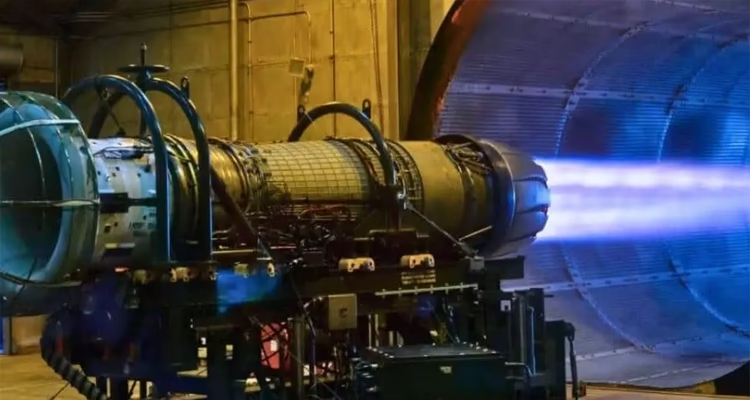
Russian scientists working under the state atomic energy corporation Rosatom have unveiled a laboratory prototype of a plasma-electric rocket engine that they claim could slash the Earth–Mars travel time to just 30 to 60 days — a journey that currently takes six to nine months using conventional chemical rockets.
The breakthrough, announced by researchers at Rosatom’s Troitsk Institute, has generated global attention as it presents a radically different propulsion concept from chemical heavy-lift systems such as SpaceX’s Starship, which relies on massive fuel burn and orbital refuelling to reach Mars.
How the Plasma Engine Works
Unlike chemical rockets that burn fuel for short, high-thrust bursts, the Russian system uses electromagnetic fields to ionise hydrogen, turning it into plasma. The charged particles are then accelerated and expelled at extremely high speeds — reportedly up to 100 km per second — producing continuous thrust over long durations.
The prototype, tested inside a vacuum chamber that simulates space conditions, operates in a pulsed mode at roughly 300 kilowatts of power. Rosatom engineers say this sustained acceleration model is the key to dramatically reducing interplanetary travel time.
Why It Could Change Space Travel
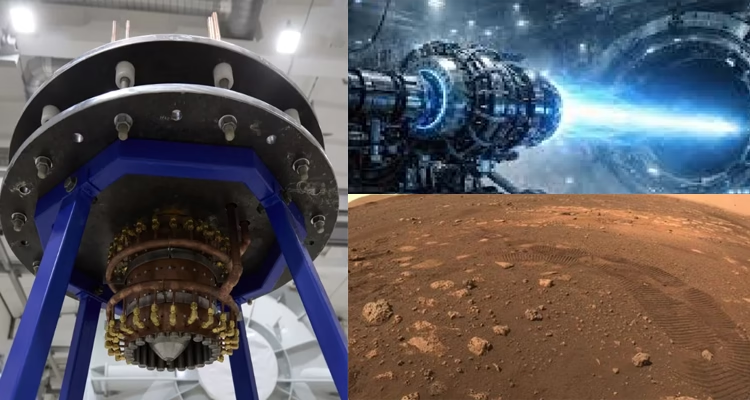
Continuous electric thrust, even at low force, can gradually build enormous velocity over weeks. Scientists say this method could allow spacecraft to follow faster, non-traditional trajectories to Mars, cutting exposure to radiation and reducing life-support demands for crewed missions.
If realised at scale, the technology could reshape deep-space travel by shifting propulsion from chemical combustion to electric plasma acceleration.
How It Compares with Starship
SpaceX’s Starship system is designed around brute-force chemical propulsion — massive thrust, orbital refuelling, and long coasting phases. The Russian plasma engine represents the opposite philosophy: low thrust, ultra-high exhaust velocity, and continuous acceleration.
In theory, the plasma system could outperform chemical rockets on long interplanetary routes. In practice, however, it remains a laboratory-stage technology.
The Big Challenges
Despite the bold claims, experts urge caution:
-
Power supply: The engine’s high electrical demand would likely require a compact space nuclear reactor, raising major engineering and regulatory challenges.
-
Thrust scaling: Current laboratory thrust is tiny. Scaling the system to move a crewed spacecraft remains a major hurdle.
-
Thermal control: Continuous plasma discharge produces extreme heat that must be safely managed.
-
Flight readiness: The engine has never been tested in orbit, and years of space qualification would be required.
Timeline and Reality Check
Rosatom scientists have suggested that a flight-ready version could be possible by 2030, but independent validation and real-world testing will determine whether the concept can move beyond the lab.
For now, the “30-day Mars” headline remains theoretical — but it highlights a growing global race to develop next-generation propulsion systems that could one day make interplanetary travel faster, safer, and more practical.