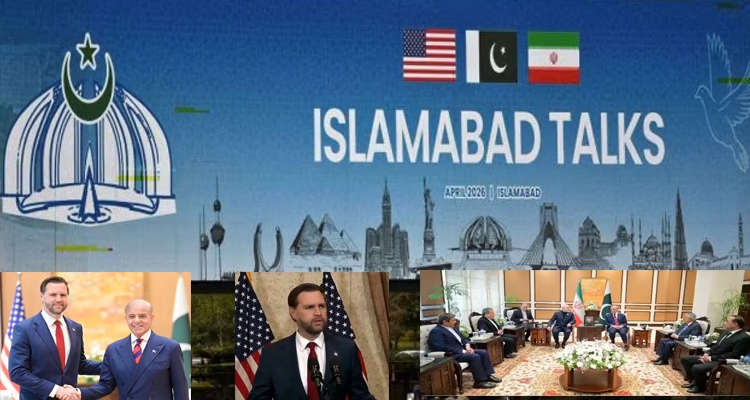
US–Iran peace talks in Islamabad collapse, raising questions over Pakistan’s role as mediator amid deep geopolitical tensions and unresolved nuclear disputes.

The collapse of high-stakes peace talks between the United States and Iran in Pakistan’s capital has sparked a wider geopolitical debate—whether Islamabad was the right venue and mediator for negotiations between two long-time adversaries.
After nearly a full day of intense discussions, the talks ended without agreement, exposing deep divisions over Iran’s nuclear programme, sanctions relief, and control of key maritime routes.
Why Pakistan Hosted the Talks
Pakistan positioned itself as a neutral facilitator, leveraging its diplomatic ties with both Washington and Tehran. Its role was seen as part of a broader attempt to assert itself as a regional peace broker.
Islamabad had earlier engaged in backchannel efforts and was viewed by some as a rare intermediary capable of bringing both sides to the table. However, hosting talks and delivering results are two very different challenges.
Limits of Pakistan’s Mediation Role
The failure of the talks has underlined Pakistan’s limitations as a mediator in a conflict involving global stakes.
Unlike major powers or blocs, Pakistan lacks the economic and strategic leverage required to push either side toward compromise. It cannot offer security guarantees, enforce commitments, or influence sanctions frameworks—key components in any US–Iran agreement.
Diplomatic observers argue that Pakistan’s role was largely confined to providing a platform, rather than shaping the outcome.
Questions Over Neutrality
Pakistan’s balancing act in the region also raised concerns about its neutrality.
While maintaining relations with Iran, Islamabad has longstanding strategic ties with countries like Saudi Arabia, a regional rival of Tehran. This dual alignment may have complicated perceptions, particularly from Iran’s standpoint.
Even a perception of bias can weaken trust in sensitive negotiations, analysts note.
Core Issues Too Deep to Resolve
At the heart of the failure were long-standing and fundamental disagreements.
The United States pushed for strict limits on Iran’s nuclear ambitions, while Iran demanded comprehensive sanctions relief and guarantees against future military action. Disputes over influence in the Strait of Hormuz—a critical global oil route—further complicated matters.
These issues go far beyond the capacity of any single mediator to resolve quickly.
Timing and Escalation Worked Against Talks
The talks were also held under intense time pressure, with limited groundwork for consensus-building.
Compounding the situation, tensions escalated even as negotiations were underway. Announcements of potential military measures and strategic blockades deepened mistrust, undermining the diplomatic process.
Was Pakistan the Wrong Choice?
The question remains open to interpretation.
Critics argue that Pakistan lacked the global influence, neutrality, and institutional capacity required for such a complex negotiation. Supporters, however, contend that few countries were in a position to bring both sides together at all.
In that sense, Pakistan may not have been the wrong choice—but it was not enough to bridge a divide rooted in decades of hostility.
Conclusion
The breakdown of the US–Iran talks in Islamabad highlights a larger truth: peace efforts fail not just because of where they are held, but because of how far apart the parties remain.
Pakistan provided the venue, but the outcome was ultimately shaped by entrenched strategic differences, mutual distrust, and rising geopolitical tensions.
In the end, the failure reflects less on the host and more on the unresolved realities of one of the world’s most complex rivalries.