
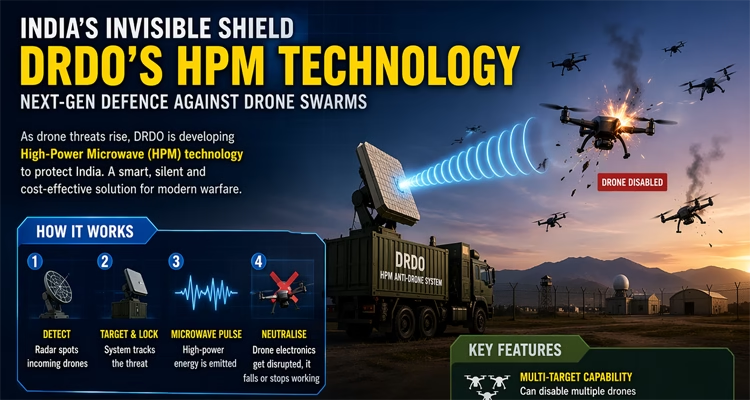
Invisible Warfare: DRDO’s HPM Anti-Drone Push Signals India’s Next Defence Leap
India is preparing for a new kind of warfare—one where threats are neutralised not by explosions, but by invisible pulses of energy. At the centre of this shift is High-Power Microwave (HPM) anti-drone technology, being developed by the Defence Research and Development Organisation as a response to the rising menace of drone swarms.
What Is HPM and Why It Matters
HPM systems are part of a new class of directed-energy weapons. Instead of firing bullets or missiles, they emit powerful microwave bursts that disable a drone’s electronic systems mid-air—knocking out its navigation, communication, and control functions within seconds.
The result is immediate: drones lose stability, fall, or become completely ineffective.
What makes HPM especially critical is its ability to neutralise multiple drones in a single strike, making it a powerful counter to swarm attacks—an increasingly common feature in modern conflicts.
Cost Dynamics: High Investment, Low Operational Cost
HPM technology represents a classic case of high upfront investment with long-term savings.
- System Cost: Advanced HPM platforms are expensive to build, often running into tens of millions of dollars per unit, given the complexity of power systems, emitters, and control architecture.
- Cost Per Use: Once deployed, the cost of firing is extremely low—essentially the cost of electricity. This makes repeated usage far cheaper than missile-based interception.
In contrast, traditional air defence systems can cost lakhs per shot, making HPM a cost-efficient solution for sustained defence scenarios.
Running Expenses: Minimal Logistics, Maximum Sustainability
Unlike conventional systems, HPM requires:
- No ammunition stockpiles
- No reload cycles
- Only power supply and cooling infrastructure
This allows for:
- Continuous operation
- Rapid repeat engagement
- Reduced logistical burden
Such characteristics make HPM ideal for protecting high-value assets like airbases, border posts, and strategic installations.
Portability: From Static Systems to Mobile Defence Units
Modern HPM systems are increasingly designed for battlefield mobility.
- Typically mounted on trucks or container platforms
- Can be deployed quickly in sensitive zones
- Designed for field conditions and rapid repositioning
The Defence Research and Development Organisation is working towards making these systems operationally deployable, rather than confined to lab environments.
Accuracy vs Coverage: Area Denial, Not Precision Strike
HPM is not a sniper—it is a zone-based weapon.
- Instead of targeting a single drone, it creates a wide electromagnetic effect zone
- Capable of disabling multiple drones simultaneously
- Particularly effective against autonomous or swarm-based UAVs
However, this also means:
- Less pinpoint precision compared to laser systems
- Requires careful calibration to avoid interference with friendly electronics
Range and Role in Defence Strategy
Current HPM systems are designed for short to medium range operations, typically in the last layer of air defence.
They are expected to work alongside:
- Radar systems
- Missile interceptors
- Electronic warfare tools
This layered approach ensures comprehensive protection against aerial threats.
Operational Advantages
HPM brings several battlefield advantages:
- Simultaneous multi-target neutralisation
- Instant, speed-of-light engagement
- Silent and invisible operation
- Low collateral damage
- Scalability for continuous defence
Challenges Ahead
Despite its promise, HPM technology is still evolving and faces key challenges:
- High power generation requirements
- Need for efficient cooling systems
- Risk of unintended electromagnetic interference
- Ongoing testing and refinement before full deployment
DRDO’s Strategic Push
The Defence Research and Development Organisation is developing HPM as part of a broader push toward next-generation air defence systems, including laser-based weapons and advanced electronic warfare tools.
The focus is clear:
- Counter emerging drone swarm threats
- Strengthen border and infrastructure security
- Reduce reliance on high-cost missile systems
Conclusion: The Future Is Electromagnetic
As drones become cheaper and more widespread, the cost of defending against them must fall. HPM offers exactly that—a scalable, efficient, and futuristic solution.
India’s progress in this domain signals a shift toward technology-driven warfare, where dominance will depend not just on firepower, but on control over the electromagnetic spectrum.
In the battles of tomorrow, the decisive strike may not be seen or heard—but it will be felt instantly.