Dr. Maguni Charan Behera
Retd. Professor of Tribal Studies
Chief Editor, Sampratyaya (sampratyaya.com)
Email: sampratyaya.ijr@email.com
The question of whether saying “Vande Mataram” conflicts with religious belief, particularly among Muslims in India time and again surfaces in public discourse. The conflict is not merely about two words, but about a deeper debate on understanding into the nature of Bharat, the evolution of Bharatiyata, and the shifting relationship between human beings, nature, and the idea of the sacred. To approach this issue meaningfully, one must move beyond emotional and narrow binaries and engage with the long civilizational foundations of the idea Bharatiyata historically.
The Idea of Bharat
Historically, Bharat was never a nation-state in the modern political sense. It was not a single centralised kingdom defined by rigid borders and uniform governance. Instead, it was a vast civilizational space comprising numerous kingdoms—some expansive like those of Ashoka or the Cholas, and others smaller and regionally confined. These political units rose and fell, expanded and contracted, but the deeper identity of Bharat remained intact.
Bharat is an ancient land, one of the oldest continuing civilizations in the world. For millennia, it has been a space where people have lived, interacted, migrated, and contributed to a shared cultural evolution. It evolved as a civilizational continuum. Over thousands of years, different communities, tribal groups, traders, scholars, and spiritual seekers entered this land. Some came peacefully, some through conquest, and many through gradual assimilation. Yet, rather than erasing one another, they contributed to a layered and evolving cultural fabric.
What bound these diverse communities together was not political authority but a shared cultural ethos, described as dharma. Here, dharma did not merely signify religion in the narrow sense but encompassed a broader framework of life: ethics, duties, social harmony, and an interconnected worldview in the ways of life and in the system of governance. This cultural unity allowed for diversity without fragmentation. Languages differed, rituals varied, and beliefs coexisted, yet there was a sense of belonging to a larger whole; they were held together by a deeper underlying ethos.
Thus, the idea of Bharat as an identity is not political; it as fundamentally cultural. It was not constructed through state power but evolved organically over centuries through shared practices, philosophies, and ways of life.
Understanding Bharatiyata
Bharatiyata, the essence of being Bharatiya – the cultural idenity, is rooted in harmony between humans and nature, and in a connection with the highest spiritual ideals. Differences are not seen as divisions, but as expressions of a larger shared identity, a unity of apparent differences. The identity reflects the belief of “Vasudhaiva Kutumbakam”—that the whole world is one family. The idea of Bharatiyata did not emerge overnight, but evolved over millennia through the lived experiences of countless communities. It is not tied to a single religion, text, or political ideology. Rather, it is a synthesis of traditions, practices, and ways of understanding life.
Understandably, the idea of Bharatiyata is not exclusionary. It does not ask anyone or group to give up their identity: whether it is religious, regional, or linguistic. Instead, it provides a larger inclusive framework within which all these identities coexist. It is an integrative identity, not a competing one.
What makes Bharatiyata unique is its foundation which is not built with primacy to power, conquest, or political control. It is rooted in a worldview that connects human life, nature, and beyond it, what may be called supernature. The dimension of existence that transcends the human and nature is supernature.
These three axes of the holistic complex were not seen as separate or opposing domains. Instead, they were deeply interconnected, encompassing.
Nature was not merely a resource to be exploited; it was a living presence. Rivers were revered, forests respected, mountains honoured. The earth itself was seen as a mother: Bharat Mata. The perception of the Earth as mother, nature as giver was ancient and existed in all the communities long before Christian era. The notion of Bharat Mata was not a metaphor in the superficial sense but an expression of lived experience. The land nourished life, sustained communities, and shaped culture.
Supernature, beyond what is natural, is the spiritual dimension. It was not conceived as something entirely detached from the world. Nature embodied supernature and found meaning through it. Nature is conceived as a medium to access supernature. Spirituality did not require rejecting the material world; it required understanding of one’s place in relation to nature in a larger cosmic space.
This integrated worldview created a sense of harmony. Human life was not isolated but part of a continuum. Culture, religion, and daily practices reflected this unity a, holistic sense of belonging.
Bharatiyata through Cultural and Political lens
The idea of nationalism in modern times is largely political. It is based on boundaries, sovereignty, and often competition between states. Political nationalism tends to categorise people into groups: religious, linguistic, or ethnic, and these categories can become sources of division.
In contrast, the nationalism that emerged in Bharat during the freedom movement had a strong cultural dimension. It was inclusive and integrative. People from different religious backgrounds such as Hindus, Nature-Worshippers other than Hindus, Muslims, Sikhs, Parsis, Christians, Jains, and Buddhists participated in the struggle for independence, not merely as representatives of their communities but as participants in a shared civilizational identity.
However, when political nationalism through ballot box politics began to dominate over cultural unity, identities hardened. A Muslim became primarily a member of a religious group, a Sikh as another, and so on. The broader cultural identity receded into the background. This shift encouraged competition, suspicion, and sometimes conflict among communities that had coexisted for centuries
Individualism over Cultural Holism
Over time, the harmony between human and nature declined with the growth of individualism. This happened when spirituality was delinked with nature. Religion was not considered embedded in culture but emerged as a separate dimension. Religion became monolithic corresponding to individual ideals. Community sense, which is holistic in nature reduced to individualism. The rise of individualism altered how people related to both nature and the spiritual realm. Individualism emphasised autonomy, personal identity, and self-definition. While this brought certain freedoms and advancements, it also led to a fragmentation of the earlier integrated worldview.
In this new framework:
- Nature increasingly became an object of control and exploitation.
- The spiritual dimension was often separated from everyday life and placed in a distant, abstract realm.
- Human identity became more self-centered and less connected to a larger whole.
This separation disrupted the earlier harmony between man, nature, and supernature. When nature lost its sacred dimension, it became merely land: a physical entity defined by boundaries. The emotional and cultural connection to it weakened. In such a framework, expressions like “Vande Mataram” may appear symbolic or even unnecessary.
In the idea of Bharatiyata, Bharat is not just land; it is a living presence. It brings together both territory and culture as one. Over time, this perspective weakened as people began to focus more on individual and group identities after religion was separated from nature. This led to divisions into groups, sects, and religions.
This change in perspective has important effects. When the nation is seen only as a political entity, a mere geographical expression, and religion becomes the main way of looking at things, expressions like “Vande Mataram” may seem unnecessary or even problematic.
But when the nation is understood as a cultural and civilizational space: one that nurtures life and shapes identity, the phrase gains a deeper and more meaningful significance.
Deeper and Contextual insight into “Vande Mataram”
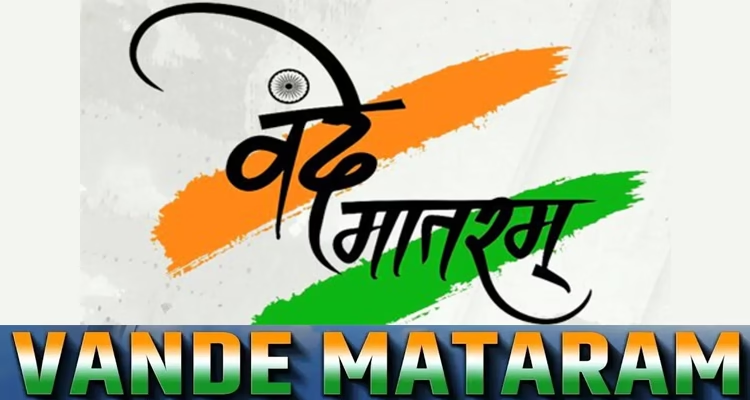
“Vande Mataram” literally means “I bow to thee, Mother.” The “mother” here is the land—Bharat—not as an idol to be worshipped in a theological sense, but as a source of life and sustenance.
Within the cultural framework of Bharatiyata, this expression arises naturally from the man–nature–supernature connection. It is an acknowledgment of the land as a nurturing presence, deserving of respect and gratitude. Importantly, this does not require one to adopt a specific religious belief. It is a cultural expression, not a doctrinal statement. It does not prescribe a ritual or demand theological agreement. Moreover, not all parts of the original composition are expected to be recited. In public life, the phrase is often reduced to its simplest form—two words expressing respect for the motherland. Interpreting it as an act of worship may overlook its cultural and historical usage.
Unfortunately, there is hesitation among some Muslims to say “Vande Mataram”. The reason is often rooted in the interpretation that the phrase implies worship of the nation as a deity, which may conflict with Islamic monotheism.
It is important to examine whether this interpretation is necessary or inevitable. Language and symbols often carry multiple meanings depending on context. In the context of the Indian freedom struggle, “Vande Mataram” was not used as a theological statement but as a patriotic expression. It did not require adherence to a particular religious doctrine.
Bharatiyata and Religion
Are religious identity and Bharatiyata contradictory binaries? Let us examine the distinction between religious identity and Bharatiyata as civilizational identity. Religious identity is specific, rooted in beliefs, practices, and scriptures or individual ideology/teachings. Bharatiyata, on the other hand, is broader. It encompasses the shared cultural space in which diverse religions coexist.
These two identities need not conflict. Just as a citizen can respect both the Constitution and their religious texts without confusion, one can also express cultural belonging without compromising faith. The Constitution governs civic life; religion guides spiritual life. They operate in different domains.
Similarly, saying “Vande Mataram” can be understood as a civic or cultural expression rather than a religious one. It does not require altering or diluting religious beliefs. It simply acknowledges a shared belonging to the land. It is much like standing for a national anthem or saluting a flag.
Bharatiyata operates at a level that transcends specific religious frameworks. It does not replace religion but coexists with it. Just as one can follow their religious teachings while respecting the Constitution, one can also participate in cultural expressions without compromising faith. One can follow the ideal of democracy without compromising with religious tenets. Otherwise, assertion of belonging to a land will be questioned.
When one says, “I am Bharatiya,” it does not erase other identities. It integrates them. A person can be Muslim, Hindu, Sikh, Christian, or belong to any other faith, and still be fully Bharatiya.
In this sense, Bharatiyata is not an exclusive category. It is a relational and inclusive identity. It connects individuals to a shared civilizational heritage without demanding uniformity.
Was Vande Mataram a problematic?
The origin of Vande Mataram lies in the colonial period. It first appeared in the novel Anandamath, written by Bankim Chandra Chattopadhyay. The song had a clear purpose:to inspire people during foreign rule. It brought people together and later became a strong expression of Bharatiyata for the nation that emerged after independence.
The Indian freedom movement shows how Bharatiyata worked in practice. People from different backgrounds came together in the struggle for independence, united by a shared sense of belonging.
Many Muslim freedom fighters also used “Vande Mataram” as a slogan against colonial rule. They did not see it as going against their faith. Instead, they understood it as a cultural and political expression of unity.
This history suggests that the discomfort some feel today is not due to the phrase itself, but due to changing interpretations and contexts over time or to ignite the fire of a hidden agenda.
Conclusion: For overcoming individualist perspective
The rise of individualism has weakened the sense of connection between people. This has led to a more fragmented understanding of identity. Because of this, phrases like “Vande Mataram” are sometimes misunderstood.
However, when we look at it through the idea of Bharatiyata, the meaning becomes clearer. Such expressions are not about religion. They are about gratitude, belonging, and respect for the land. Bharatiyata existed long before modern individualism and emphasises the connection between humans, nature, and a higher reality.
Understanding this can help bridge differences between people. It can create a more inclusive and harmonious society. In this view, diversity is respected, faith is protected, and a shared identity is celebrated. People can keep their religious beliefs while still being part of a common cultural identity.
In a country as diverse as India, unity cannot exist if communities focus only on their differences. Instead, unity should be built on mutual respect, open dialogue, and a willingness to look beyond narrow identities. Bharatiyata offers such a framework. It helps us see that saying “Vande Mataram”, which has a civilizational dimension, is not against any faith, but a simple expression of belonging.