
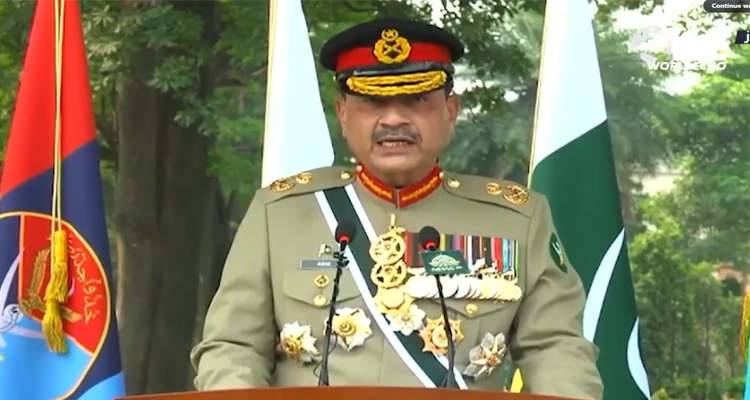
News Desk: Pakistan’s Chief of Defence Staff and Army Chief, Field Marshal Asim Munir, has issued a fresh warning to India, saying that any future military “misadventure” against Pakistan would invite “extremely far-reaching and painful” consequences.
Speaking at a ceremony at the General Headquarters (GHQ) in Rawalpindi on the anniversary of the 2025 India-Pakistan military confrontation, Munir accused India of attempting to violate Pakistan’s sovereignty during the clashes linked to Operation Sindoor.
“Our enemies should know that if any attempt is made in the future to carry out a misadventure against Pakistan, the impact of war will not remain limited, but will be widespread, dangerous, far-reaching and painful,” Munir said during his address.
Field Marshal Asim Munir highlights far reaching consequences for any notorious attempt by India.
Pakistan is fully prepared and steadfast to take the battlefield to its climax if the time demands. pic.twitter.com/pWteLXL00y— Inkman 🖋️ (@iabknow) May 10, 2026
The Pakistani military chief claimed Islamabad had responded to India’s actions with “full national unity and military force”. He also described the 2025 conflict as part of what he called India’s continuing pattern of “aggressive tactics”.
Munir further alleged that incidents in 2001, 2008, 2016 and 2019 were “false flag operations” aimed at creating grounds for military escalation and achieving political objectives against Pakistan.
Pakistan’s military leadership has issued a strong warning on the anniversary of Marka-e-Haq, saying any future aggression against the country will face “far-reaching consequences.” Speaking at a commemorative event, Chief of Defence Forces Asim Munir emphasized national… pic.twitter.com/FZ0Tdux9Rw
— Ocean News (@OceanNewsUK) May 10, 2026
Operation Sindoor
India launched Operation Sindoor on May 7, 2025, following the deadly terror attack in Pahalgam, Jammu and Kashmir, in which 26 civilians lost their lives.
Under the operation, the Indian Armed Forces carried out precision strikes on multiple terror infrastructure sites located in Pakistan and Pakistan-occupied Kashmir (PoK). The strikes reportedly targeted camps linked to terror outfits such as Lashkar-e-Taiba, Jaish-e-Mohammed and Hizbul Mujahideen.
The military action led to a sharp escalation between the two nuclear-armed neighbours, including exchanges involving drones, missiles and artillery before tensions eased days later.
Pahalgam Terror Attack
The crisis was triggered by the terror attack at Baisaran Valley in Pahalgam, where terrorists opened fire on tourists and civilians, killing 26 people. The incident sparked nationwide outrage in India and prompted strong retaliatory measures from New Delhi.