
Dr. Vinod Chandrashekhar Dixit
On National Dengue Day, Dr. Vinod Chandrashekhar Dixit highlights the urgent need for community action, mosquito breeding control, stronger surveillance and public awareness to fight the growing dengue crisis in India.

National Dengue Day is observed on May 16 following the recommendation of the Ministry of Health and Family Welfare, Government of India. Dengue has emerged as one of the country’s most serious public health concerns, spreading rapidly across urban and rural regions alike. Yet, despite its alarming rise, the actual burden of dengue remains largely underestimated because current surveillance systems record only laboratory-confirmed cases from government-designated sentinel hospitals, most of which belong to the public sector. As a result, a vast number of infections remain unreported.
Today, dengue has surpassed malaria in terms of morbidity and mortality in several regions. Globally, nearly 400 million people are affected by dengue every year, and around 40 percent of the world’s population remains at risk of exposure and infection. One of the biggest reasons behind the growing dengue crisis is the failure of mosquito-control programmes. In many places, vector control is treated as a seasonal or outbreak-driven activity rather than a year-round public health mission.
India aims to eliminate malaria by 2030, but this goal cannot be achieved without simultaneously tackling dengue and other vector-borne diseases with equal seriousness. Malaria continues to threaten millions of Indians and causes thousands of deaths annually due to complications. However, dengue too demands urgent attention because timely diagnosis and proper treatment can prevent severe complications and fatalities.
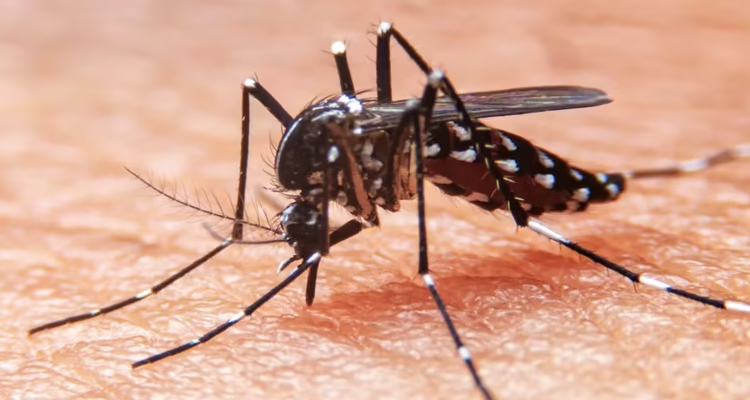
For malaria, every reported case generally triggers mapping, fogging and pesticide spraying in surrounding areas. Dengue, however, requires a different strategy. The disease is spread by the Aedes aegypti mosquito, which bites during the daytime and breeds in clean stagnant water. Water accumulation in homes, coolers, construction sites, discarded containers, flower pots and rooftop tanks creates ideal breeding grounds.
Public awareness, therefore, becomes the most powerful weapon against dengue. Recognition of mosquito breeding sites should be taught in schools and become common knowledge for every household. Weekly “dry day” campaigns must be encouraged, where families empty, clean and scrub water containers to destroy mosquito eggs before they hatch.
Unfortunately, excessive dependence on mosquito repellents and fogging has not delivered lasting results. Fogging only kills adult mosquitoes temporarily and does little to eliminate larvae or breeding sources. The focus must shift from merely preventing mosquito bites to destroying mosquito breeding grounds altogether. At the same time, mosquito nets, window screens and full-sleeved clothing should be promoted, especially for children and during daytime hours when Aedes mosquitoes are most active.
Strengthening real-time surveillance is equally important. Dengue reporting should expand beyond sentinel hospitals to include private clinics, laboratories and digital health platforms so the true scale of the disease can be understood. Early warning systems based on rainfall, temperature and weather trends should also be introduced to predict outbreaks before cases surge.
Municipal accountability must improve. Ward-level officials should be made directly responsible for vector-control outcomes, supported by public dashboards tracking breeding sites and reported cases. More scientific research is also needed on local and traditional mosquito repellents such as neem and plant-based solutions, whose effectiveness remains insufficiently studied.
Year-round awareness campaigns through television, radio, social media and school curricula are essential to promote “search and destroy” practices for mosquito breeding sites. Rapid testing facilities like NS1 antigen and IgM tests should be made widely available at primary health centres to ensure early diagnosis and reduce severe infections. Healthcare workers must also be trained to identify warning signs such as persistent vomiting, abdominal pain and bleeding.
Urban planning has a major role to play in controlling dengue. Proper drainage systems, prevention of waterlogging and stricter monitoring of construction sites are critical, as such locations often become mosquito breeding hotspots.
Eliminating dengue and malaria must become a true national priority. Grand declarations alone will achieve little if data remains incomplete and governance weak. Poor reporting leads to poor planning, while weak implementation wastes valuable resources. What India urgently needs is accurate surveillance, sustained funding, scientific action and active community participation.
Mosquito breeding recognition should become universal public knowledge. Until the country shifts from reactive fogging to proactive elimination of breeding sites, mosquitoes will continue to spread disease and endanger lives.