Dr. Vinod Chandrashekhar Dixit
World Turtle Day highlights the urgent need to protect turtles and tortoises facing extinction due to habitat loss, pollution, climate change, and illegal wildlife trade.

To raise awareness about turtles and tortoises, their conservation needs, and the serious threats they face, the world observes World Turtle Day every year on May 23. The day celebrates the beauty, diversity, and vital ecological roles these reptiles play in ecosystems worldwide. More importantly, it serves as a global call to action, urging individuals, organizations, and governments to strengthen conservation efforts.
World Turtle Day was founded in 2000 by American Tortoise Rescue, a California-based non-profit organization established by Susan Tellem and Marshall Thompson. The organization works to rescue, rehabilitate, and protect turtles and tortoises from abuse, illegal trade, and habitat loss. The observance was launched to highlight how human activity, pollution, and environmental hazards have caused severe declines in their populations. Every year on May 23, schools, wildlife rescue centers, zoos, and nature enthusiasts come together to educate communities, share research, and pledge support for the protection of these remarkable animals.
Turtles and tortoises belong to the order Testudines, one of the oldest reptile groups on Earth. They have roamed the planet for more than 200 million years — long before snakes, crocodiles, or alligators evolved. These ancient reptiles survived the age of dinosaurs and multiple mass extinctions. Their extraordinary evolutionary history makes their conservation not only important but urgent. Losing them would mean losing a living link to Earth’s distant past.
World Turtle Day also highlights the importance of scientific research and sustainable habitat management. Many turtle species depend on wetlands, among the most biodiverse yet most threatened ecosystems on the planet. Wetlands are disappearing at an alarming rate because of drainage, pollution, and unchecked development. Protecting species such as the European pond turtle (Emys orbicularis) also means safeguarding marshes, rivers, and coastal ecosystems that support thousands of other plant and animal species.
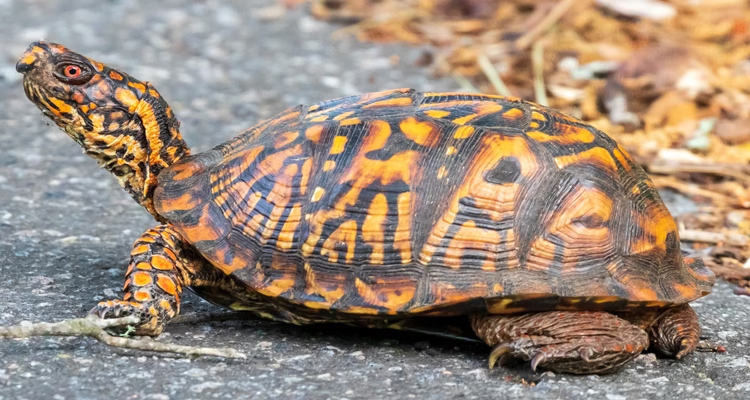
Understanding the distinction between turtles and tortoises is essential for their protection. Although the terms are often used interchangeably, they refer to different animals with distinct lifestyles and ecological needs. Turtles generally live in water or divide their time between land and water. They possess flatter, streamlined shells and webbed feet or flippers adapted for swimming. Most turtle species live between 40 and 80 years, though some sea turtles can survive even longer.
Tortoises, by contrast, are land-dwelling reptiles with large, domed shells and sturdy, elephant-like legs. They are herbivores, and several species rank among the longest-living animals on Earth, with verified lifespans ranging from 150 to 190 years. Although claims of tortoises living for 300 years remain unverified myths, their longevity is still extraordinary.
The size variation within these reptiles is equally fascinating. The tiny speckled padloper tortoise measures only 3 to 4 inches in length, while the massive leatherback sea turtle can grow beyond 7 feet and weigh more than 2,000 pounds. Turtles inhabit oceans, rivers, and lakes on every continent except Antarctica, whereas tortoises are commonly found in grasslands, deserts, scrub forests, and tropical islands.
Today, more than half of all turtle and tortoise species face the threat of extinction. Habitat destruction, climate change, plastic pollution, illegal wildlife trade, and accidental capture in fishing nets are rapidly driving their decline. Since these reptiles grow slowly and reproduce later in life, their populations recover very slowly once depleted.
World Turtle Day is far more than a symbolic date on the calendar. It is a reminder that these quiet, ancient creatures have survived shifting continents and dramatic climate changes, yet they may not survive the pressures created by modern human activity without urgent intervention. Every individual can contribute by reducing single-use plastics, refusing to purchase wild-caught turtles or tortoises, supporting wetland and beach conservation, volunteering with rescue organizations, and teaching children to respect wildlife.
Protecting turtles and tortoises ultimately means protecting oceans, rivers, forests, and grasslands — along with the countless species that depend on those ecosystems. Their slow and steady existence carries a powerful message: conservation cannot be delayed. The choices humanity makes today will determine whether future generations will continue to witness and admire these living fossils. Let World Turtle Day inspire a renewed commitment to preserving them for the future.