
From Modi’s Degree to Youth Mindsets: The Crisis of Critical Thinking
Maguni Charan Behera, Ph.D.
Former Professor, Rajiv Gandhi University, Itanagar
Currently Associated with the Council of Analytical and Tribal Studies (COATS), Koraput
Email: mcbehera1959@gmail.com
Is a university degree the true measure of leadership? This thought-provoking article explores the debate over Narendra Modi’s educational qualifications, the value of critical thinking, youth perceptions, and the dangers of political conditioning in a democracy.
The controversy surrounding Prime Minister Narendra Modi’s educational qualifications periodically resurfaces in public discourse. It first emerged prominently through Arvind Kejriwal and the Aam Aadmi Party (AAP). Although the issue generated considerable debate, it yielded little political advantage and gradually lost momentum. Recently, however, it has been revived by groups and individuals echoing many of the earlier arguments. Through social media and digital platforms, the controversy has found renewed traction, particularly among sections of Generation Z.
Does a Degree Qualify a Leader?
Why does Arvind Kejriwal repeatedly raise the issue of Narendra Modi’s degree? I do not claim to know his motives, nor is it my intention to judge them. However, certain facts deserve consideration. Kejriwal is an IIT graduate, a former Indian Revenue Service officer, and a person whose educational credentials are frequently highlighted. Narendra Modi, by contrast, rose through a very different path, one in which documentary proof of academic qualifications was not a prerequisite for political advancement.
Despite their contrasting educational backgrounds, Modi became Prime Minister and has been elected to the office three times. Kejriwal’s direct challenge to Modi in Varanasi ended in a decisive defeat. Thereafter, questions regarding Modi’s educational qualifications became a recurring political issue.
Whether the allegation is true or false is not the focus of this essay. My interest lies elsewhere: what makes a person attach such significance to another individual’s degree?
Political opponents continue to revive the issue, supporters dismiss it, and social media amplifies it. Yet one important question remains: Is this issue truly relevant to the future of the country?
For me, the question is largely irrelevant. Whether Narendra Modi possesses a particular degree or not does not alter the fact that he has been elected Prime Minister three times by the people of India. Elections are not university examinations. Citizens do not vote for certificates; they vote for leadership, judgment, vision, and performance. A degree may be useful, but it is neither the sole measure of knowledge nor a guarantee of wisdom.
Hubris Behind the Debate
The explanation may lie in a common feature of human nature. People often evaluate others through the standards they value most in themselves. A scholar respects scholarship, a wealthy person respects wealth, a warrior respects courage, and a highly educated individual may naturally place great value on academic qualifications.
When a person possessing such credentials encounters someone who achieves greater success without what he regards as an essential qualification, a psychological tension may arise. The focus then shifts from understanding the other’s success to questioning his credentials.
In this sense, Kejriwal’s emphasis on Modi’s degree may be viewed not merely as a political strategy but also as an illustration of a broader human tendency. The issue ceases to be about a certificate and becomes a window into how pride, rivalry, disappointment, and deeply held beliefs influence human judgment.
This is why I find the debate over degrees less interesting than the debate over minds. A degree may impart specialised knowledge, but leadership, public trust, practical wisdom, communication skills, and the ability to inspire millions are qualities that cannot be measured by certificates alone.
History offers numerous examples of extraordinary individuals whose influence far exceeded their formal educational attainments. The real question, therefore, is not whether a leader possesses a particular degree, but why societies sometimes become so obsessed with credentials that they overlook performance, experience, and public acceptance.
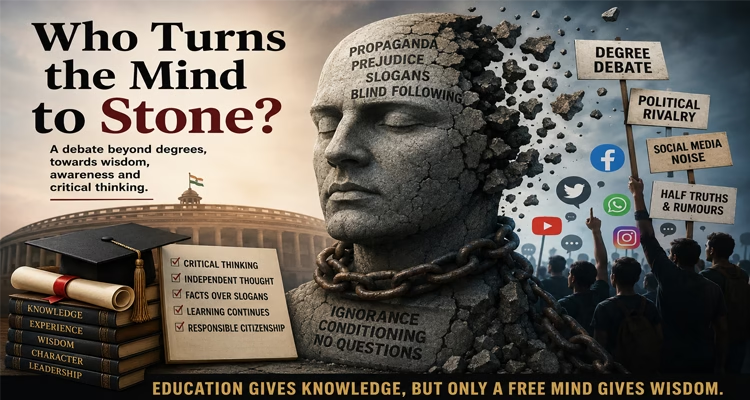
When that happens, the debate ceases to be about education and becomes a question of whether minds have turned to stone.
Degree, Knowledge, and Understanding Are Not the Same
Modern society often treats degrees as the highest proof of intelligence. This assumption is mistaken. A degree certifies that a person has completed a course of study in a particular discipline. It does not certify complete knowledge, sound judgment, creativity, leadership, patriotism, practical wisdom, or even mastery of every branch of that discipline.
The ability to govern a nation requires an understanding of history, economics, society, diplomacy, administration, technology, culture, and human behaviour. No single university degree can provide mastery over all these fields. Much of this understanding comes from experience, self-learning, observation, reading, and interaction with society.
History provides many examples of influential thinkers and leaders whose greatness did not depend upon formal degrees. Spiritual teachers, reformers, writers, and statesmen have often acquired knowledge through lifelong learning rather than formal certification. The value of a person should therefore be judged by character, understanding, and contribution rather than by a certificate alone.
A Disturbing Trend Among the Youth
What concerns me is not the debate about a politician’s degree but the quality of public understanding among some young people.
In recent years, television interviews and social media clips have revealed an alarming tendency. Many young people repeat political slogans without understanding the facts behind them. Some confidently express opinions on complex economic, educational, or political matters while possessing very little knowledge of the subjects they discuss.
One hears statements such as, “The GDP has fallen because the Prime Minister has no degree.” Yet, when asked what GDP means or where exactly it has fallen, the speaker is often unable to explain. Others participate in protests without clearly understanding the issues they are protesting against. Their opinions are frequently borrowed rather than formed through independent thought.
The problem is not ignorance alone. Ignorance can be corrected through learning. The real problem is the illusion of knowledge—the belief that repeating a slogan is equivalent to understanding an issue.
A Lesson from the Panchatantra
This reminds one of a famous tale. The unquestioning acceptance of claims on social media resembles the Panchatantra story often known as Budhia Died.
A washerman’s donkey named Budhia (literally meaning “wise”) died. The washerman wept because the animal had helped him earn his livelihood. People who saw him crying asked what had happened. Hearing only that “Budhia has died,” they too began to cry. Soon the news spread from street to street and eventually reached the royal palace. Before long, even the King and the Queen mourned without knowing who Budhia actually was.
Only later did the Minister ask a simple question: “Who was Budhia?” It was then discovered that Budhia was merely a donkey.
The story illustrates a timeless truth. People often repeat information without examining it. They react emotionally before understanding the facts. In the age of social media, this tendency has become even stronger. Rumours, half-truths, and slogans travel far faster than careful reasoning.
Who Turned This Man into Stone?
At this point, I am reminded of Godabarish Mohapatra’s famous Odia story, E Manishaku Pathar Kala Kie? (“Who Turned This Man into Stone?”).
The story narrates the life of Bhima Das, a stone-cutter who spends his days breaking stones for the construction of palaces, temples, and monuments. Years of harsh and repetitive labour gradually rob him of sensitivity, joy, and emotional richness. In a symbolic sense, he himself becomes like stone.
The original story criticises social and economic conditions that dehumanise workers. Yet its central metaphor can also be applied to another phenomenon: the hardening of the human mind.
Just as endless stone-cutting can turn a man into stone, endless exposure to misinformation, propaganda, prejudice, and slogans can turn the mind into stone. A person repeatedly fed distorted information may gradually lose the habit of questioning. He may stop examining evidence, stop listening to alternative viewpoints, and stop thinking independently.
The story therefore inspires a broader question: Who turns the mind into stone?
The Conditioned Mind and the Loss of Critical Thinking
Every political group attempts to influence public opinion. This is not unique to any one party or ideology. The danger arises when persuasion is replaced by conditioning.
A conditioned mind does not ask questions. It merely repeats answers supplied by others. It becomes emotionally attached to slogans and hostile to facts that challenge its beliefs.
When this happens, young people cease to be learners and become carriers of borrowed opinions and vested interests. Their education may continue, and degrees may accumulate, but genuine understanding remains absent.
The purpose of education is not to produce ideological followers. It is to cultivate critical thinking, intellectual honesty, curiosity, and the ability to distinguish truth from falsehood.
The Obsession with Degrees
Those who continuously attack political opponents over educational qualifications often assume that a degree is the ultimate measure of competence. Reality suggests otherwise.
If degrees alone guaranteed success, every highly educated person would become an outstanding leader. History does not support such a conclusion. Some highly qualified individuals have failed in public life, while others with modest educational backgrounds have demonstrated remarkable leadership.
Similarly, degrees do not automatically create honesty, integrity, patriotism, courage, or dedication to public service. Nor do they prevent corruption, arrogance, extremism, or poor judgment.
A university can teach a subject. It cannot guarantee character.
Therefore, the central question should not be whether a leader possesses a particular degree certificate. The more important questions are: What policies does the leader pursue? What results are achieved? How effectively are national challenges addressed? How does the leader respond to crises? What vision is offered for the future?
Knowledge in the Age of Self-Learning
The modern world has transformed the nature of learning. Knowledge is no longer confined to classrooms and universities. Books, digital resources, lectures, archives, and research materials are available to anyone willing to learn.
Today, self-learning is recognised as an essential skill. Individuals routinely acquire expertise beyond their formal academic backgrounds. Engineers study history. Historians learn economics. Administrators read psychology. Scientists explore philosophy.
Therefore, it is entirely possible for a person to develop broad knowledge through continuous learning even outside formal academic structures.
The true divide is not between degree holders and non-degree holders. It is between those who continue learning and those who stop learning.
What Should the Youth Learn?
The energy of the youth is one of the greatest assets of a nation. Unfortunately, much of that energy is increasingly consumed by political gossip, social media outrage, and endless controversies.
Young people deserve better.
They should be encouraged to understand economics rather than merely repeat economic slogans. They should learn constitutional principles rather than blindly embrace political slogans such as “The Constitution is in danger” or “Democracy is under threat.” They should study history critically rather than accept simplified narratives. They should analyse data, verify claims, and distinguish facts from opinions.
Most importantly, they should cultivate the courage to think independently.
A nation advances not because its citizens repeat political slogans, but because they acquire knowledge, develop skills, innovate, and contribute to society.
Conclusion
The debate about Narendra Modi’s degree ultimately distracts from a far more important issue. The real challenge before India is not the educational qualification of one individual but the intellectual condition of its citizens.
When young minds become dependent on slogans rather than reasoning, on propaganda rather than evidence, and on emotional reactions rather than informed judgment, society suffers. Such minds become like the stone in Godabarish Mohapatra’s story—hard, unreflective, and resistant to truth.
The question before us is therefore not whether a political leader possesses a degree. The more urgent question is: Who is shaping the minds of our youth, and what kind of citizens are they becoming?
A healthy democracy requires informed citizens, not merely opinionated ones. Nation-building demands knowledge, critical thinking, responsibility, and intellectual independence. These qualities matter far more than any certificate hanging on a wall.