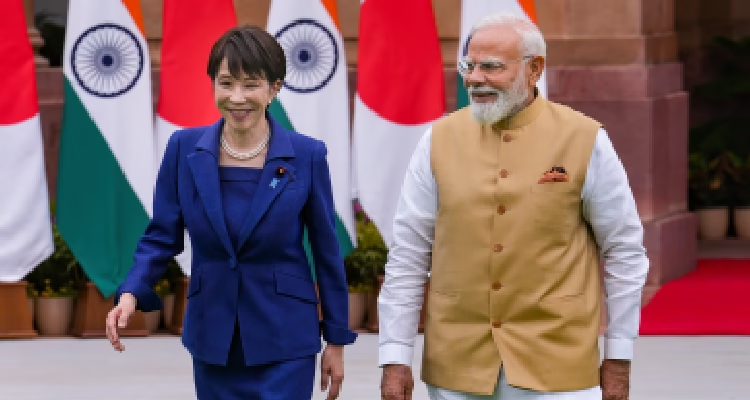
New Delhi:India and Japan have unveiled an ambitious roadmap to mobilise 10 trillion yen (around US$68 billion) in Japanese investment into India over the next ten years, marking a major step forward in their growing economic and strategic partnership. The announcement was made during the 16th India-Japan Annual Summit in New Delhi, where Prime Minister Narendra Modi and Japanese Prime Minister Sanae Takaichi reaffirmed their commitment to expanding cooperation across investment, technology, defence and energy.

The new target is expected to significantly strengthen India’s manufacturing ecosystem, infrastructure development and innovation landscape while encouraging a larger presence of Japanese businesses in the country. The two leaders also expressed confidence that the investment goal would help accelerate India’s journey towards becoming a developed economy by 2047.
🇯🇵 PM Takaichi: $12BN+ In India-Japan Deals Announced
PM Narendra Modi also set a target of attracting around $60bn+ in Japanese investment into 🇮🇳 over the next decade, while doubling the number of Japanese companies operating in the country. https://t.co/pynuv7ueDp pic.twitter.com/NDrbAItCZI
— RT_India (@RT_India_news) July 2, 2026
Prime Minister Modi said the India-Japan investment partnership has gained remarkable momentum, noting that around 120 new business agreements have been signed over the past year, bringing commitments of more than US$10 billion in fresh Japanese investments. He also announced a shared objective of doubling the number of Japanese companies operating in India over the coming decade, highlighting India’s improving ease of doing business and expanding opportunities for foreign investors.
Delhi: At the India-Japan Joint Economic Forum, PM Narendra Modi says, “Together all of you have to ensure that in the next one decade, Japan’s investment in India crosses 10 Trillion Yen and the number of Japanese companies in India doubles in 10 years”
Source: DD/ANI pic.twitter.com/ss5ACn5sYL
— WION (@WIONews) July 2, 2026
New Roadmap for High-Tech Cooperation
Beyond investment, both nations unveiled a comprehensive roadmap to deepen collaboration in semiconductors, quantum technologies, artificial intelligence, advanced materials, clean energy and resilient supply chains. The initiative reflects a shared strategy to strengthen economic security amid growing geopolitical and supply chain uncertainties.
The two countries also agreed to expand cooperation in green hydrogen, battery technologies, critical minerals and nuclear energy, positioning India and Japan as key partners in the global clean energy transition.
Business and Innovation at the Core
Japanese Prime Minister Sanae Takaichi described India as a crucial partner in Japan’s long-term economic strategy and stressed that public-private collaboration would play a central role in achieving the investment target. She highlighted that the Japanese business delegation accompanying her visit announced numerous cooperation agreements across manufacturing, infrastructure, technology and innovation.
Both leaders agreed that stronger industrial collaboration and investment-led growth would benefit not only their respective economies but also contribute to greater stability and resilience across the Indo-Pacific region.
Strategic Partnership Expands
The summit also witnessed significant progress in strategic cooperation. India and Japan signed key agreements covering artificial intelligence, defence technology, economic security and energy resilience, while reaffirming their shared commitment to a free, open and inclusive Indo-Pacific.
The discussions underscored the growing convergence between New Delhi and Tokyo on issues ranging from advanced technology and industrial competitiveness to maritime security and resilient global supply chains.
Looking Ahead
The 10 trillion yen investment target represents one of the most ambitious economic commitments between India and Japan to date. As both nations seek to diversify supply chains, promote innovation and strengthen strategic cooperation, the new roadmap is expected to deepen bilateral ties, attract high-quality investments and create long-term opportunities in emerging sectors that will shape the next decade of economic growth.