Lok Sabha May Expand to 850 Seats, Women’s Quota Could Finally Take Effect—But NDA Needs 42 More Votes Across Parliament
Explained: The Delimitation Bill 2026 could redraw India’s political map, increase Lok Sabha seats to 850, implement women’s quota, and test the NDA’s parliamentary strength.

India’s next major political battle is unlikely to be fought on the streets—it will be fought inside Parliament.
The Delimitation Bill, 2026, expected to be a key agenda item during the Monsoon Session beginning July 20, has the potential to transform India’s democratic landscape more dramatically than any electoral reform in decades.
If passed, the legislation would redraw parliamentary constituencies, expand the Lok Sabha to nearly 850 members, alter the political weight of several states, and pave the way for implementing the long-awaited 33% reservation for women in Parliament and State Assemblies.
Yet the biggest obstacle before the Narendra Modi-led NDA government is not the Bill itself—but the numbers.
Although the ruling alliance enjoys a majority in the Lok Sabha, it does not currently possess the special constitutional majority required to amend the Constitution, making support from regional and Opposition parties crucial.
What is Delimitation?
Delimitation is the constitutional exercise of redrawing the boundaries of Lok Sabha and State Assembly constituencies and, where necessary, redistributing parliamentary seats among states according to population changes.
The objective is simple: every elected representative should represent roughly the same number of citizens so that every vote carries nearly equal value.
Over decades, population growth has varied sharply across states. As a result, some Members of Parliament today represent more than three million people, while others represent far fewer.
Delimitation seeks to correct this imbalance and strengthen the principle of “One Person, One Vote, One Value.”
Why is Delimitation Being Taken Up in 2026?
The allocation of Lok Sabha seats among states has remained frozen for almost 50 years.
In 1976, through the 42nd Constitutional Amendment, Parliament froze the distribution of seats based on the 1971 Census to ensure that states successfully controlling population growth would not lose political representation.
Later, the 84th Constitutional Amendment (2001) extended this freeze until the first Census conducted after 2026, permitting only changes in constituency boundaries but not in the number of seats allotted to states.
With that constitutional deadline now approaching, the Centre has moved to begin the next phase of India’s electoral restructuring.
What Does the Delimitation Bill Propose?
The proposed legislation seeks to establish a new Delimitation Commission, an independent body responsible for carrying out the nationwide exercise.
The Commission would:
- Redraw Lok Sabha and Assembly constituencies;
- Determine the distribution of seats based on the Census approved by Parliament;
- Ensure constituencies have nearly equal populations;
- Issue orders having the force of law, which ordinarily cannot be challenged before courts.
Alongside the Delimitation Bill, the government has also proposed the Constitution (131st Amendment) Bill, which empowers Parliament to decide the Census that will form the basis of future delimitation exercises.
Lok Sabha Could Become the World’s Largest Elected House
One of the most striking proposals is the expansion of the Lok Sabha.
The Constitution currently allows a maximum strength of 550 members, while the present House has 543 elected MPs.
The proposed amendment would raise the constitutional ceiling to 850 seats, making India’s Lower House the largest democratically elected legislature in the world.
The additional seats are intended to reflect India’s enormous population growth over the past five decades and reduce disparities in voter representation.
Women’s Reservation Could Finally Become Reality
The Delimitation exercise is also the key to implementing the 33% reservation for women in the Lok Sabha and State Legislative Assemblies.
Although Parliament approved the Nari Shakti Vandan Adhiniyam in 2023, its implementation was linked to a fresh Census and delimitation exercise.
The proposed constitutional amendment seeks to operationalise the reservation in time for future elections following delimitation.
Why Southern States Are Worried
The proposed reforms have triggered intense political debate.
Northern states such as Uttar Pradesh, Bihar, Rajasthan and Madhya Pradesh have experienced much faster population growth than many southern states.
If seats are redistributed strictly on population, these states could gain a significantly larger share of Lok Sabha seats.
Southern states—including Tamil Nadu, Kerala, Karnataka, Telangana and Andhra Pradesh—fear their relative political influence in Parliament could decline despite decades of successful population control and stronger social indicators.
Regional parties argue that states which implemented national family planning policies effectively should not now be politically disadvantaged.
This remains the single biggest political challenge before the proposed legislation.
The Real Battle Is Arithmetic, Not Politics
Passing the Delimitation Bill is not simply a matter of majority support.
Because it involves constitutional amendments, it must be approved under Article 368 of the Constitution, requiring:
- A majority of the total membership of each House; and
- A two-thirds majority of members present and voting.
This is where the government’s challenge begins.
Lok Sabha
The current effective strength of the Lok Sabha is 540 members.
If all members participate in the vote, approximately 360 votes would be required to secure the necessary two-thirds majority.
The NDA currently commands around 324 MPs, leaving it 36 votes short of the required mark.
Rajya Sabha
The ruling alliance also falls short in the Upper House.
Based on the current composition of the Rajya Sabha, the government is estimated to require at least six additional votes to comfortably achieve the special majority.
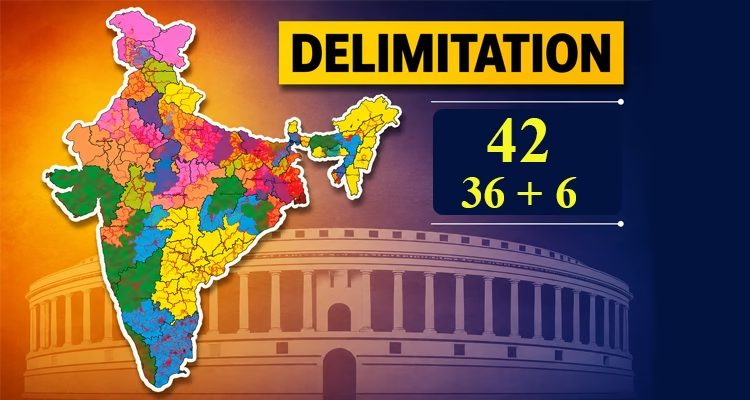
In effect, the NDA needs the support of around 42 additional MPs across both Houses of Parliament to ensure the smooth passage of the constitutional package.
This political arithmetic explains the government’s outreach to regional parties and select Opposition leaders ahead of the Monsoon Session.
Supriya Sule’s Remarks Add Fresh Twist
Amid intense political negotiations, comments by NCP (Sharad Pawar) MP Supriya Sule have attracted considerable attention.
While no formal change in the Opposition’s strategy has been announced, political observers believe her remarks have fuelled speculation that some regional parties may adopt an issue-based approach rather than oppose the legislation outright.
Every abstention or crossover vote could prove decisive if the government seeks to bridge the gap in both Houses.
Why This Bill Could Change Indian Politics Forever
The Delimitation Bill is much more than an electoral reform.
It has the potential to:
- Redraw India’s parliamentary map;
- Expand the Lok Sabha to an unprecedented size;
- Shift political influence among states;
- Implement one-third reservation for women in legislatures;
- Influence the balance of power in future general elections.
Supporters argue that representation based on population figures from over five decades ago no longer reflects democratic realities.
Critics, however, warn that delimitation without adequate safeguards could upset India’s federal balance by rewarding high population growth while reducing the relative voice of states that successfully controlled it.
As Parliament prepares for a high-voltage Monsoon Session, the Delimitation Bill is emerging as one of the most consequential constitutional reforms since Independence—a legislation capable of reshaping India’s electoral map and political future for decades to come.