Ajay Kumar | Senior Journalist
Nitish Kumar’s move to the Rajya Sabha signals a major political transition in Bihar, marking the end of his long tenure as Chief Minister and hinting at a new BJP-led era in the state.

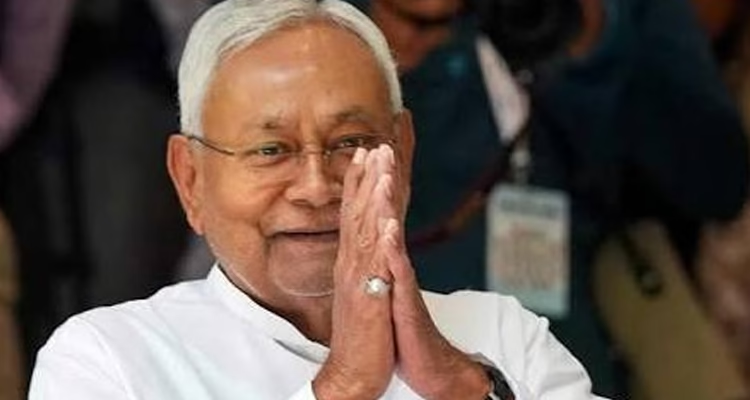
After dominating Bihar’s political landscape for nearly two decades, Nitish Kumar’s transition to the Rajya Sabha marks more than a routine shift—it signals the beginning of a new political phase in both the state and national arena. His move effectively draws the curtain on a long era that shaped Bihar’s governance since 2005.
Nitish Kumar, who remained at the center of power for nearly 18–19 years across multiple terms, is among the longest-serving Chief Ministers in Bihar’s history. From his first brief stint in 2000 to forming a stable government on November 24, 2005, and eventually taking oath ten times as Chief Minister, his tenure has been marked by continuity as well as political adaptability.
His political journey began in 1985 when he was elected as a legislator. By 1989, he entered the Lok Sabha and went on to serve four consecutive terms until 2004. During this period, he held key portfolios in the Union government, including Railway Minister and Surface Transport Minister. His tenure in the Railways saw infrastructure expansion and improvements in passenger services, strengthening his administrative credentials.
When Nitish Kumar assumed office in Bihar in 2005, the state was grappling with weak infrastructure and governance challenges. Over the years, significant improvements were recorded in rural connectivity, with extensive road construction linking villages to district centers. His government also introduced landmark welfare measures, including the widely acclaimed bicycle scheme launched in 2006, which boosted school attendance—especially among girls—and transformed educational participation.
Another major reform was the introduction of 50 percent reservation for women in the Panchayati Raj system, which significantly increased female participation in grassroots governance. Thousands of women entered local politics as elected representatives, reshaping rural political dynamics.
The health sector also saw expansion, with increased numbers of primary health centers and improved facilities in district hospitals. Rising footfall in government hospitals indicated better access to healthcare services during his tenure.
However, Nitish Kumar’s political career has also been defined by frequent shifts in alliances. He parted ways with the BJP-led National Democratic Alliance (NDA) in 2013, returned in 2017, exited again in 2022, and rejoined in 2024. These shifts underscored his role as a pivotal player in coalition politics.
The 2025 Bihar Assembly elections proved to be another milestone, with the ruling alliance securing a majority in the 243-member House, leading to his tenth oath as Chief Minister. Yet, within months, his decision to move to the Rajya Sabha hinted at a larger political strategy rather than a routine transition.
With this move, Nitish Kumar joins a select group of leaders who have served in all four legislative bodies—Legislative Assembly, Legislative Council, Lok Sabha, and Rajya Sabha—an achievement held by only a few in Indian politics.
His entry into national politics raises questions about his future role in Delhi. Given his extensive administrative experience and decades-long parliamentary career, he is expected to play a significant role in policy-making and coalition management at the national level.
Meanwhile, Bihar is witnessing a crucial transition. Discussions over the next Chief Minister have intensified, as the responsibility of governing a populous state of over 13 crore people passes to new leadership. The challenge ahead lies in sustaining existing welfare schemes while introducing new developmental priorities.
As Bihar enters this transitional phase, the focus will remain on whether the new leadership can maintain the governance momentum built over the past two decades. Nitish Kumar’s move to Delhi, in many ways, completes a full political cycle—from Parliament to state leadership and back again.
Whether this shift marks a strategic elevation to a larger national role or simply a change in responsibility will become clearer in the months ahead. For now, it unmistakably signals the end of an era in Bihar and the possible beginning of a BJP-led political phase in the state.