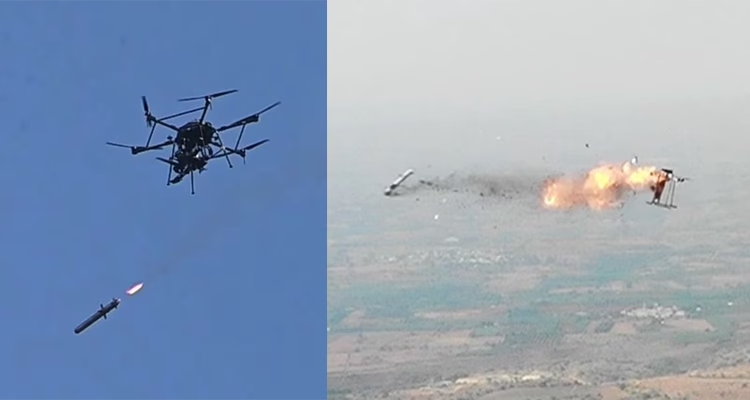
New Delhi: India’s defence capabilities received a major boost after the Defence Research and Development Organisation (DRDO) successfully carried out development trials of the indigenous Unmanned Aerial Vehicle Launched Precision Guided Missile-V3 (ULPGM-V3) in both Air-to-Ground and Air-to-Air modes at the National Open Area Range (NOAR) near Kurnool in Andhra Pradesh.
The trials were conducted on May 18 and 19, 2026, according to defence officials, marking a significant step forward in India’s push to strengthen indigenous drone warfare and precision-strike technologies.
Successful Air-to-Ground and Air-to-Air Engagements
During the trials, the missile successfully demonstrated its capability to destroy both ground-based and airborne targets with high precision. In the Air-to-Ground mode, the ULPGM-V3 accurately engaged designated land targets, while in the Air-to-Air configuration, it successfully intercepted aerial targets, including simulated drones and airborne threats.
The tests validated the missile’s operational flexibility and its effectiveness for future unmanned combat operations.
Development trials of Unmanned Aerial Vehicle Launched Precision Guided Missile-V3 in Air-to-Ground & Air-to-Air modes was successfully completed at DRDO test range near Kurnool, Andhra Pradesh. pic.twitter.com/Hl3AuJhsMP
— DRDO (@DRDO_India) May 19, 2026
Indigenous Missile for Next-Generation Drone Warfare
The ULPGM-V3 is an upgraded variant of the earlier ULPGM-V2 missile system and has been developed specifically for deployment from unmanned aerial vehicles (UAVs). The missile is designed for precision engagement during both day and night operations and is equipped with advanced guidance and targeting systems.
Officials said the missile can significantly enhance India’s tactical drone strike capability, especially in modern battle environments where unmanned systems are playing an increasingly critical role.
Trials Conducted with Advanced Ground Control System
DRDO stated that the trials involved an integrated Ground Control System (GCS) featuring automated weapon management, launch control and mission coordination systems. The missile reportedly performed successfully across different engagement scenarios during the evaluation phase.
The development programme was led by several DRDO laboratories, including the Research Centre Imarat (RCI), Defence Research & Development Laboratory (DRDL), Terminal Ballistics Research Laboratory (TBRL), and High Energy Materials Research Laboratory (HEMRL).
DRDO has successfully completed development trials of the UAV Launched Precision Guided Missile (ULPGM)-V3 in both Air-to-Ground and Air-to-Air modes.
DRDO said the system includes advanced technologies to automate readiness and launch operations.
Follow the complete story on… pic.twitter.com/RyaxY9dX7s
— PB-SHABD (@PBSHABD) May 19, 2026
Rajnath Singh Congratulates DRDO
Defence Minister Rajnath Singh congratulated DRDO scientists, industry partners, start-ups and MSMEs associated with the programme, calling the achievement a “major milestone” in India’s defence indigenisation mission.
The missile system has been developed in collaboration with Bharat Dynamics Limited, Adani Defence & Aerospace and Bengaluru-based UAV firm NewSpace Research and Technologies.
Push Towards Defence Self-Reliance
The successful completion of the development trials is expected to pave the way for future induction of indigenous UAV-launched precision weapons into the Indian armed forces. Defence experts believe the system could become a crucial component of India’s expanding drone warfare ecosystem amid rising global focus on autonomous combat technologies.
The achievement also aligns with the government’s broader “Aatmanirbhar Bharat” initiative aimed at reducing dependence on imported defence systems and strengthening domestic military manufacturing.