
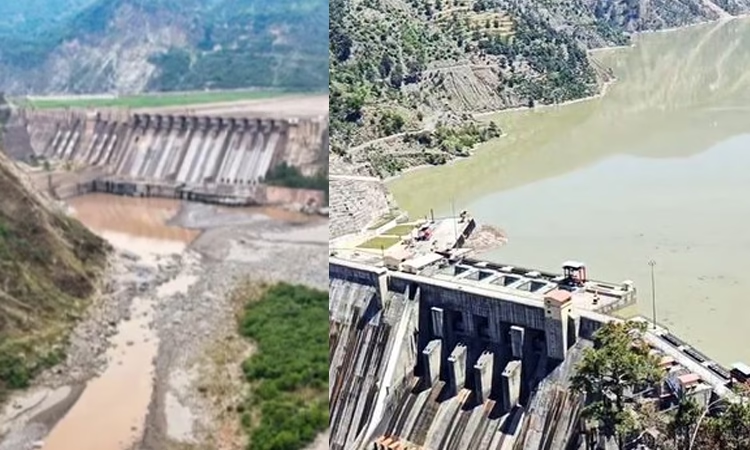
News Desk: India has accelerated its hydroelectric and river infrastructure expansion in the Chenab basin with the launch of projects worth nearly Rs 2,600 crore, underlining New Delhi’s growing focus on renewable energy, water security and Himalayan infrastructure development.
The projects are spread across Himachal Pradesh and Jammu & Kashmir and are expected to significantly strengthen hydropower generation and inter-basin water management in northern India.
Rs 2,352 Crore Chenab–Beas Link Tunnel Project
The biggest component of the new investment package is the Rs 2,352 crore Chenab–Beas Link Tunnel Project in Himachal Pradesh’s Lahaul-Spiti region.
The proposal involves constructing an 8.7-km tunnel to divert surplus water from the Chenab basin into the Beas river system. According to reports, the project is part of a broader inter-basin river-linking initiative designed to transfer water from the Chandra river — a tributary of the Chenab — toward the Beas basin through hydraulic structures and tunnels.
As part of Phase-I construction, authorities have also proposed a 19-metre-high barrage across the river in the Lahaul valley.
#BreakingNews | After putting Indus treaty in abeyance last year, India continues to strike Pakistan strategically
India starts two big projects on Chenab River, EXCLUSIVE documents accessed by CNN-NEWS18@AmanKayamHai_ explains each and every point in detail#Nationat5… pic.twitter.com/XGHb5ZUvfP
— News18 (@CNNnews18) May 21, 2026
Strategic Location Near Atal Tunnel
The diversion point is located near Koskar village in the strategically important Himalayan belt, upstream of the north portal of the Atal Tunnel at Rohtang.
The region has witnessed rapid infrastructure expansion in recent years, including highways, tunnels and hydropower projects aimed at improving connectivity and strengthening India’s northern frontier infrastructure.
Dulhasti Stage-II to Boost Power Generation
The second major project is the Dulhasti Stage-II hydropower project in Jammu & Kashmir’s Kishtwar district.
Officials say the project is expected to substantially increase electricity generation capacity in the Chenab basin and strengthen renewable energy supply in northern India.
The project also forms part of the Centre’s broader push to accelerate hydropower development in Jammu & Kashmir, where several large-scale projects are currently under construction.
Chenab Basin Emerging as Key Hydropower Hub
India has been fast-tracking multiple hydroelectric projects across the Chenab river system, including Ratle, Kiru, Kwar and Pakal Dul projects.
These projects are being closely monitored by the Centre to ensure faster execution and timely completion, amid increasing emphasis on clean energy and regional infrastructure growth.
Experts say the Chenab basin is emerging as one of India’s most strategically important hydropower corridors due to its massive untapped energy potential and geographical significance.
Indus Waters Treaty Context
The latest developments come after India suspended engagement under the 1960 Indus Waters Treaty following the Pahalgam terror attack earlier this year.
The treaty, brokered by the World Bank, governs water-sharing arrangements between India and Pakistan over the Indus river system.
Analysts believe the renewed focus on Chenab basin projects reflects India’s increasing emphasis on maximising river water utilisation, strengthening energy security and improving strategic infrastructure in the Himalayan region.