
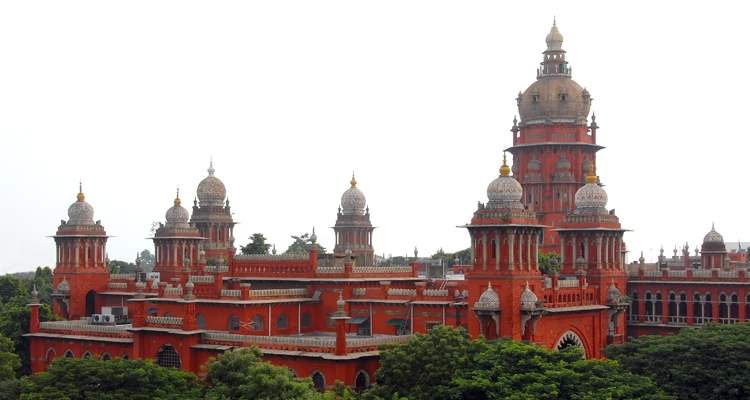
Chennai | India: In a rare and candid observation, the Madras High Court has acknowledged that corruption exists within the judiciary, asserting that judges should not be treated as “holy cows” immune from criticism or public scrutiny.
The remarks were made by a division bench comprising Justice G.R. Swaminathan and Justice V. Lakshminarayanan while dismissing a petition seeking a ban on the Tamil film Karuppu. The petitioner had alleged that the movie portrayed the judiciary in a negative light and could lower public confidence in courts.
Rejecting the plea, the High Court observed that cinema, as a form of artistic expression protected under Article 19(1)(a) of the Constitution, cannot be censored merely because it depicts corruption or unethical conduct in public institutions, including the judiciary.
‘There Is Corruption In Judiciary’: Madras HC Says Judges Need Not Be Treated As ‘Holy Cows’https://t.co/D4HwG0M6jM#MadrasHC #Judiciary #JudicialSystem #Justice #Law
— News18 (@CNNnews18) May 28, 2026
In one of the strongest observations made during the hearing, the bench stated that “none can deny that there is corruption in the judiciary” and admitted that “there were and are corrupt judges.” The court further underlined that accountability within the judicial system is essential for maintaining public trust.
The bench remarked that judges are not beyond criticism and should not be considered untouchable figures. Referring to a famous observation by British jurist Lord Atkin, the court said justice “must be allowed to suffer scrutiny and outspoken comments of ordinary citizens.”
There Is Corruption In Judiciary, Judges Need Not Be Treated As Holy Cows: Madras High Court |@UpasanaSajeev #MadrasHighCourt https://t.co/iUpMb96hzZ
— Live Law (@LiveLawIndia) May 27, 2026
The judges also pointed out that corruption within the judiciary cannot happen in isolation and noted that certain members of the legal fraternity may become complicit in such practices. However, the court stressed that High Courts continue to exercise vigilance and disciplinary control to identify and remove “black sheep” from the system.
The observations have triggered a nationwide debate on judicial transparency, ethics, and institutional accountability. Legal experts say such frank admissions from within the judiciary are uncommon and may strengthen demands for greater reforms, including transparent appointments, stronger internal oversight mechanisms, and faster action against misconduct.
None can deny that there is corruption in the judiciary, the Madras High Court recently observed while refusing to ban Karuppu, a Tamil film which involves a portrayal of corruption in a trial court.
Read the judgment: https://t.co/Fiuyyf0nhN pic.twitter.com/uswehuxgZM
— Bar and Bench (@barandbench) May 27, 2026
The remarks come amid increasing public discourse around judicial accountability in India. Recently, controversy had also erupted over an NCERT textbook chapter discussing corruption in the judiciary, which eventually reached the Supreme Court.
Despite acknowledging corruption, the Madras High Court maintained that isolated misconduct should not undermine the credibility of the institution as a whole. The court emphasized that self-corrective mechanisms and constitutional safeguards remain crucial for preserving the integrity of the justice delivery system.



Nice