
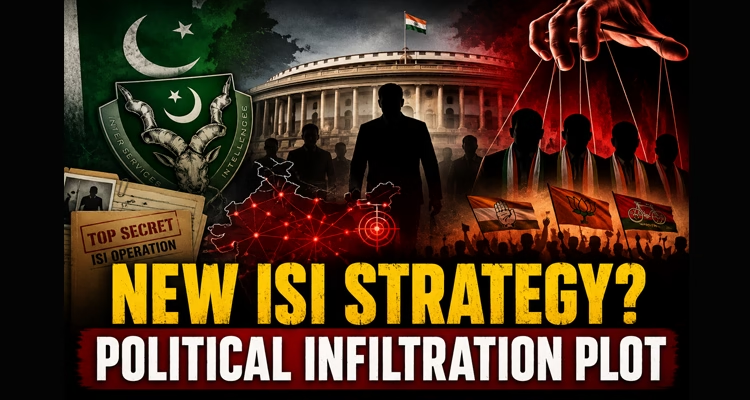
New Delhi: Indian intelligence and security agencies have reportedly uncovered a disturbing new strategy allegedly backed by Pakistan’s Inter-Services Intelligence (ISI), in which terrorist operatives and sleeper-cell networks are being encouraged to infiltrate political organizations and local socio-political structures to expand their influence and gather strategic intelligence.
The revelation comes amid a series of nationwide crackdowns on Pakistan-linked espionage and terror modules, with investigators warning that hostile networks are increasingly shifting from conventional infiltration tactics to deeper political and social penetration.
According to security sources, the objective behind the alleged strategy is not merely to carry out terror attacks but to gradually create influence networks capable of collecting sensitive information, identifying vulnerable targets, influencing local narratives, and providing logistical support to anti-India activities.
The development has raised fresh concerns within India’s security establishment, especially after multiple investigations in recent months pointed to growing attempts by Pakistan-based handlers to recruit Indian nationals through social media platforms, encrypted messaging applications, financial inducements, and ideological radicalization.
Shift from Border Infiltration to Institutional Penetration
Security experts believe the alleged directive reflects a significant evolution in Pakistan-backed proxy warfare. For decades, infiltration largely focused on pushing trained militants across the Line of Control and using terror modules to execute attacks. However, intelligence assessments now indicate efforts to establish long-term influence networks within civilian spaces.
Investigators say such networks can serve multiple purposes, including reconnaissance, recruitment, propaganda dissemination, fund transfers, and identification of strategic targets. The concern is that political platforms, local organizations, and community bodies may be viewed as convenient channels for expanding such influence operations.
The alleged strategy comes at a time when intelligence agencies have reported renewed infiltration attempts along India’s borders and increased activity at terror launch pads across Pakistan-occupied territories.
Recent Arrests Add to Security Concerns
The warning assumes greater significance following recent operations by Indian agencies against Pakistan-linked terror and espionage networks.
In one of the latest cases, Delhi Police’s Special Cell arrested nine suspects allegedly linked to a terror module connected with the Dawood Ibrahim network and Pakistan’s ISI. Investigators claimed the group was planning attacks on key locations in the national capital before the network was dismantled.
Separate investigations across multiple states have also uncovered alleged espionage and reconnaissance modules accused of collecting information about military installations, railway corridors, and strategic infrastructure for handlers based in Pakistan. Security agencies have reported the use of social media recruitment, fake identities, and encrypted communication channels in these operations.
Growing Focus on Youth Recruitment
Counter-terror officials have repeatedly warned about attempts to recruit young individuals through online platforms. Intelligence reports indicate that minors and economically vulnerable youths are increasingly being targeted through emotional manipulation, monetary incentives, and ideological propaganda.
Investigations in several recent cases revealed that handlers allegedly linked to Pakistan-based networks used digital platforms to cultivate contacts, obtain sensitive information, and build local support structures without attracting immediate suspicion.
India Strengthens Counter-Terror Framework
The latest intelligence inputs emerge as India continues to strengthen its counter-terror architecture following a series of security challenges over the past year. The National Investigation Agency (NIA) and other security agencies have intensified efforts to track cross-border terror financing, sleeper-cell operations, digital radicalization campaigns, and espionage activities.
Security analysts note that infiltration into political or social structures, if proven, represents a more complex threat than traditional terror operations because it seeks to build influence from within rather than relying solely on armed attacks.
With investigations continuing, agencies are expected to increase scrutiny of suspected recruitment channels, funding routes, and cross-border communication networks believed to be linked to hostile intelligence operations. Officials maintain that heightened vigilance and coordinated intelligence sharing remain critical to countering evolving terror strategies targeting India’s internal security.



We need to be alert.