
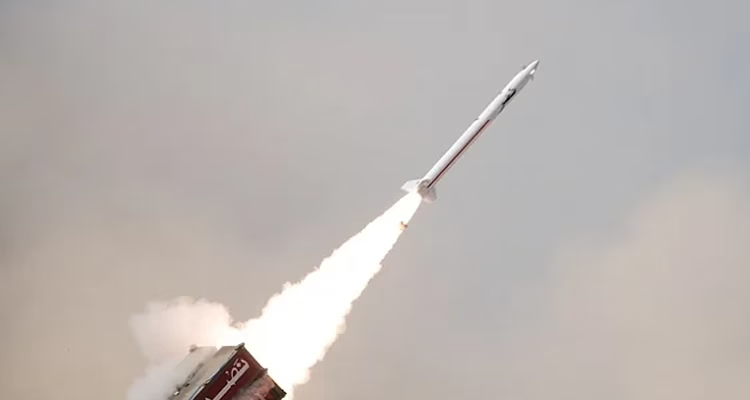
New Delhi: India has operationally deployed a section of its nuclear arsenal for the first time, marking a notable evolution in its strategic posture, according to the latest assessment by the Stockholm International Peace Research Institute (SIPRI).
In its 2026 Yearbook, SIPRI estimates that India now possesses around 190 nuclear warheads, up from 180 a year earlier. More significantly, the report assesses that 12 of these warheads are now operationally deployed, the first time SIPRI has classified any portion of India’s arsenal as being deployed rather than held in storage.
The Stockholm-based arms research institute suggests that New Delhi may be gradually moving away from its long-standing practice of keeping nuclear warheads and delivery systems separated during peacetime. Instead, a small number of warheads may now be mated with missiles or deployed alongside operational forces, indicating a higher level of readiness.
The nine nuclear-armed states—🇺🇸🇷🇺🇬🇧🇫🇷🇨🇳🇮🇳🇵🇰🇰🇵🇮🇱— continued programmes to modernize and enhance their nuclear arsenals in 2025, and most deployed new nuclear-armed or nuclear-capable weapon systems during the year. Learn more ➡️ https://t.co/LTARRAo4bW#SIPRIYearbook2026… pic.twitter.com/E02lOqXzfE
— SIPRI (@SIPRIorg) June 7, 2026
Shift Towards Greater Nuclear Readiness
According to SIPRI, India’s growing reliance on canisterised missile systems and the increasing role of nuclear-powered ballistic missile submarines (SSBNs) in deterrence patrols have contributed to this shift.
The report notes that India may have deployed a limited number of nuclear warheads aboard a ballistic missile submarine conducting occasional deterrence patrols. Such deployments enhance the survivability of India’s nuclear forces and strengthen its second-strike capability.
SIPRI cautions that the assessment carries a degree of uncertainty, but concludes that India “could be shifting in the direction of mating some of its warheads with their launchers in peacetime.”
Nuclear Triad Continues to Mature
India’s estimated stockpile of 190 warheads is assigned to a steadily maturing nuclear triad—the capability to launch nuclear weapons from land, air and sea platforms.
The report highlights continued modernization of India’s strategic forces, including the development of longer-range missile systems, canisterised launch platforms, multiple independently targetable re-entry vehicle (MIRV) technology, and expansion of the country’s sea-based nuclear deterrent.
SIPRI notes that India’s modernization efforts are increasingly focused on developing weapons capable of reaching targets across China, while strategic planning remains influenced by its long-standing rivalry with Pakistan.
BIG BREAKING: Marking a significant shift in nuclear weapons policy, India has for the first time “deployed” 12 NUCLEAR WARHEADS.
The revelation has been made in the latest report of the Stockholm International Peace Research Institute (SIPRI). pic.twitter.com/GrQmEl0bpN
— Megh Updates 🚨™ (@MeghUpdates) June 9, 2026
Sea-Based Deterrent Gains Importance
The report identifies India’s expanding fleet of ballistic missile submarines as a key component of its future nuclear strategy. The deployment of nuclear weapons aboard SSBNs and the conduct of deterrence patrols indicate a gradual move toward a more operational sea-based deterrence posture.
Experts view submarine-based nuclear forces as the most survivable leg of a nuclear triad because they are difficult to detect and destroy, ensuring retaliation capability even after a first strike.
No Change in Nuclear Doctrine
Despite the reported operational deployment of some warheads, SIPRI notes that there has been no official change in India’s nuclear doctrine.
India continues to adhere to its “No First Use” (NFU) policy, under which nuclear weapons would only be used in retaliation against a nuclear attack on Indian territory or Indian forces. The doctrine remains rooted in the principle of credible minimum deterrence, maintaining a nuclear force sufficient to deter adversaries without pursuing an open-ended arms race.
The Indian government has not made any announcement indicating a change in either its NFU policy or its broader nuclear doctrine.
Global Nuclear Competition Intensifies
SIPRI’s findings come amid broader concerns over a renewed global nuclear buildup. The institute warns that nuclear-armed states are increasingly modernising and expanding their arsenals, raising the risk of a new era of strategic competition.
Globally, SIPRI estimates there were approximately 12,187 nuclear warheads as of January 2026, with around 9,745 held in military stockpiles for potential use. The report says the long-term trend of declining nuclear inventories is slowing as major powers invest heavily in modernisation programmes.
For India, the latest assessment signals a gradual but significant evolution in operational readiness, even as the country’s official commitment to deterrence and no-first-use remains unchanged.