by Nava Thakuria
Geneva: A marked improvement was recorded during the first six months of 2026, with 39 journalists killed, compared to 85 during the same period in 2025—a decline of more than 54%. However, the Middle East remained the world’s most dangerous region for journalists, followed by Latin America, according to the Press Emblem Campaign (PEC).
“This decline in the number of victims is finally some good news after three record-breaking years,” said Blaise Lempen, President of PEC, a global media safety and rights organization. “But 39 murders are still far too many. The Israeli military was once again responsible for a high number of journalist deaths, particularly in Lebanon,” he added.
Middle East Remains the Deadliest Region
The Middle East accounted for 19 journalist deaths during the period. Of these, nine media workers were killed in Lebanon during Israeli military operations, while seven were killed in Gaza. The remaining deaths included one each in Syria, Iran, and Yemen.
According to PEC, 228 Palestinian journalists have been killed since the outbreak of the Gaza conflict on October 7, 2023—including 81 in 2023, 80 in 2024, 60 in 2025, and 7 in 2026. PEC said it continues to include all Palestinian journalists in its records, arguing that alleged affiliations with Hamas do not justify their killing unless they were directly involved in hostilities.
Latin America and Asia
In Latin America, 12 journalists lost their lives. Mexico remained the deadliest country, with five journalists murdered, including two who were killed in June but whose bodies were discovered in July. Colombia, Haiti, and Venezuela each recorded two killings, while Guatemala reported one.
In Asia, six journalists were killed. The Philippines recorded the highest toll with three deaths, followed by Bangladesh, India, and Pakistan, with one journalist killed in each country.
Africa and Europe
In Africa, two journalists were killed—one each in Somalia and Uganda.
Notably, no journalists were killed in Europe, despite the continuing war between Ukraine and Russia (excluding journalists serving as members of the armed forces). PEC said this demonstrates that adequate precautions can significantly reduce the risks faced by media professionals in conflict zones.
Impunity Remains a Major Concern
PEC expressed concern that little progress has been made in combating impunity. It said Israeli military personnel accused in some cases of deliberately targeting journalists continue to enjoy near-total impunity, while investigations in Mexico are frequently obstructed by alleged links between criminal organizations and state institutions.
The organization urged international judicial mechanisms to intervene where national authorities fail to investigate or prosecute those responsible for crimes against journalists.
South and Southeast Asia Shows Improvement
The South and Southeast Asian region recorded a significant improvement in journalist safety during the first half of 2026.
During the same period in 2025, the region had reported 21 journalist killings—including six in India, five each in Bangladesh and Pakistan, four in the Philippines, two in Afghanistan, and one in Nepal.
PEC regional representative Nava Thakuria said that only six journalists were killed in the region between January 1 and June 30, 2026.
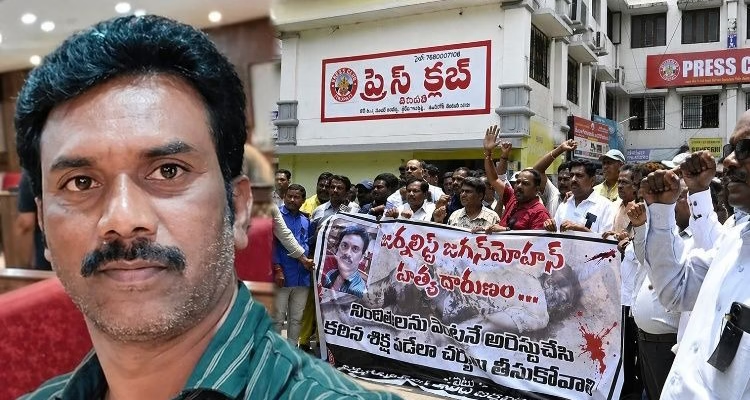
The Philippines lost Julio Calo (DNN News FM), RJ Nichole Ledesma (Paghimutad-Negros), and Nestor Micator (Empire Radio Station). India recorded the killing of Jaganmohan Reddy (ABN AndhraJyothy), Pakistan reported the murder of Lala Israfil Khan (HUM News), and Bangladesh lost Rana Pratap Bairagi (Dainik BD Khabar) to attacks by assailants during the period.
Overall, while the sharp decline in journalist killings during the first half of 2026 represents a positive trend, PEC stressed that the continuing violence, particularly in conflict zones, and the persistence of impunity remain serious threats to press freedom worldwide.