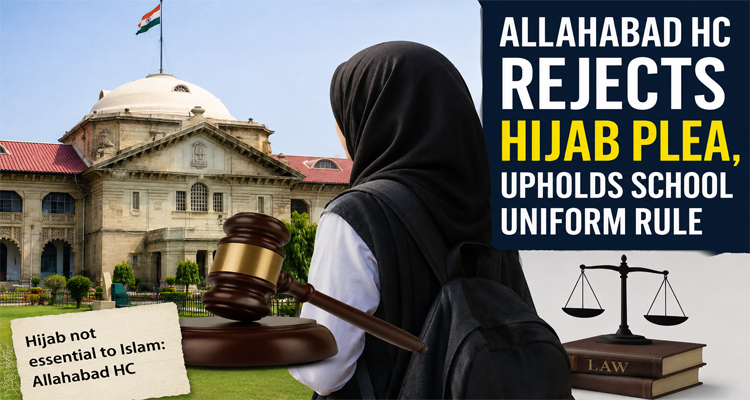
Prayagraj: The Allahabad High Court has dismissed a petition by a minor student seeking permission to wear a hijab or headscarf along with her prescribed school uniform, holding that an individual student cannot claim a right to modify a uniform based on personal preference.
A Division Bench of Justices J.J. Munir and Indrajeet Shukla, in its judgment delivered on August 21, also held that the petitioner had failed to place sufficient factual, legal or authoritative material before the court to establish that wearing a headscarf is an essential religious practice of Islam.
Student sought permission to wear headscarf
The petition was filed through the student’s mother. The girl, a student of Tagore Public School, Attarsuiya, Prayagraj, had completed Class X and was seeking admission to Class XI in the same institution.
BREAKING || Allahabad HC Dismisses Plea Seeking Hijab in School
– HC: Hijab not an essential part of Islam
– Minor girl had asked to wear hijab with uniform
– Plea filed through girl’s mother@WalterAdeeb shares more details with @akankshaswarups pic.twitter.com/wUYGE7L3Qe
— TIMES NOW (@TimesNow) August 25, 2026
She told the court that she had been wearing a headscarf since Class VI and sought permission to continue wearing it with the school’s prescribed uniform. Her plea relied on the argument that wearing the headscarf was an essential aspect of her religious practice.
The school, however, maintained that the headscarf was an addition to the prescribed uniform and that its dress code applied equally to students.
Court: Uniform cannot be altered at individual choice
The High Court examined photographs of the petitioner from different classes and observed that she appeared to be the only girl wearing a headscarf, including among students belonging to the same religious community.
The Bench said the petition contained only a bare assertion that wearing a headscarf was an essential religious practice and lacked the necessary factual and legal foundation to support the claim.
The court further observed that previous High Court decisions had taken the view that wearing a headscarf could not be treated as an essential part of Islamic faith in circumstances where its non-observance would jeopardise the person’s religious identity.
School’s authority over dress code upheld
A key aspect of the judgment was the court’s emphasis on institutional autonomy. It held that where a school’s uniform policy is uniform, bona fide, non-discriminatory and aimed at maintaining discipline and institutional identity, the choice and enforcement of the prescribed dress code primarily falls within the school’s domain.
The Bench noted that a school uniform is intended not merely to regulate clothing but also to promote discipline, equality among students and institutional identity, while reducing visible distinctions within the classroom.
The court also rejected the argument that the student’s earlier use of a headscarf, without objection from the school, created a permanent right to continue doing so. The fact that the school may not have strictly enforced its uniform policy in earlier classes did not, according to the judgment, prevent it from enforcing the dress code later.
Uniformity versus individual exemption
The High Court cautioned that permitting individual students to depart from a common uniform on subjective grounds could weaken the very purpose of having a uniform.
It observed that allowing students to decide individually which parts of a prescribed dress code they would follow could effectively shift control over institutional discipline from the school administration to individual students.
The judgment therefore focused on the validity and uniform enforcement of the school’s dress code, rather than creating an individual exemption for the petitioner.
The State Government and the Central Board of Secondary Education (CBSE) also opposed the petition.
The ruling adds to the continuing legal debate in India over religious attire in educational institutions. The Allahabad High Court also noted the persuasive value of the Karnataka High Court’s 2022 Full Bench ruling on the hijab issue, while acknowledging that the Supreme Court has not yet delivered a final authoritative ruling resolving the broader dispute.