
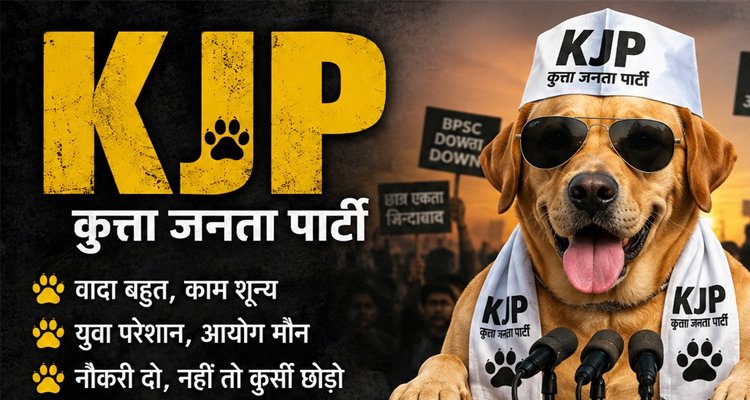
The name “Kutta Janta Party” (KJP) has recently begun appearing across social media, accompanied by political slogans, memes, reels and posts centred on dogs, loyalty, public issues and satire. But despite the political-party-style branding, available public information indicates that KJP should not be confused with a recognised mainstream political party or an established electoral organisation.
The emerging phenomenon appears to be primarily social-media driven, with different accounts using the KJP name and presenting it in varying ways—from dog-welfare advocacy to political humour and commentary on contemporary issues. One Instagram account describes itself as the “Official Account of Kutta Janta Party” and uses slogans including “Loyalty • Security • Biscuit Development” and “Har Gali Me Bhaukta Vikas.”
बीपीएससी के इस बयान का KJP निंदा करता है pic.twitter.com/qrDcbYiVua
— KUTTA JANTA PARTY (KJP) (@Anilkum09398354) August 24, 2026
What Is Kutta Janta Party?
Kutta Janta Party, popularly abbreviated as KJP, is an unconventional political-sounding brand built around the word kutta (dog). Its messaging uses the familiar qualities associated with dogs—loyalty, alertness, protection and street-level presence—to create a humorous political identity.
The concept has gained visibility through Instagram, Facebook, YouTube and other social-media platforms. Posts using the KJP name have promoted slogans such as “Wafadari hamari pehchan, seva hamara abhiyan” and presented the organisation as being focused on development and public service.
Another public Facebook page lists Kutta Janta Party KJP as a political-party category and describes its focus as dog welfare. The page is associated with Ludhiana, although that alone does not establish a formal organisational headquarters or nationwide political structure.
A Party Built Around Loyalty and Dog Welfare
The most distinctive feature of KJP’s branding is its attempt to turn the traditional political vocabulary of development, service and loyalty into a dog-themed campaign.
Its social-media messaging has included references to dog welfare and slogans portraying dogs as loyal and protective members of society. One account describes its position as being neutral and committed to showing the truth about political parties, while another KJP account promotes dog welfare.
This makes the phenomenon different from a conventional political party. Rather than being defined by a conventional ideology, legislative programme or established leadership structure, KJP’s appeal appears to lie largely in its satirical identity and highly shareable political language.
Why Has KJP Attracted Attention?
The rise of KJP comes at a time when social media has made it increasingly easy for political satire, parody organisations and meme-based movements to acquire an identity of their own.
The KJP name itself lends itself naturally to humour. Slogans about barking for development, loyalty and biscuits turn familiar political campaign language into comic content. Several Instagram posts have used phrases such as “Kutta Janta Party Jindabad” and hashtags around KJP, indicating that the name has developed a recognisable meme-style presence online.
A YouTube channel using the Kutta Janta Party name also describes itself as an effort to “bring smile on your face”, reinforcing the entertainment and satire dimension of at least some KJP-linked online activity.
KJP and the Politics of Memes
The rise of KJP also illustrates how political communication is changing.
Traditional political parties generally depend on leaders, party offices, workers, manifestos, election symbols and formal organisational structures. Online movements can operate very differently. A catchy name, a recognisable logo, a few slogans and viral short videos can create the appearance of a political organisation even when there is little evidence of a conventional party structure.
KJP fits into this broader meme-politics ecosystem, where humour is used to comment on political personalities, public problems and social debates.
Its name has also appeared in posts discussing Bihar and student issues. A social-media account identified as Kutta Janta Party (KJP) | Bihar has posted about teacher-recruitment examination issues, including demands concerning the TRE-4 examination, negative marking and transparency.
That suggests that at least some KJP-branded accounts are attempting to move beyond pure dog-themed humour into commentary on youth, examinations and governance.
Is Kutta Janta Party a Registered Political Party?
This is the most important distinction.
There is currently no reliable evidence in the sources reviewed for this report establishing Kutta Janta Party as a recognised political party of the Election Commission of India. Searches for the name did not produce authoritative Election Commission material establishing KJP as a recognised state or national party.
Therefore, it would be misleading to describe KJP simply as a conventional political party without qualification.
The available evidence instead points to multiple social-media accounts and pages using the Kutta Janta Party name, some associated with dog welfare, some with comedy or satire, and others with political commentary. The existence of an Instagram or Facebook account carrying the party name does not, by itself, establish legal registration as a political party.
Not to Be Confused With Other “Janta Party” Trends
The KJP phenomenon is also part of a wider recent trend of humorous or satirical political labels appearing online.
For example, “Cockroach Janta Party” (CJP) emerged separately in connection with student protests in 2026. Reports have described it as an online political-satire identity that became associated with youth protests and political commentary.
KJP should therefore not automatically be treated as an offshoot of CJP or any established political organisation. The similar “Janta Party” wording is not enough to establish an organisational connection.
The Political Meaning Behind the Joke
Despite its comic presentation, the KJP phenomenon reflects a serious change in the way younger internet users engage with politics.
Political communication is increasingly being expressed through memes, parody names, reels, slogans and deliberately exaggerated identities. Such formats can make political commentary more accessible and entertaining, particularly for audiences that may not engage with conventional party speeches or manifestos.
The KJP brand also taps into the cultural image of the dog as a symbol of loyalty and protection. Its slogans attempt to contrast these qualities with the negative perceptions often associated with conventional politics.
Whether such messaging can translate into sustained political participation, however, is a different question.
From Viral Brand to Political Force?
For KJP to evolve from a social-media phenomenon into a genuine political organisation, it would need much more than viral posts.
A formal political party would ordinarily require a clearly identifiable leadership structure, organisational network, stated policy positions, members or workers, financial and administrative arrangements, and—where applicable—registration and participation within India’s electoral framework.
At present, the public information available about KJP does not demonstrate such a nationwide structure.
Its strongest asset appears to be its unusual name and social-media appeal.
Why KJP Matters
The significance of Kutta Janta Party may therefore lie less in its current electoral strength—which cannot be established from available evidence—and more in what it says about India’s evolving political culture online.
A political label once required offices, cadres and rallies to gain recognition. Today, a memorable name can first emerge as a meme, attract followers through short videos and gradually become a vehicle for commentary on public issues.
KJP’s combination of dog welfare, loyalty-themed messaging, political satire and social-media activism makes it an unusual example of this trend.
For now, Kutta Janta Party is best described as a social-media political-satire/dog-welfare brand rather than an established or recognised electoral party, unless and until authoritative evidence demonstrates otherwise.
In short, KJP may be more “viral politics” than conventional politics—but its rise shows how humour, animals, memes and public grievances are increasingly converging in India’s digital political space.