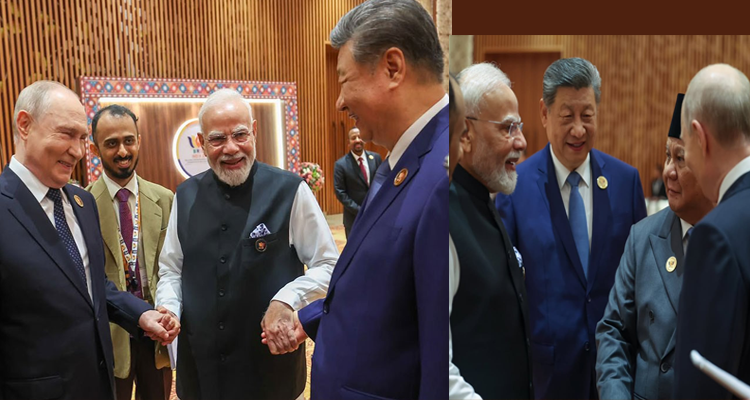
New Delhi: Prime Minister Narendra Modi, Chinese President Xi Jinping and Russian President Vladimir Putin shared a striking moment of camaraderie at the 18th BRICS Summit in New Delhi on Saturday, with the three leaders seen holding hands in a display that underscored the grouping’s emphasis on cooperation among major emerging economies.
The image from the summit quickly drew attention as leaders of the expanded BRICS grouping gathered in the Indian capital for the two-day summit on September 12-13. Prime Minister Modi shared photographs from the event, highlighting the participation of leaders from across the BRICS bloc.
The summit brings together leaders from the expanded grouping, including Brazil, Russia, India, China, South Africa, Egypt, Ethiopia, Indonesia, Iran and the United Arab Emirates. The grouping has grown considerably since its formation and now represents more than 40% of the world’s population and nearly a quarter of global GDP, according to Reuters.
Modi-Xi-Putin moment draws attention
The Modi-Xi-Putin interaction came against the backdrop of significant geopolitical shifts and efforts to strengthen cooperation within BRICS. Xi’s presence in New Delhi is particularly significant, marking his first visit to India in seven years.
Big Big Big 🔥🔥 Leaked conversation from Modi, Putin and Xi Jinping.
Such casual talks in midst of big global summit is unprecedented…🔥#Brics pic.twitter.com/O246vyPL7v
— Prashant Gopinath Menon (@PrasantGopinat) September 12, 2026
Modi and Xi also held bilateral talks on the sidelines of the summit, where they discussed improving economic and transport links, expanding business cooperation and maintaining peace along the India-China border. Modi stressed that peace and stability along the border are important for the further development of bilateral ties.
The meeting comes after years of strained relations following the 2020 Galwan Valley clash. While tensions have eased considerably since the 2024 disengagement process, important differences between the two countries remain.
Strong India-Russia engagement
Modi also met Putin on the sidelines of the BRICS Summit. According to the Prime Minister’s Office, the two leaders reviewed cooperation in political, economic, defence, energy, space, skill mobility and people-to-people ties.
The BRICS+ 2026 family photo in New Delhi: Putin, Modi and Xi take center stage pic.twitter.com/EKBiZdNQ7A
— Sputnik (@SputnikInt) September 13, 2026
They also discussed India-Russia engagement within BRICS under India’s 2026 chairship and exchanged views on conflicts in West Asia and the Black Sea region, particularly their impact on maritime trade and the safety of Indian seafarers. Modi reiterated India’s position that dialogue and diplomacy are essential for resolving conflicts.
Putin also invited Modi to Russia for the 24th India-Russia Annual Summit, an invitation the Indian Prime Minister accepted. The dates will be finalised through diplomatic channels.
West Asia conflict takes centre stage
The BRICS discussions are taking place against the backdrop of the continuing conflict in West Asia, the Russia-Ukraine war and mounting concerns over global economic and trade disruptions.
Chinese President Xi Jinping called on BRICS to play a peacemaking role in the West Asia conflict, arguing that the war does not serve the interests of the international community.
BRICS members also worked towards a consensus on a joint declaration addressing the conflict, with efforts focused on de-escalation, civilian protection, sovereignty and the protection of global trade and energy security.
India pushes practical BRICS cooperation
India is using its 2026 BRICS chairship to push for a more practical and forward-looking agenda, with emphasis on resilience, innovation, cooperation and sustainability. The Ministry of External Affairs’ diplomatic training programme under the chairship has identified political and security, economic and financial, and cultural and people-to-people exchanges as the three core pillars of BRICS cooperation.
New Delhi is also seeking greater cooperation on global governance reform, economic development, technology, trade, connectivity and issues affecting the Global South.
The summit therefore carries significance beyond the symbolism of the Modi-Xi-Putin photograph. The challenge for BRICS is to translate its growing geopolitical weight and increasingly diverse membership into concrete cooperation despite differences among its members on security, trade and foreign policy.
With India hosting the summit, New Delhi is seeking to position BRICS as a stronger platform for dialogue among emerging economies and as an important voice in discussions on the evolving global order.