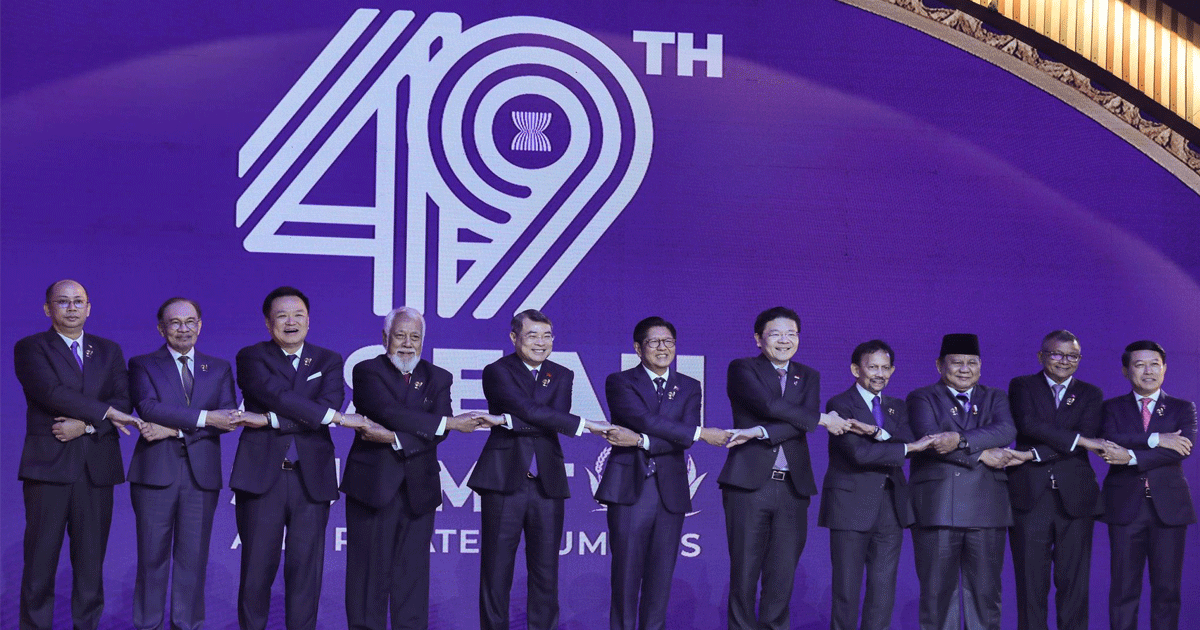
Manila: The 49th Association of Southeast Asian Nations (ASEAN) Summit opened in Manila on Sunday, bringing together regional leaders and major global powers at a time of mounting geopolitical tensions, economic uncertainty and intensifying strategic competition in the Indo-Pacific.
Hosted by the Philippines under President Ferdinand Marcos Jr., the three-day summit is drawing international attention with the expected participation of Indian Prime Minister Narendra Modi, US President Donald Trump and Brazilian President Luiz Inácio Lula da Silva. Their presence underscores ASEAN’s growing importance as a diplomatic and economic platform amid a rapidly changing global order.
The Philippines, which holds the ASEAN chairmanship for 2026, has chosen the theme “Navigating Our Future, Together”, highlighting the need for regional unity, economic resilience and stronger international cooperation. The summit is scheduled to conclude on November 17, when Singapore will assume the rotating chairmanship.
📹 ‘Geopolitical Tensions Are Reshaping Our Region’: Philippine President Marcos Opens 49th ASEAN Summit In Manila
“Geopolitical tensions, economic uncertainty, new technologies, climate change, and transnational threats are reshaping our region faster than any one country can respond to alone,” Marcos warned.
Recalling disruptions caused by developments in the Middle East, he said it was “precisely the moment for ASEAN to come together to forge a decisive response.”
📹 ASEAN Philippines 2026
— RT_India (@RT_India_news) November 15, 2026
Myanmar crisis and South China Sea tensions in focus
Regional security is expected to dominate the discussions, particularly the continuing political and humanitarian crisis in Myanmar and escalating tensions in the South China Sea.
More than five years after Myanmar’s military takeover in February 2021, ASEAN’s efforts to restore peace through its Five-Point Consensus have made limited progress. Persistent violence, political instability and the worsening humanitarian situation remain major challenges for the organisation.
The South China Sea dispute presents another serious test. The Philippines and several other ASEAN members have competing maritime claims with China, raising concerns over freedom of navigation, regional stability and the possibility of military confrontation. Efforts to establish a binding Code of Conduct between ASEAN and China remain an important diplomatic priority.
Modi’s participation to strengthen India’s Act East Policy
Prime Minister Narendra Modi is scheduled to participate in the summit on November 16, reinforcing India’s strategic engagement with Southeast Asia.
For New Delhi, ASEAN is central to its Act East Policy and broader Indo-Pacific vision. India’s priorities include expanding trade and investment, strengthening maritime security and defence cooperation, improving regional connectivity and deepening collaboration in digital technology, energy and critical supply chains.
Modi’s engagement with ASEAN leaders will also be significant amid growing strategic competition between Washington and Beijing. India has consistently supported a free, open, inclusive and rules-based Indo-Pacific, while seeking stronger economic and security partnerships with Southeast Asian countries.
The wider diplomatic engagements in Manila, including discussions involving the Quad partners, could further strengthen India’s regional strategic position.
Trump and Lula add global significance
US President Donald Trump is expected to arrive on November 17 to participate in the ASEAN-US Special Summit. His presence is likely to draw considerable attention, particularly over Washington’s security commitments, trade policies and approach towards China’s expanding influence in the Indo-Pacific.
For Southeast Asian countries, maintaining strong economic ties with the United States while managing their extensive trade and diplomatic relations with China remains a delicate balancing act.
Brazilian President Luiz Inácio Lula da Silva has already arrived in Manila, marking a significant expansion of diplomatic engagement between Brazil and the Philippines. His visit is expected to strengthen cooperation in agriculture, livestock, trade and other areas. His participation also reflects ASEAN’s growing outreach beyond the Indo-Pacific region.
Canadian Prime Minister Mark Carney is another prominent international participant, highlighting the growing interest of Western economies in strengthening partnerships with Southeast Asia.
Digital economy and energy security on agenda
Apart from geopolitical concerns, the summit is expected to focus on economic resilience, digital transformation, energy security, climate challenges and regional supply chains.
The proposed ASEAN Digital Economy Framework Agreement is an important initiative aimed at facilitating cross-border digital trade, electronic payments, data connectivity and technology cooperation among member countries.
Artificial intelligence, advanced manufacturing, critical minerals and renewable energy are also emerging as important areas of regional cooperation. Disruptions in global supply chains, energy-market volatility and international trade uncertainties have made economic diversification and regional integration increasingly important.
ASEAN faces a crucial test of unity
The Manila summit comes at a defining moment for ASEAN. Despite its growing economic influence and strategic importance, the organisation continues to face internal differences over China, Myanmar and regional security.
Its challenge is to maintain unity and strategic autonomy without becoming a battleground for competing global powers. The presence of leaders from India, the United States, Brazil, China and other major economies provides an opportunity to expand cooperation, but also exposes the difficult geopolitical choices confronting the region.
Ultimately, the success of the summit will depend not merely on high-profile participation or diplomatic declarations, but on whether ASEAN can translate discussions into concrete action on regional security, economic integration and political stability.
As global power equations continue to shift, ASEAN’s ability to preserve its unity and centrality in the Indo-Pacific will remain critical to the emerging international order.