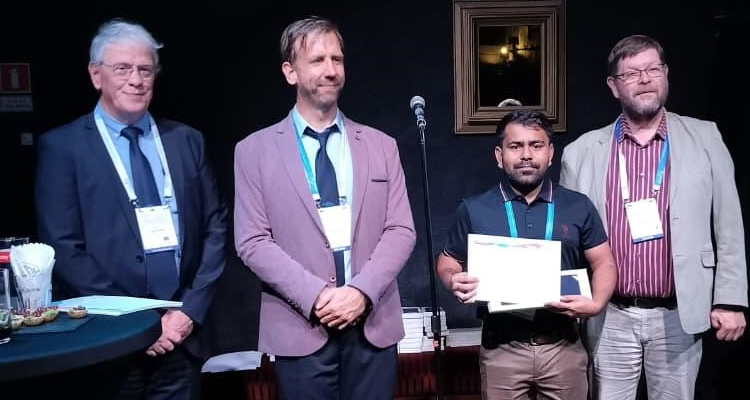
Ranchi: Nitish Kumar, a researcher in the Department of Remote Sensing and Geoinformatics at Birla Institute of Technology, Mesra (BIT Mesra), has been honoured with the Young Scientist Award (YSA) at the URSI General Assembly and Scientific Symposium (GASS) 2026 in Krakow, Poland, for his research on the Moon’s icy craters using data from India’s Chandrayaan-2 mission.
Kumar received the international recognition for his study, “Analysis of Ejecta from an Icy Crater using Chandrayaan-2 Dual-Frequency Synthetic Aperture Radar.” The research examines ejecta—material thrown out during crater formation—from an icy crater in the Moon’s south polar region.
The study uses dual-frequency Synthetic Aperture Radar (SAR) observations and advanced polarimetric parameters from Chandrayaan-2 to analyse the composition and characteristics of crater-associated ejecta. The work demonstrates how radar remote sensing can provide valuable insights into the lunar surface and support planetary exploration, particularly in regions where conventional optical observations face limitations.
The research was carried out under the guidance of Principal Investigator Dr V. S. Rathore and Co-Principal Investigator Dr A. P. Krishna as part of the Chandrayaan-2 research programme.
The award also underscores the growing international reach of the research, with Kumar developing collaboration with Dr Ajit Kumar of RaS Lab, CNIT, Italy, in advanced radar remote sensing and planetary exploration.
Kumar’s recognition at URSI GASS 2026 highlights the growing contribution of young Indian researchers to global space science and demonstrates the potential of SAR technology, polarimetric analysis and remote sensing in advancing the study of the Moon and other planetary bodies.