
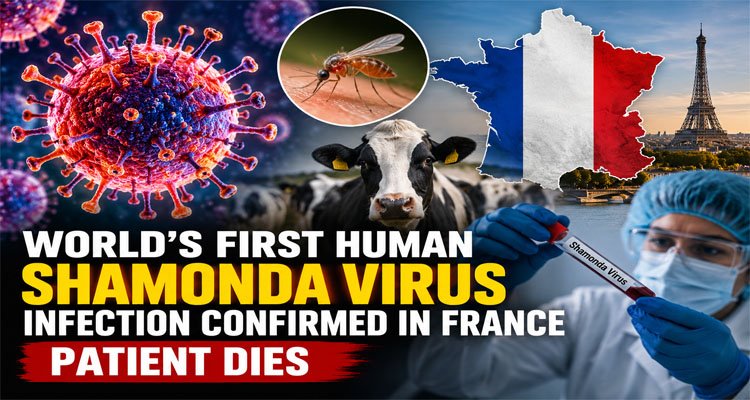
News Desk: France has confirmed the world’s first reported human infection with the Shamonda virus, a pathogen previously known to primarily affect animals, particularly cattle. The infected patient died in early October, prompting health authorities to investigate the circumstances of the infection and determine whether the virus contributed to the death.
The case has raised fresh concerns among scientists and public-health officials about the potential for animal-associated viruses to infect humans. However, the precise cause of the patient’s death remains uncertain, and authorities have not established whether the Shamonda virus was directly responsible.
According to reports, the patient had an underlying serious illness that may have increased their vulnerability. Investigations are continuing to establish how the infection occurred and assess its possible implications for public health.
French health authorities said they had detected the Shamonda virus usually affecting livestock in a human for the first time in a patient who later died, while adding that they saw no risk to the general population at this stage. https://t.co/kMJoHA3Df6 https://t.co/kMJoHA3Df6
— Reuters Health (@Reuters_Health) October 22, 2026
Authorities Assess Potential Public Health Risk
French health authorities, in coordination with European public-health agencies, are examining the case to determine the source of the infection and whether any additional human cases have occurred.
The leading hypothesis is that the patient acquired the infection in eastern France, where the virus had been detected in animals during the spring and summer of 2026.
Authorities have not identified evidence of sustained human-to-human transmission. The confirmation of a single human infection does not, by itself, indicate that the virus can spread readily between people or poses an immediate widespread threat.
Further investigations are expected to clarify the transmission route and the level of risk to the general population.
What Is the Shamonda Virus?
The Shamonda virus belongs to the Orthobunyavirus group and was first identified in Nigeria in the 1960s. Before the French case, it was primarily associated with infections in animals, particularly cattle.
The virus is linked to biting midges belonging to the genus Culicoides, which can transmit certain infections between susceptible animals. It has also been detected in other species, including sheep, goats, horses and alpacas.
The virus attracted renewed attention in 2026 after infections were identified in livestock across parts of Europe, including France, Germany and Switzerland.
Its detection in European herds prompted veterinary investigations and genomic studies to better understand the emerging viral lineage, its geographical distribution and its potential effects on animal health.
Virus Linked to Reduced Milk Production in Cattle
The emergence of the Shamonda virus in European livestock has raised concerns among farmers and veterinary experts.
Affected cattle have reportedly shown symptoms such as fever, diarrhoea, lethargy and a decline in milk production. The severity of the symptoms has varied across herds.
A scientific study published in Eurosurveillance in August 2026 documented the detection of a European Shamonda virus lineage in affected cattle in France. Investigations across nine dairy herds recorded reductions of between 15% and 75% in overall milk production, although the impact differed from farm to farm.
Researchers have also investigated possible links between the virus and reproductive problems in livestock, including abortions. Further research is needed to establish the full range of clinical effects and the long-term consequences for affected animals.
How Is the Shamonda Virus Transmitted?
Shamonda virus is associated with the bites of infected Culicoides midges. Its established transmission patterns have primarily involved animals.
The route through which the French patient became infected has not yet been conclusively established. Investigators are examining the patient’s exposure history and other circumstances that could help explain the infection.
The case is significant because it represents the first reported confirmation of the virus in a human. However, scientists will need additional evidence to determine how frequently such infections might occur, whether particular individuals face a higher risk and whether any other routes of transmission are possible.
A confirmed human infection should not automatically be interpreted as evidence of an emerging epidemic. The scale of the risk depends on further epidemiological findings.
No Commercial Vaccine Available
There is currently no commercially available vaccine against the Shamonda virus. Measures to reduce exposure to biting midges remain important for protecting livestock in affected areas.
Veterinary surveillance, insect-control measures and monitoring of suspected infections can help authorities track the virus and limit its impact on animal health.
The newly reported human case has added another dimension to these efforts, making it important for researchers to examine the virus’s potential to infect people and assess any implications for public-health preparedness.
What Happens Next?
The investigation in France is expected to focus on the origin of the infection, the patient’s exposure history and the possible contribution of the virus to the fatal outcome.
Researchers will also need to assess whether the case was an isolated event or whether additional human infections have gone undetected. Continued surveillance of livestock and potential insect vectors will be important in understanding the virus’s circulation.
For now, the available information does not establish sustained human-to-human transmission or a widespread public-health threat.
The confirmation of the first reported human Shamonda virus infection is nevertheless an important development in infectious-disease surveillance. Further scientific evidence will be essential to determine the virus’s implications for human health and whether additional precautions are warranted.