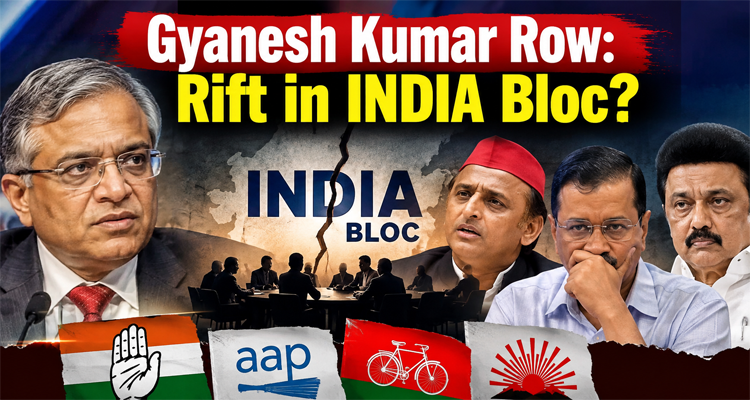
News Desk: The Opposition INDIA bloc’s efforts to build a coordinated response to the Election Commission controversy have been accompanied by fresh signs of differences within the broader opposition camp. Several opposition parties met in New Delhi on Wednesday to discuss the Special Intensive Revision (SIR) of electoral rolls and demands for action against Chief Election Commissioner Gyanesh Kumar, but the absence of the Aam Aadmi Party (AAP) and Dravida Munnetra Kazhagam (DMK), along with Samajwadi Party chief Akhilesh Yadav’s decision to stay away, has drawn attention to the bloc’s internal coordination.
The meeting comes against the backdrop of an investigative report by The Indian Express that said Election Commissioners Sukhbir Singh Sandhu and Vivek Joshi had formally raised objections at least 14 times over a 10-month period regarding decisions connected with electoral rolls and the SIR exercise. The report has triggered a political controversy over the functioning and decision-making process of the three-member Election Commission.
AAP stays away but backs action against CEC
The AAP decided not to attend the meeting. However, its absence does not amount to a rejection of the Opposition’s proposed action against Gyanesh Kumar. According to reports, AAP has agreed to support a proposed notice seeking the CEC’s removal. The party, along with the DMK, has continued to coordinate with opposition parties on specific issues concerning the Election Commission and SIR despite distancing itself from the INDIA bloc’s formal meetings.
#WATCH | Delhi: On INDIA Bloc meeting, AAP MP Sanjay Singh says, “Aam Aadmi Party has already made it clear that we are not a part of the INDIA alliance. So, there is no point in attending such a meeting, and secondly, as far as the impeachment is concerned, we have already… pic.twitter.com/EsRoMJJPLz
— ANI (@ANI) September 29, 2026
This distinction is significant because the Opposition’s immediate objective is broader than participation in a single alliance meeting. Parties are seeking to coordinate their response to the SIR exercise and the allegations concerning the Election Commission’s internal functioning.
DMK keeps its distance from INDIA bloc
The DMK has also stayed away from Wednesday’s meeting. The party’s relationship with the Congress has deteriorated following political developments in Tamil Nadu, and DMK leaders have indicated that they no longer regard themselves as part of the INDIA bloc in its earlier form.
At the same time, the DMK remains opposed to the BJP on several political issues and has continued to cooperate with opposition parties on specific matters, including the Election Commission controversy. Both AAP and DMK had also joined opposition parties in raising concerns over the EC and SIR in an earlier communication to the Chief Justice of India.
I.N.D.I.A. Bloc Huddle
Opposition leaders meet at Constitution Club to discuss action against CEC Gyanesh Kumar over alleged SIR irregularities.
But questions over Opposition unity intensify as the DMK skips the meeting, while Akhilesh Yadav sends SP representatives. AAP and… pic.twitter.com/tfBAYfLVBi
— TIMES NOW (@TimesNow) September 30, 2026
Akhilesh Yadav absent, SP sends representative
Another notable absence was that of Samajwadi Party president Akhilesh Yadav. The SP chief did not attend the meeting because of pre-scheduled political engagements linked to the Rajya Sabha elections in Uttar Pradesh. The party, however, sent a representative, allowing it to participate in the discussions.
Yadav’s absence has nevertheless attracted political attention because the Samajwadi Party is a major opposition force in Uttar Pradesh and has been vocal on the SIR issue. His absence also comes at a time when relations between the SP and Congress remain an important factor in opposition coordination in the state ahead of the 2027 Assembly elections.
Reports have therefore raised questions about whether the absence was purely schedule-related or also reflected broader differences within the opposition. However, there is no definitive evidence that Yadav’s decision was intended as a political boycott; the SP has cited his prior engagements and sent a representative to the meeting.
Not a complete Opposition boycott
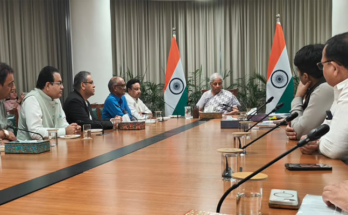
Despite the absences, Wednesday’s meeting cannot be described as a wholesale boycott. Congress, Trinamool Congress, Rashtriya Janata Dal, National Conference, Left parties, Nationalist Congress Party (Sharadchandra Pawar) and Shiv Sena (UBT), among others, participated or were represented. Uddhav Thackeray was expected to join virtually, while several senior opposition leaders attended in person.
Reports after the meeting said representatives of 19 opposition parties participated and discussed a common response to the Election Commission controversy. The discussions included demands relating to SIR, electoral-roll transparency and the proposed action against the CEC.
Gyanesh Kumar issue at the centre
The controversy surrounding Gyanesh Kumar has intensified following the reported objections by the two other Election Commissioners. The Indian Express reported that the objections involved issues such as voter registration, deletion and restoration of names, changes to Form 6 and the handling of electoral-roll data.
The Election Commission, however, has defended its functioning and maintained that its decisions have followed established procedures. Reuters reported that the Commission described internal disagreements as part of institutional decision-making, while it has also initiated a review of voter-roll software following concerns raised over the electoral-roll revision process.
The issue has also acquired a legal dimension. The Supreme Court has agreed to hear a petition challenging the functioning of the CEC and the legality of the SIR process, with the petition raising questions about collective decision-making within the Election Commission.
Opposition seeks coordinated strategy
For the participating opposition parties, the immediate challenge is to convert their separate objections to SIR and the Election Commission into a coordinated political and parliamentary campaign. The meeting was expected to consider a fresh motion seeking Kumar’s removal, along with a joint programme over the electoral-roll revision issue.
The developments underline a complicated picture for the INDIA bloc. While a substantial group of opposition parties is continuing to coordinate against the Election Commission on SIR and related issues, some former or current constituents are maintaining greater distance from the bloc’s joint meetings.
Thus, the Gyanesh Kumar controversy has produced both coordination and visible differences within the Opposition. AAP and DMK have indicated willingness to cooperate on specific action against the CEC despite skipping the meeting, while the SP participated through a representative rather than through Akhilesh Yadav himself. The extent to which these issue-based alliances can translate into sustained coordination will remain an important factor in the Opposition’s strategy on electoral reforms and the SIR controversy.