India’s Permanent UNSC Seat Bid Gets Strong Backing from V4 Nations – Hungary, Poland, Slovakia, Czech Republic
New York: India’s long-standing campaign for a permanent seat on the United Nations Security Council has received a fresh diplomatic boost, with Hungary, Poland, Slovakia and the Czech Republic jointly backing New Delhi’s bid.
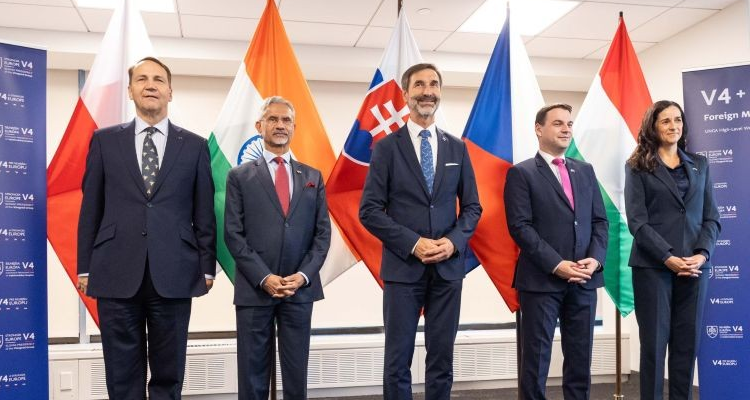
The support came during the first Visegrád Group (V4)-India foreign ministers’ meeting, held on the sidelines of the 81st session of the UN General Assembly in New York. Slovak Foreign Minister Juraj Blanár said the four V4 countries agreed that India, as a major country of the Global South and an emerging power in the Indo-Pacific, should have a permanent place on the Security Council.
The endorsement adds four more European voices to India’s campaign for restructuring the UN’s most powerful decision-making body.
‘India must be at the table’
Blanár made the position of the four countries clear after meeting External Affairs Minister S. Jaishankar. He said the V4 countries collectively support India becoming a permanent member of the Security Council.
Jaishankar described the inaugural V4-India meeting as a “new historic occasion” and said the countries had agreed to strengthen political, economic, technological, defence and people-to-people cooperation. The two sides also agreed to hold annual foreign ministers’ meetings and establish an annual business forum.
The V4 comprises Poland, Hungary, Slovakia and the Czech Republic.
‘We all agree as V4 countries that India as a part of the Global South, upcoming superpower in the Indo-Pacific region, must be at the table as the permanent member of the UN Security Council’
– Foreign Minister Juraj Blanár of Slovakia after the first V4 + India FMM #UNGA81… pic.twitter.com/QwFsjlXWYC
— Dr. S. Jaishankar (@DrSJaishankar) September 21, 2026
India’s case for a permanent seat
India has repeatedly argued that the structure of the Security Council no longer reflects present-day geopolitical realities. The Council was established in 1945 with five permanent members — China, France, Russia, the United Kingdom and the United States — while the remaining 10 members are elected for two-year terms. The five permanent members possess veto power.
New Delhi argues that Asia, Africa and Latin America remain inadequately represented in the Council’s permanent membership. India has also highlighted its population, economic weight, diplomatic role and longstanding contribution to UN peacekeeping as part of its case.
India has served as an elected Security Council member eight times, most recently in 2021-22. It has also formally advocated expansion in both the permanent and non-permanent categories.
European support gathering
The latest V4 endorsement comes on top of support India has received from several major powers. France has repeatedly backed India’s permanent membership, while the UK has also supported an expansion that includes India. The United States and Russia have likewise expressed support for India’s permanent membership.
France reiterated its commitment to Security Council reform during a September 21 meeting between French Foreign Minister Jean-Noël Barrot and Jaishankar, with both sides reaffirming their determination to pursue a reformed and effective multilateral system.
Slovakia has separately stated in UN intergovernmental negotiations that it supports expansion involving new permanent members and specifically backs Brazil, Germany, India and Japan, the four members of the G4 grouping.
G4 pushing for wider reform
India is part of the G4, along with Brazil, Germany and Japan. The four countries support each other’s bids for permanent membership and have called for comprehensive Security Council reform.
India has maintained that simply adding more elected members would not adequately address the Council’s representation problem. Its position calls for expansion of both permanent and non-permanent membership, with greater representation for developing regions.
The Permanent Mission of India to the UN has argued that the present structure, designed more than eight decades ago, does not adequately reflect contemporary geopolitical realities and has identified both membership and veto arrangements as central elements of the reform debate.
Support does not mean immediate membership
Despite the growing number of countries backing India, securing a permanent seat remains a complicated diplomatic process.
Any substantial expansion of the Security Council would require agreement among UN member states and an amendment to the UN Charter. There are continuing differences over the number of new seats, their geographical distribution and whether new permanent members should receive veto powers.
The five existing permanent members also have different positions on the details of reform. China, in particular, has not given the same explicit support for India’s permanent membership as the other four permanent members, according to recent reporting.
For New Delhi, therefore, the latest V4 endorsement is a diplomatic gain rather than a final breakthrough. But with four more European countries now publicly supporting India’s candidature, the demand for a Security Council that gives greater representation to today’s global powers has gained another layer of international backing.