Indigenous 1,000-km kamikaze UAV draws interest from Gulf nations, signalling India’s growing clout in the global arms market
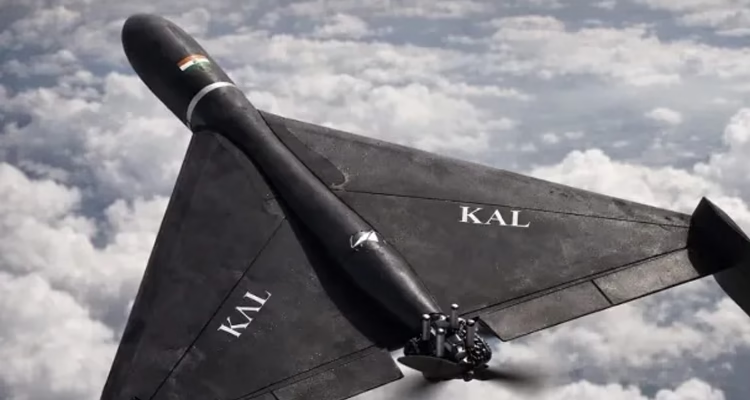
New Delhi: After the global success of the BrahMos supersonic cruise missile, India may be on the verge of adding another indigenous weapon to its export portfolio. The KAL long-range attack drone, a homegrown kamikaze unmanned aerial vehicle (UAV) developed by Noida-based IG Defence, has begun attracting interest from Gulf countries, raising hopes that it could become India’s next major defence export.
The growing international attention comes as India pushes to establish itself as a leading defence manufacturing hub under the Atmanirbhar Bharat initiative. If export negotiations culminate in formal contracts, KAL could mark India’s entry into the lucrative global market for long-range loitering munitions—one of the fastest-growing segments of modern warfare.
India’s First Indigenous 1,000-km Attack Drone
Designed as a one-way attack drone, or loitering munition, KAL is built to strike high-value military targets deep inside hostile territory with precision. Unlike conventional UAVs that return to base, the drone destroys itself on impact after completing its mission, making it an effective and relatively low-cost precision-strike platform.
According to the developer, KAL boasts an operational range of 1,000 km, an endurance of seven to eight hours, and can carry a 50-kg high-explosive warhead. Weighing around 200 kg, the drone cruises at nearly 160 kmph, reaches speeds of 200 kmph, and can operate at altitudes of up to 5,000 metres.
Its long reach enables it to target enemy command centres, radar installations, air-defence systems, logistics hubs and other strategic assets far behind the frontline.
Built in India, Designed for Modern Warfare
Developed entirely with indigenous technology, KAL reflects India’s rapidly growing expertise in advanced unmanned combat systems. The drone integrates multi-band GNSS navigation with an Inertial Navigation System (INS), backed by anti-jamming CRPA antenna technology, allowing it to operate even in contested electronic warfare environments.
It also features encrypted communications, autonomous mission planning and multiple launch configurations, including vehicle-mounted and rocket-assisted deployment, making it adaptable to diverse operational scenarios.
The system has been designed for high reliability, precision targeting and mission flexibility across different terrains and battlefield conditions.
Export Interest Builds
IG Defence has confirmed that discussions are underway with several Gulf nations for the possible export of the drone. While no agreement has yet been announced, the company says the platform has completed development and is ready for overseas markets, subject to approvals from the Government of India.
The timing is significant. Recent conflicts in West Asia and Eastern Europe have underscored the growing importance of long-range autonomous strike drones, prompting many countries to seek affordable alternatives to expensive cruise missiles and manned combat aircraft.
A New Chapter in India’s Defence Exports
India’s defence export story has been dominated by the BrahMos missile, now supplied to friendly foreign nations and regarded as one of the country’s biggest strategic export achievements.
KAL has the potential to open an entirely new export category for India. As indigenous drone technology matures and private-sector innovation accelerates, the country is emerging as a credible supplier of advanced unmanned combat systems alongside missiles, artillery and armoured platforms.
India has already developed several indigenous loitering munitions, including Nagastra-1 and Sheshnaag-150, reflecting the rapid evolution of its domestic drone ecosystem.
Strategic Significance
Beyond its technical capabilities, KAL represents India’s broader ambition to transition from being one of the world’s largest arms importers to becoming a major exporter of cutting-edge defence technologies.
Should international orders materialise, the indigenous kamikaze drone could follow the trail blazed by BrahMos—strengthening India’s defence diplomacy, boosting indigenous manufacturing and enhancing its standing in the rapidly expanding global market for autonomous weapon systems.