- Modi Builds Global Partnerships as Trump’s America Becomes Less Predictable: NYT
PM Modi is diversifying India’s global partnerships as Trump-era tariffs and geopolitical uncertainty test US-India ties, The New York Times reports.

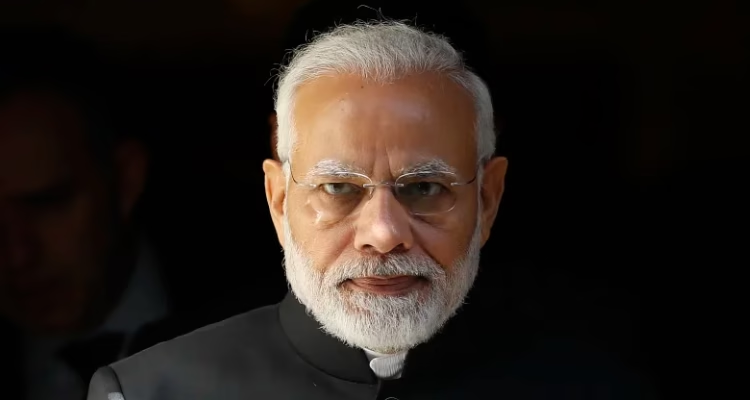
Prime Minister Narendra Modi is quietly widening India’s global economic and strategic options as ties with US President Donald Trump become increasingly unpredictable, according to a recent New York Times report.
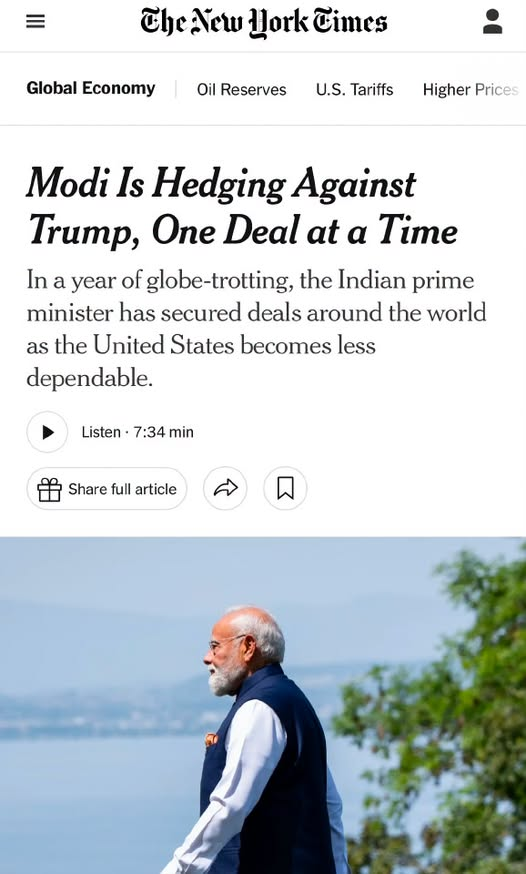
The report, “Modi Is Hedging Against Trump, One Deal at a Time,” says India has accelerated diplomatic and economic engagement with Europe, Asia, the Middle East and other strategic partners, pursuing a series of agreements aimed at strengthening trade, defence, technology, energy security and critical supply chains.
The approach reflects a broader effort by New Delhi to reduce its vulnerability to sudden shifts in US policy while preserving its important relationship with Washington. Trump’s tariff policies, pressure over India’s Russian oil purchases and disagreements over issues such as the India-Pakistan conflict have introduced fresh uncertainty into bilateral ties.
Modi corre o mundo e blinda a Índia em relação a Trump. Matéria no New York Times. pic.twitter.com/mfOrgPuN7m
— Dawisson Belém Lopes (@dbelemlopes) August 30, 2026
Deals become the new diplomatic currency
According to the NYT, Modi’s recent overseas engagements have increasingly focused on concrete economic and strategic outcomes. India has expanded cooperation with countries including France, Germany, South Korea, the United Kingdom, Norway and New Zealand, while also seeking stronger partnerships across the Indo-Pacific and Europe.
The long-awaited India-EU trade agreement represents one of the most significant developments. After years of negotiations, the pact is expected to deepen market access and strengthen economic ties between India and the European bloc.
India has also strengthened its relationship with France in areas including artificial intelligence, technology and defence, while South Korea has emerged as an important partner in shipbuilding and investment.
Energy security adds urgency
India’s push for diversified partnerships has gained added importance amid geopolitical tensions affecting global energy supplies. The instability surrounding Iran and the Strait of Hormuz has highlighted the risks faced by countries heavily dependent on energy imports.
New Delhi is therefore seeking greater flexibility in securing energy, technology and critical resources, while maintaining its longstanding strategic relationship with Russia.
Not anti-US, but less dependent on the US
The strategy does not necessarily signal a retreat from Washington. Rather, it reflects India’s traditional pursuit of strategic autonomy—maintaining relationships with competing powers while avoiding excessive dependence on any one of them.
The NYT report suggests that Modi’s government is effectively creating more diplomatic and economic room for manoeuvre. Stronger ties with Europe and Asian powers can provide India with alternatives when disagreements emerge with the United States.
For India, the calculation is straightforward: Washington remains an important partner, but it should not be the only option.
As Trump’s second presidency reshapes the global trade and geopolitical landscape, Modi’s answer appears to be a broader network of partnerships—one deal at a time.