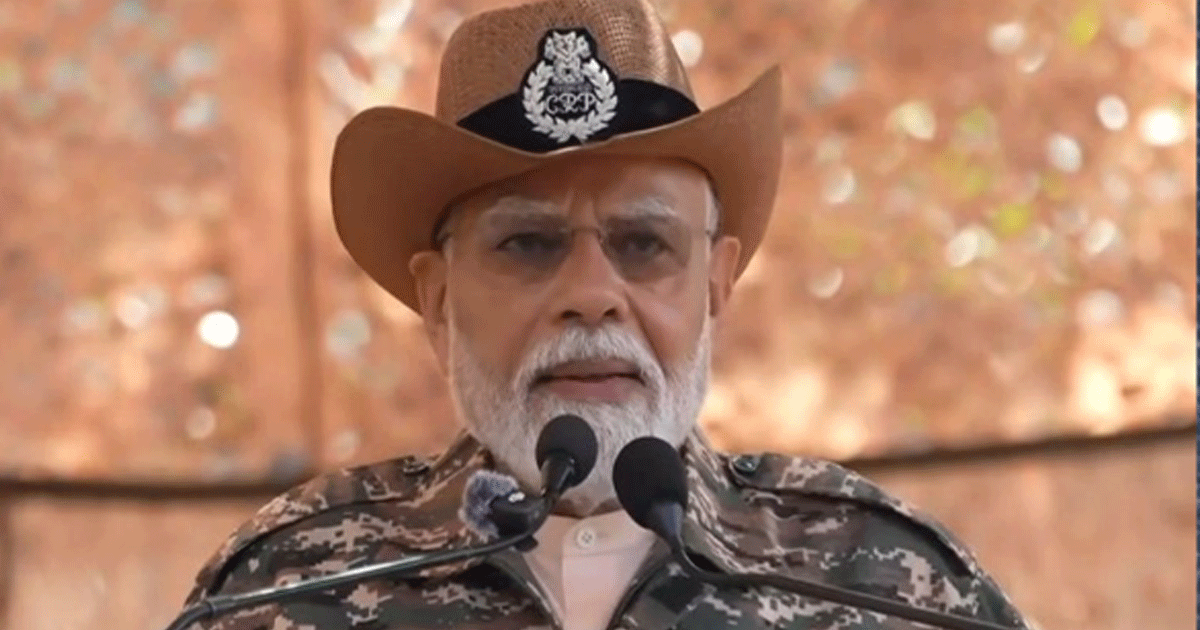
Bastar (Chhattisgarh): Prime Minister Narendra Modi on Sunday celebrated Diwali with security personnel at the CoBRA Operations Base in Karanpur, Bastar, declaring that India had won its decades-long battle against armed Naxalism but warning that the ideological challenge remained.
Addressing personnel engaged in anti-Maoist operations, Modi said that although armed Naxalites had disappeared from the forests, what he described as ‘dimagi Naxals’ had established influence in several organisations and political parties.
“Armed Naxalites have been eliminated, but the threat is not over yet. They are still instigating people against the country’s Constitution and democracy. We must identify and defeat such elements to secure the nation,” he said.
The Prime Minister’s remarks brought the issue of ideological Naxalism back into the national political debate. He had also used the expression ‘dimagi Naxals’ during his Independence Day address earlier this year.
First Diwali After the Declared End of Naxalism
Describing Diwali 2026 as particularly significant, Modi said it was the first festival of lights since the country had overcome its decades-old challenge of Naxalism and Maoist violence.
He asserted that every district in the country was now free from Naxalism and credited the achievement to the sacrifices, determination and operational efforts of security personnel.
The government had declared the country free from Naxalism on March 31, 2026, following intensified security operations, the elimination of senior Maoist leaders, arrests and large-scale surrenders.
A very special Diwali with our brave security forces in Bastar, Chhattisgarh. https://t.co/7I5aOQdMSk
— Narendra Modi (@narendramodi) November 8, 2026
The Prime Minister said he had chosen to celebrate Diwali with the security forces to express gratitude on behalf of 140 crore Indians for their dedication and sacrifices.
The Karanpur CoBRA base served as an important training centre and operational launchpad for counter-Naxal operations in Bastar and Abujhmad, areas that were once considered major Maoist strongholds.
Government Credits Security Forces for Changing Situation
Recalling the history of Maoist violence, Modi said Left-Wing Extremism had once affected more than 230 districts across nearly 20 states. He referred to the thousands of villages that had experienced violence, restrictions on daily life and disruptions to democratic activities.
He also recalled the deadly Dantewada attacks of 2010, in which 76 CRPF personnel were killed in one attack, while another attack claimed the lives of 44 civilians.
According to the Prime Minister, the security situation began changing significantly after 2014, with the government adopting a more comprehensive strategy involving security operations, intelligence gathering and measures to disrupt Maoist financial networks.
He further claimed that, for the first time in 47 years, not a single CRPF personnel had lost their life while on duty during the preceding year, describing it as a major achievement for the country’s security establishment.
Modi said security forces had been given operational freedom to take necessary decisions while maintaining the larger objective of preventing further loss of innocent lives.
Funding Networks and Supply Chains Targeted
The Prime Minister said the government had taken several tough decisions to weaken the financial and operational foundations of Maoist organisations.
He claimed that action against Naxalite and separatist funding networks, the dismantling of fake currency channels and disruption of supply lines had restricted the movement of weapons and recruitment of cadres.
According to Modi, the strategy was not limited to security operations but also aimed at ensuring that young people in affected regions did not take up arms.
He said the government’s objective had been to ensure that no mother lost her child, no family was destroyed by violence and no young person was deprived of a future because of Maoist extremism.
Development Push in Former Maoist Strongholds
Highlighting the development initiatives undertaken in Left-Wing Extremism-affected areas, Modi said the government had simultaneously pursued infrastructure expansion and welfare programmes.
He cited the construction of more than 15,000 kilometres of roads, installation of over 9,500 mobile towers, establishment of nearly 175 Eklavya Model Residential Schools, around 50 Industrial Training Institutes and 50 Skill Development Centres.
He said improved connectivity, education, banking facilities, healthcare and access to government welfare schemes had helped transform the lives of people in remote tribal areas.
Referring to the Bastar Olympics, the Prime Minister said the region’s young generation was increasingly turning towards sports and development rather than violence.
He described this transformation as evidence that restoring security and creating economic opportunities must go hand in hand.
Poverty Reduction and Vision for a Developed India
Linking the fight against Naxalism with economic development, Modi also referred to a recent World Bank report, claiming that around 50 crore Indians had moved out of extreme poverty over the past 12 years.
He highlighted initiatives such as Jan Dhan, PM Awas Yojana, Mudra loans, Ayushman Bharat, free foodgrain distribution and the Swachh Bharat Mission, saying these programmes had helped improve living conditions among economically weaker sections.
The Prime Minister reiterated his government’s broader objectives of eliminating poverty, building a drug-free nation, strengthening self-reliance and achieving the vision of Viksit Bharat.
He said the achievements against Naxalism should be treated not as the end of the journey but as the beginning of a new phase of development and national progress.
The Challenge Beyond Armed Insurgency
Modi’s Bastar address placed renewed emphasis on the distinction between armed Maoist insurgency and what he termed its ideological supporters.
While the government maintains that the organised armed insurgency has been defeated, the Prime Minister’s remarks about ‘dimagi Naxals’ are likely to generate further political debate over the definition of ideological extremism and the distinction between Maoist support and legitimate democratic dissent.
His message from Bastar was that the end of armed insurgency must be accompanied by lasting peace, stronger democratic institutions and development in regions that endured decades of violence.
The Diwali celebrations at the CoBRA base thus combined a tribute to security personnel with the government’s declaration of a major milestone in its campaign against Naxalism.