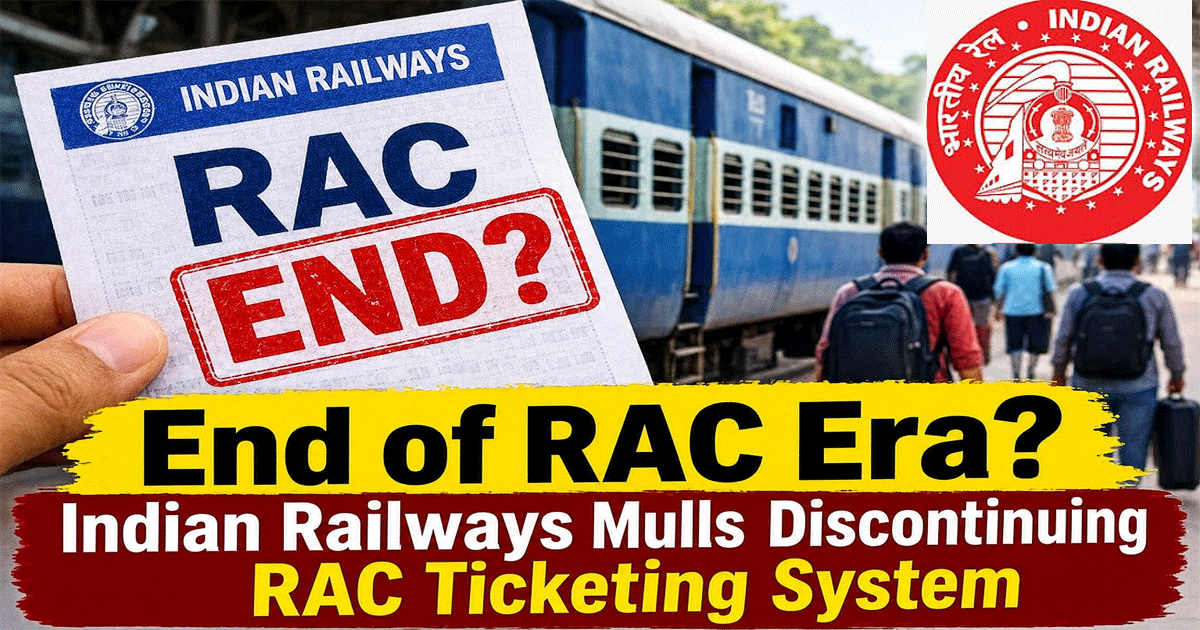
New Delhi: Indian Railways is reportedly considering discontinuing its nearly 43-year-old Reservation Against Cancellation (RAC) ticketing system, a move that could significantly change the way passengers secure accommodation on long-distance trains.
The proposal is being examined amid growing concerns over passenger convenience, the fairness of charging full fares for shared berths and improvements in digital ticketing and reservation management. According to recent media reports based on inputs from railway officials, a section of senior officials believes that the RAC arrangement has outlived its original purpose and may no longer be necessary in the era of technology-driven railway operations.
However, the Railway Ministry has not yet announced any final decision or issued an official notification abolishing the system. For the time being, RAC bookings continue under the existing rules.
What Is the RAC System and Why Was It Introduced?
The RAC facility was introduced in 1983-84 by the then Railway Minister A.B.A. Ghani Khan Choudhury. Its original objective was to ensure that passengers who could not secure confirmed berths were still able to travel, rather than remain stranded on waiting lists.
Under the arrangement, two RAC passengers are allotted a single side-lower berth, allowing both to travel by sharing the available accommodation. If a confirmed passenger cancels the ticket or fails to turn up, an RAC passenger may be upgraded to a full berth, depending on availability and priority.
The system was also designed to minimise discretionary allotment of vacant berths by railway staff and ensure that passengers higher on the waiting list received accommodation when it became available.
Over the years, RAC became an important component of the Indian railway reservation system, particularly during festive seasons, holidays and periods of heavy passenger demand.
𝐑𝐀𝐂 𝐓𝐢𝐜𝐤𝐞𝐭 𝐇𝐨𝐥𝐝𝐞𝐫𝐬 𝐀𝐥𝐞𝐫𝐭! 𝐈𝐧𝐝𝐢𝐚𝐧 𝐑𝐚𝐢𝐥𝐰𝐚𝐲𝐬 𝐌𝐚𝐲 𝐄𝐧𝐝 𝐑𝐀𝐂 𝐒𝐲𝐬𝐭𝐞𝐦!
Big Update for RAC Ticket Holders! Indian Railways is considering a major change in the RAC ticket system, which allows two passengers to share one Side Lower Berth.
The proposal is still under review, with no final decision announced yet.Stay updated with RailMitra for the Railway fact & Train updates.
Download the app or visit our website for more!
► https://t.co/uWJmVg1IyT#racticket #RACSystem #indianrailways #railwaynews #RACPassengers #trainticket #indianrailwayupdate #railwayrules #railwayannouncement #railmitra
— RailMitra – Your Train Travel Partner (@RailmitraaIndia) November 19, 2026
Why Is the Railways Considering Scrapping RAC?
The principal argument for discontinuing RAC is that technological advancements have changed the way vacant berths are identified and allotted.
Earlier, railway reservation and ticket-checking systems were not fully integrated digitally. Consequently, the RAC arrangement provided a practical mechanism for accommodating passengers when confirmed ticket-holders cancelled their journeys or failed to board.
Today, Train Ticket Examiners (TTEs) use Hand Held Terminals (HHTs), which are digitally connected to the railway reservation system. If a confirmed passenger does not turn up, the TTE can record the passenger as a ‘No Turn-Up’ on the device. The vacant berth can subsequently be offered to another eligible passenger, including those boarding from the next station.
Railway officials reportedly believe that this digital mechanism has reduced the need for maintaining a separate RAC arrangement.
Another argument is that discontinuing RAC could reduce the scope for discretionary allotment of vacant berths and improve transparency in the allocation process. Digital recording of vacant accommodation would make it easier to track available berths and offer them to passengers through the reservation system.
Full Fare for Half a Berth: The Growing Controversy
One of the strongest arguments against the existing RAC system concerns its fare structure.
Under the present arrangement, two passengers share one side-lower berth, but both are required to pay the full applicable ticket fare. Although they are entitled to travel, neither is guaranteed an individual sleeping berth unless an upgrade becomes available.
This has increasingly raised questions about whether passengers are receiving value for the money they pay.
The problem becomes particularly uncomfortable during overnight journeys, when two unrelated passengers have to share limited sleeping space. Situations involving male and female passengers sharing the same berth can also create practical difficulties and discomfort.
The issue is not merely about convenience but also about the fairness of railway fares. Passengers argue that paying the full fare should entitle them to proper accommodation rather than a shared sleeping arrangement.
Parliamentary Panel Questions Full Fare; Recommends Refund
The debate over RAC has also reached Parliament.
The Parliamentary Public Accounts Committee (PAC), in its 36th Report on ‘Punctuality and Travel Time in Train Operations in Indian Railways’, tabled in the Lok Sabha on February 4, 2026, questioned the justification for charging the full fare from passengers who continue to remain in RAC status even after the preparation of reservation charts.
The committee recommended that the Railway Ministry develop a mechanism to provide partial refunds to RAC passengers who are not allotted individual berths.
The recommendation has added another dimension to the controversy, putting the Railways under pressure to reconsider whether the existing fare arrangement adequately protects passenger interests.
However, implementing a partial-refund mechanism could involve administrative complications, particularly because passengers purchase tickets through both online platforms and physical reservation counters.
RAC Quota Was Expanded in 2016
Interestingly, rather than reducing the RAC facility, Indian Railways had expanded its accommodation capacity in 2016 to accommodate more passengers.
The changes covered sleeper, AC 3-tier and AC 2-tier coaches.
-
Sleeper Class: RAC allocation increased from five to seven side-lower berths per coach, accommodating 14 passengers instead of 10.
-
AC 3-tier: The allocation increased from two to four side-lower berths, accommodating eight passengers instead of four.
-
AC 2-tier: RAC allocation increased from two to three side-lower berths, accommodating six passengers instead of four.
The expansion reflected the growing demand for reserved accommodation and the Railways’ attempt to accommodate more passengers without adding additional coaches.
The present proposal, therefore, represents a significant shift in the philosophy of railway reservation management.
Will the Railways Lose Revenue by Ending RAC?
Railway officials reportedly believe that discontinuing RAC would not necessarily result in financial losses.
Under the existing cancellation rules, passengers holding confirmed tickets who fail to turn up without cancelling their reservations are generally not entitled to refunds. Consequently, the Railways retains the fare collected from such passengers.
If their vacant berths are subsequently offered to other passengers at the next station, the Railways could potentially collect additional revenue from the same accommodation.
Officials believe that a digitally managed system could help utilise vacant berths more efficiently while reducing dependence on the RAC mechanism.
However, the effectiveness of such an arrangement would depend on timely ticket verification, accurate updating of vacancy information and the availability of eligible passengers at intermediate stations.
What Happens to Passengers If RAC Is Discontinued?
If the proposal is eventually approved, passengers who currently depend on RAC accommodation could face a different booking experience.
Under the existing arrangement, RAC passengers are permitted to board trains and travel even without receiving a full berth. If RAC is abolished, the Railways would need to establish an alternative mechanism for accommodating passengers who cannot secure confirmed reservations.
One possibility would be to rely more extensively on real-time vacancy management and current bookings. However, the precise arrangements have not yet been announced.
The change could particularly affect passengers travelling on heavily occupied routes during festivals, summer vacations and other peak travel periods, when confirmed berths are difficult to obtain.
It would also raise questions about how passengers on waiting lists would be accommodated and whether additional reservation quotas or alternative arrangements would be introduced.
A New Era of Railway Reservation?
The reported move to discontinue RAC reflects a broader transformation in Indian Railways, which is increasingly relying on digital technology to modernise ticketing, reservation management and passenger services.
The Railways has also been working on upgrading its passenger reservation system to improve booking capacity, transparency and operational efficiency.
Interestingly, Vande Bharat Sleeper trains have been designed without the traditional RAC facility, indicating that alternative reservation arrangements are already being used in newer train services.
Nevertheless, abolishing a system that has served millions of passengers for more than four decades will require careful consideration.
The central challenge for the Railways will be to balance passenger comfort, affordability, transparency and the optimum utilisation of available berths.
Whether the RAC system is genuinely outdated or still provides an essential safety net for passengers during periods of heavy demand remains a question that the Railway Ministry will have to address before taking a final decision.