
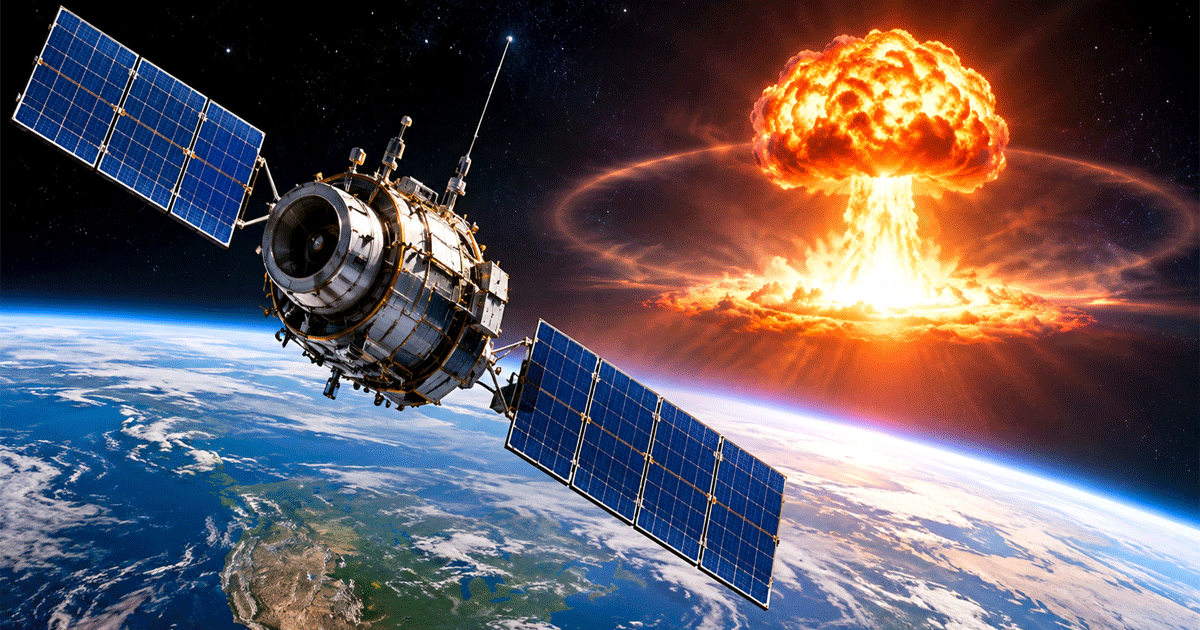
Western intelligence agencies reportedly suspect Moscow (Russia) could launch a nuclear-equipped satellite into orbit before the end of 2026, raising fears of a potential threat to thousands of satellites and the world’s communication, navigation and military networks.
by Ashis Kumar Sinha
International Affairs | The Researchers
Russia is reportedly preparing to launch a nuclear-armed satellite into Earth’s orbit, raising fresh concerns over the militarisation of space and the security of global satellite infrastructure.
According to reports by German public broadcasters NDR and WDR and newspaper Süddeutsche Zeitung, intelligence agencies of NATO member countries believe Moscow could deploy a satellite carrying a nuclear weapon before the end of 2026. A launch as early as December is reportedly being considered possible.
The alleged spacecraft, reportedly named Sputnik-S, is believed to have been assembled several years ago and is currently stored in the Moscow region. Western intelligence assessments reportedly suggest that preparations could be advanced enough for a launch within weeks.
However, neither the proposed launch timetable nor the identity and operational status of the satellite have been independently confirmed.
Why is a nuclear-armed satellite so dangerous?
Unlike conventional anti-satellite weapons designed to destroy individual spacecraft, a nuclear explosion in orbit could potentially affect hundreds or even thousands of satellites simultaneously.
A nuclear detonation in space could generate intense radiation and electromagnetic disturbances, damaging satellite electronics and disrupting communication and navigation systems. It could also create artificial radiation belts around Earth, exposing satellites passing through them to prolonged damage.
The consequences could extend far beyond military operations. Satellite-dependent services such as GPS navigation, aviation, maritime transport, telecommunications, weather forecasting and financial infrastructure could face serious disruption.
The threat is particularly significant because modern military forces increasingly depend on satellite networks for intelligence gathering, surveillance, battlefield coordination and secure communications.
Commercial satellite systems, including Elon Musk’s Starlink network, have also become strategically important during the Russia-Ukraine war.
NATO concerned over possible deployment
The reported intelligence assessments have raised concerns among Western governments, particularly Germany and other NATO members.
According to the German media investigation, Western intelligence agencies exchanged warnings in November, with assessments suggesting that Russia could attempt to place the spacecraft into orbit within approximately 60 days.
NATO officials have emphasised that the alliance is closely monitoring developments in space and has options to respond to emerging security threats.
The possibility of a nuclear weapon being deployed in orbit would represent a significant escalation in the strategic competition between Russia and Western powers, potentially transforming space into a new arena of nuclear confrontation.
Russia rejects allegations
Moscow has strongly rejected allegations that it is preparing to deploy a nuclear-armed satellite.
The Russian Embassy in Berlin reportedly described the claims as unfounded and part of a propaganda campaign, maintaining that Russia’s space activities comply with international obligations and are intended for peaceful purposes.
The Kremlin has also questioned the credibility of the reports, which rely heavily on intelligence sources that have not been publicly identified.
Russia had previously rejected similar American allegations in 2024 concerning the development of a nuclear anti-satellite capability.
Violation of international space law?
The deployment of a nuclear weapon in Earth’s orbit would violate the 1967 Outer Space Treaty, which prohibits countries from placing nuclear weapons or other weapons of mass destruction in orbit.
The treaty, signed by Russia, the United States and other major spacefaring nations, establishes the principle that outer space must remain free from the deployment of weapons of mass destruction.
A nuclear explosion in orbit would also have consequences beyond the country or military alliance being targeted. Satellites belonging to Russia, China, the United States, India and other countries could potentially be affected.
The dangers are not merely theoretical. The United States’ 1962 Starfish Prime nuclear test, conducted at an altitude of approximately 400 kilometres, demonstrated that a high-altitude nuclear explosion could damage satellites and create artificial radiation belts around Earth.
A new front in the Russia-West confrontation
The latest developments come amid intensifying competition among major powers to establish military superiority in space. Russia, China and the United States are investing heavily in anti-satellite technologies, electronic warfare, space surveillance and other military capabilities.
The Russia-Ukraine conflict has further demonstrated how critical satellite infrastructure has become in modern warfare.
If the reported Russian programme advances towards deployment, it could trigger a new arms race in space and undermine international efforts to prevent the militarisation of Earth’s orbit.
For now, the reported Sputnik-S launch remains unconfirmed. Nevertheless, the prospect of a nuclear weapon being placed in orbit has raised a troubling question: could the next major nuclear confrontation begin not on Earth, but in space?