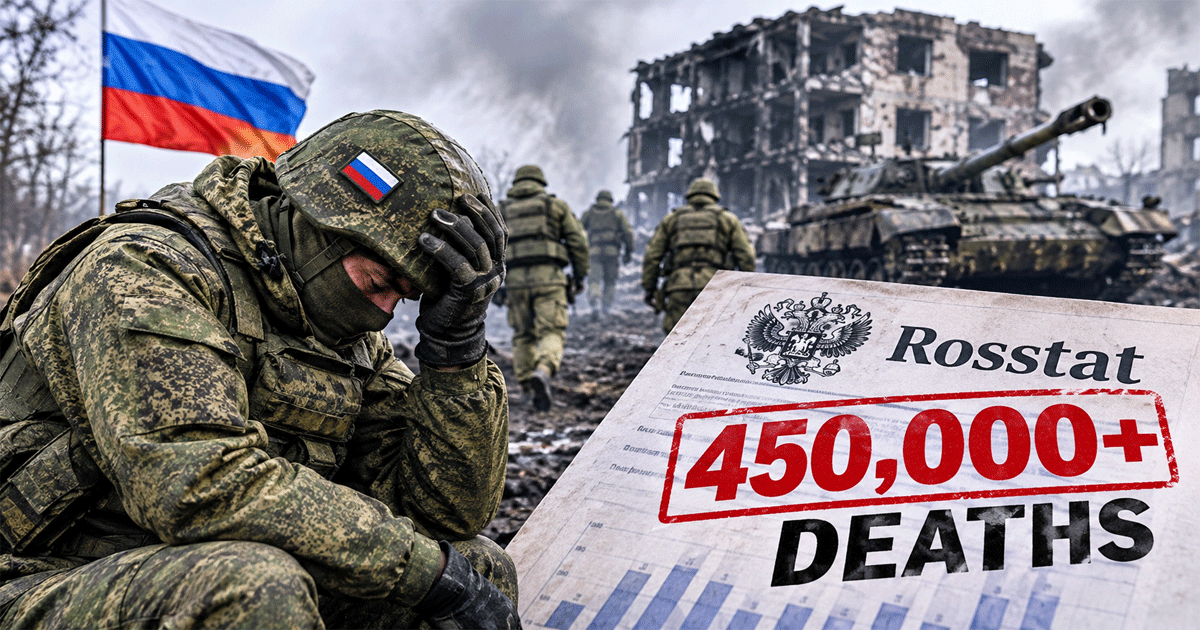
Leaked Russian statistical records suggest that more than 450,000 people may have died in connection with the Ukraine war, exposing the mounting human cost of a conflict Moscow has largely kept out of public scrutiny.
More than 450,000 Russians may have died in connection with the war in Ukraine, according to an analysis of allegedly leaked records from Russia’s Federal State Statistics Service (Rosstat). The revelations offer a rare insight into the scale of Russian losses since Moscow launched its full-scale invasion of Ukraine in February 2022.
The figures, released by hacking groups Silent Crow and Belarusian Cyber Partisans, have triggered fresh questions about the Kremlin’s handling of military casualty information. Their analysis puts the estimated number of deaths at between 393,881 and 450,100, depending on the methodology used to identify and classify war-related fatalities.
The figures are based on a large collection of death records allegedly extracted from Rosstat’s systems. However, they have not been officially authenticated by the Russian government, and the precise number of military personnel killed in combat remains uncertain.
Different estimates, different methodologies
The two hacking groups have arrived at different estimates because they applied different criteria to the records. Silent Crow’s broader calculation puts the figure at approximately 450,100, while Belarusian Cyber Partisans reported 393,881 deaths using a narrower classification.
An investigation by The Guardian, based on more than 11 million allegedly leaked death certificates, identified 412,576 records explicitly associated with the war through official cause-of-death codes or references to military operations.
These figures should not be treated as a confirmed count of soldiers killed on the battlefield. The datasets reportedly include military deaths from combat and other causes, while differences in classification may also account for the variation in estimates.
A data leak from state statistics agency Rosstat shows that, according to official figures, over 450,000 Russians have been killed in the war in Ukraine, making the war the fourth most common cause of death in Russia since 2022.
https://t.co/7VM1F9EMr8— The Moscow Times (@MoscowTimes) November 9, 2026
Rosstat acknowledges cyberattack
The controversy follows a cyberattack on Rosstat between October 29 and November 1, 2026. Silent Crow and Belarusian Cyber Partisans claimed responsibility, alleging that they had penetrated the agency’s systems and extracted approximately 23 terabytes of information.
The material reportedly included demographic records, death certificates, economic statistics and internal government documents.
Rosstat acknowledged that its systems had been targeted but denied that sensitive databases or protected information had been compromised. The agency has not independently confirmed the authenticity of the casualty figures circulated by the hackers.
Russia has not published a comprehensive military death toll since September 2022, when the country’s Defence Ministry last released an official figure for its battlefield fatalities. The absence of regular disclosures has made it difficult to establish the full human cost of the invasion.
Independent investigations point to heavy losses
The leaked figures broadly correspond with estimates produced by independent Russian media organisations.
BBC Russian and Mediazona have been documenting the deaths of Russian military personnel through obituaries, social media posts by relatives, regional news reports and official announcements. Their investigations have identified hundreds of thousands of military deaths by name, although the confirmed list represents only cases for which identities could be established.
In another statistical investigation, Mediazona and Meduza estimated that approximately 352,000 Russian men aged between 18 and 59 had died in the war by the end of 2025. The estimate was based on inheritance registry records and statistical calculations designed to identify deaths that were not publicly reported.
Although the methodologies differ, these investigations reinforce the assessment that Russia has suffered exceptionally heavy losses during the prolonged conflict.
Death toll rises as fighting intensifies
One of the most striking aspects of the leaked data is the reported increase in registered deaths over the course of the war.
According to Silent Crow’s analysis, the number of recorded deaths rose from 18,877 in 2022 to 42,365 in 2023. The figure increased sharply to 109,683 in 2024 and 182,264 in 2025.
The dataset reportedly covers registrations up to August 28, 2026, making the latest year’s figures incomplete.
The Guardian’s investigation also identified periods in late 2024 and 2025 when monthly war-related deaths exceeded 15,000. Such figures underline the intensity of the fighting and the growing human cost of Russia’s military campaign.
However, registration delays and differences in the classification of deaths make direct year-to-year comparisons difficult.
Poorer regions bear a disproportionate burden
The impact of the war has not been evenly distributed across Russia. The leaked records reportedly point to disproportionately high losses in poorer and more remote regions, including Buryatia, Tuva and Zabaykalsky Krai.
These areas have experienced a significantly higher proportion of military deaths relative to their populations than major metropolitan centres such as Moscow and St Petersburg.
The pattern highlights the unequal social burden of the war, with economically disadvantaged communities appearing to have supplied a disproportionate share of military personnel and suffered heavier losses.
Actual losses could be higher
Independent analysts caution that the leaked figures may still fail to capture the full scale of Russian deaths.
Unidentified bodies, missing servicemen, delayed death registrations and cases that have not entered official records could all contribute to an undercount. The database also does not provide a complete picture of the number of wounded Russian personnel.
Some analysts have suggested that the actual number of Russian military deaths could be approaching 500,000, although this remains an estimate rather than an independently established figure.
The distinction between deaths and total casualties is also important. Military casualty estimates frequently combine killed, wounded, missing and captured personnel, producing substantially higher figures than death counts alone.
As the conflict moves towards its fifth year, the leaked records have intensified scrutiny of Russia’s military losses and the demographic consequences of the invasion.
For the Kremlin, which has largely avoided releasing updated figures on battlefield fatalities, the disclosures represent a significant challenge to its control over information about the war. Beyond the battlefield, the growing loss of working-age men could have lasting consequences for Russia’s labour market, regional economies and population structure.