Trump’s New Tariff Bombshell
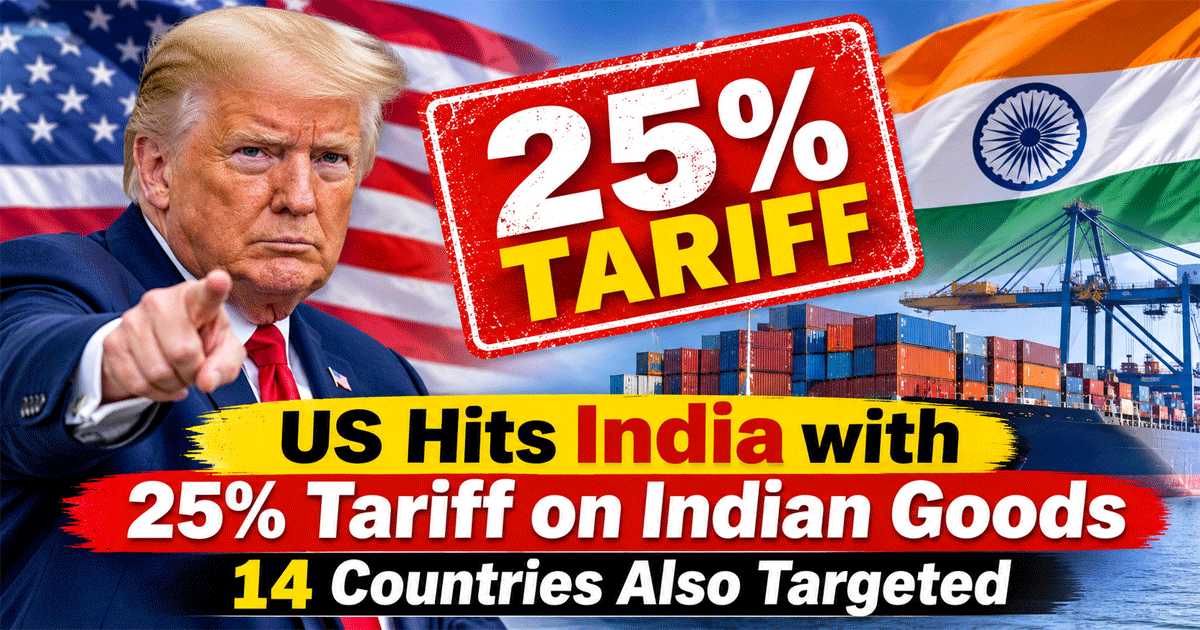
News Desk: The Donald Trump administration has proposed fresh import tariffs of up to 25 per cent on Indian goods as part of a wider trade offensive targeting 14 major economies, including China, the European Union (EU), Japan, South Korea and several Southeast Asian countries.
The proposed duties follow an eight-month investigation by the Office of the United States Trade Representative (USTR) under Section 301 of the Trade Act of 1974, which allows Washington to take action against foreign trade practices it considers unreasonable or harmful to American commerce.
For India, the proposed tariff ceiling is 25 per cent. However, the rate could be reduced to 17 per cent if New Delhi concludes a reciprocal trade agreement with Washington that addresses the concerns raised in the investigation.
The announcement comes amid continuing negotiations between the two countries over a comprehensive trade agreement and could add fresh pressure to an already challenging trade relationship.
#NewsNight with @AdityaRajKaul | US Proposes 25% Tariffs On India. Centre Says “Notice Under Examination” https://t.co/rpeEf33CRW https://t.co/u1H60nw4hZ
— NDTV (@ndtv) November 25, 2026
14 economies in the US tariff crosshairs
Apart from India, the proposed measures cover China, Bangladesh, Cambodia, Indonesia, Malaysia, Thailand, Vietnam, Singapore, Japan, South Korea, Switzerland, Taiwan and the European Union.
China faces a proposed additional tariff of up to 20 per cent, while Vietnam could face the highest proposed rate of 35 per cent. Bangladesh, Cambodia, Indonesia, Malaysia and Thailand face proposed rates of up to 18 per cent each.
The proposed rates for the European Union, Japan, South Korea, Switzerland and Taiwan are up to 15 per cent. Singapore faces a proposed rate of up to 20 per cent, which could be reduced to 10 per cent under a reciprocal trade agreement with the US.
The US plans to impose new import taxes on goods from China, the European Union and a dozen other economies, in a move to rebuild President Donald Trump’s sweeping global tariff agenda that the Supreme Court found unconstitutional. https://t.co/ldCyIRlaho
— Bloomberg (@business) November 25, 2026
The proposed tariff structure is as follows:
| Country/economy | Proposed tariff |
|---|---|
| India | Up to 25% |
| China | Up to 20% |
| Vietnam | Up to 35% |
| Singapore | Up to 20% |
| Bangladesh | Up to 18% |
| Cambodia | Up to 18% |
| Indonesia | Up to 18% |
| Malaysia | Up to 18% |
| Thailand | Up to 18% |
| European Union | Up to 15% |
| Japan | Up to 15% |
| South Korea | Up to 15% |
| Switzerland | Up to 15% |
| Taiwan | Up to 15% |
The rates are proposed ceilings, not necessarily the final duties applicable to every product. Existing trade commitments and tariff arrangements will also influence their implementation.
Mexico and Norway, which were also examined during the broader investigation, have not been included in the latest proposed tariff action.
Why Washington is targeting India
The USTR has accused the targeted economies of maintaining structural excess manufacturing capacity through government-backed industrial expansion, production incentives, subsidies, financial support and trade policies that allegedly distort global markets.
In its assessment of India, the US cited five major areas of concern: industrial policies aimed at expanding manufacturing, inadequate labour protections, financial repression, sustained barriers to market access and insufficient action to address global excess production capacity.
Washington has particularly flagged pharmaceuticals, medical devices, steel, solar energy and information and communications technology (ICT) as sectors where India’s policies could affect American manufacturers and exporters.
The US administration argues that subsidised production and excess manufacturing capacity in these economies create unfair competition, suppress prices and undermine domestic industrial investment and employment in the United States.
Tariffs not immediately applicable
The proposed duties will not come into force immediately. The USTR has initiated a public consultation process, with written comments due by January 5, 2027. Public hearings are scheduled to begin on January 25, after which the administration can move towards a final decision.
The proposed measures also provide exemptions for certain products. These include goods already covered by separate US national-security tariffs under Section 232, such as steel, aluminium and copper products, vehicles and their parts, certain wood products, patented pharmaceutical articles and semiconductor products.
Books and other informational materials, donations and accompanied baggage are also among the proposed exemptions.
Importantly, the proposed duties are generally structured net of existing Section 301 tariffs rather than being automatically added on top of all existing duties. Their final impact will depend on the product category, applicable exemptions and existing trade arrangements.
China faces significant pressure
China faces one of the most consequential measures under the latest proposal. The proposed additional tariff ceiling is 20 per cent, which could bring the combined rate on certain Chinese products to approximately 45 per cent when existing duties of around 25 per cent are taken into account.
The Trump administration has repeatedly accused Beijing of using industrial subsidies and state-backed manufacturing expansion to flood international markets with inexpensive goods, particularly in sectors such as steel, electric vehicles, solar products and industrial equipment.
Beijing, however, has rejected accusations of excess capacity, arguing that its manufacturing competitiveness reflects market advantages rather than unfair trade practices.
Fresh challenge for India’s exports
For India, the proposed 25 per cent tariff ceiling could complicate efforts to expand exports to the US, particularly if bilateral negotiations fail to produce an agreement.
The possibility of a reduced 17 per cent rate offers New Delhi an incentive to accelerate trade negotiations, although the final outcome will depend on the terms of any agreement and the resolution of Washington’s concerns.
The latest move also highlights the Trump administration’s determination to use tariffs as a negotiating instrument to reshape international trade relations.
With 14 major trading partners now facing proposed duties, the coming months could prove crucial for global supply chains and international commerce. For India, the immediate challenge will be to protect its export interests while securing a favourable trade arrangement with its largest trading partners.
| NOTE: The 25 per cent figure for India is a proposed ceiling, not an already implemented tariff. The proposed 17 per cent rate is conditional on a qualifying trade agreement with the US. |
India rejects US allegations
Rejecting Washington’s assessment, India on Wednesday strongly contested allegations that its industrial and trade policies were contributing to structural excess manufacturing capacity, asserting that the country had no surplus production capacity in any sector.
The government maintained that trade-related differences with the US should be addressed through ongoing negotiations for the proposed India-US Bilateral Trade Agreement (BTA), rather than through unilateral trade measures.
New Delhi said it had taken note of the US Trade Representative’s (USTR) Notice of Determination and Request for Comments and was examining its implications. It also reiterated that India’s Department of Commerce had already clarified during the investigation and subsequent proceedings that the country did not have structural excess capacity in any sector.
The government’s response comes amid Washington’s proposal to impose tariffs of up to 25 per cent on Indian goods, with the possibility of a reduced rate of 17 per cent if the two countries reach a mutually acceptable trade agreement.
(updated)