
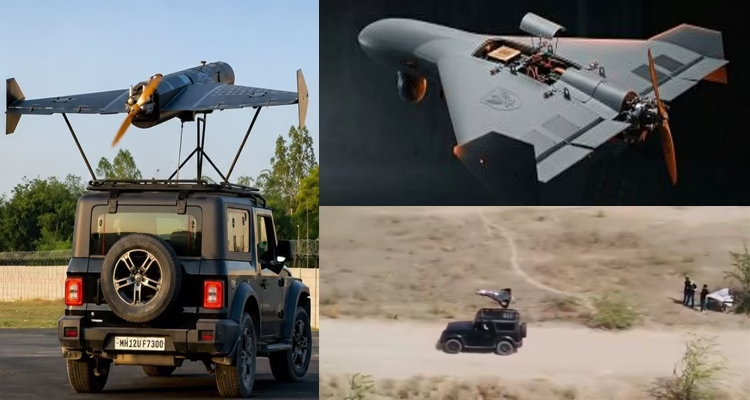
News Desk: India has achieved another significant milestone in indigenous defence technology with the successful testing of the AI-powered loitering munition drone, Divyastra Mark-1 (Mk-1). The successful trial marks a major step forward in the country’s efforts to strengthen its unmanned combat capabilities and reduce dependence on imported military systems.
“The indigenous drone has been developed by Lucknow-based defence firm HoverIT, aligning with the government’s efforts to strengthen self-reliance in critical defence technologies through the ‘Make in India’ and ‘Aatmanirbhar Bharat’ initiatives.”
Successful Trial Demonstrates Advanced Combat Capabilities
The Divyastra Mk-1 recently underwent a successful demonstration before senior Indian Army officials, showcasing its ability to perform intelligence, surveillance, reconnaissance, and precision-strike missions.
During the trial, the drone demonstrated autonomous navigation, target acquisition, and attack capabilities, highlighting its potential role in future battlefield operations. Defence experts have described the successful test as a significant achievement for India’s rapidly growing drone manufacturing ecosystem.
𝐃𝐢𝐯𝐲𝐚𝐬𝐭𝐫𝐚 𝐌𝐤-𝟏: 𝐈𝐧𝐝𝐢𝐚’𝐬 𝐍𝐞𝐰 𝐋𝐨𝐢𝐭𝐞𝐫𝐢𝐧𝐠 𝐌𝐮𝐧𝐢𝐭𝐢𝐨𝐧! 𝐖𝐚𝐭𝐜𝐡 𝐭𝐡𝐞 𝐟𝐮𝐭𝐮𝐫𝐞 𝐨𝐟 𝐢𝐧𝐝𝐢𝐠𝐞𝐧𝐨𝐮𝐬 𝐰𝐚𝐫𝐟𝐚𝐫𝐞 𝐭𝐚𝐤𝐞 𝐟𝐥𝐢𝐠𝐡𝐭! 🎥
HoverIt has successfully demonstrated the Divyastra Mk-1 in Jodhpur, with multiple launches… pic.twitter.com/lSAXTQXOQX
— BJP (@BJP4India) June 1, 2026
Long Range and High-Endurance Platform
Designed as a long-range loitering munition, Divyastra Mk-1 can reportedly remain airborne for several hours while carrying out surveillance and combat missions. With an operational reach of nearly 500 kilometres, the drone is capable of striking targets deep inside enemy territory without exposing manned aircraft to hostile air-defence systems.
Its endurance and precision make it suitable for a wide range of military operations, including border surveillance, tactical strikes, and high-value target engagements.
AI-Powered Autonomous Warfare System
One of the drone’s most advanced features is its artificial intelligence-driven operational architecture. The platform can independently navigate complex environments, identify potential targets, and execute missions with minimal human intervention.
The system is also equipped with swarm technology, enabling multiple drones to coordinate missions simultaneously. Such capabilities are increasingly becoming a defining feature of modern warfare, allowing armed forces to overwhelm enemy defences through coordinated attacks.
Reducing Dependence on Foreign Defence Imports
The successful testing of Divyastra Mk-1 is expected to strengthen India’s efforts to develop indigenous alternatives to imported loitering munitions and autonomous strike systems.
Military analysts believe the platform can offer a cost-effective and strategically valuable solution for the Indian Armed Forces while supporting the government’s broader objective of building a robust domestic defence manufacturing base.
Future Development Already Underway
Following the success of Divyastra Mk-1, work is reportedly progressing on a more advanced variant, Divyastra Mk-2. The next-generation platform is expected to feature a significantly extended strike range, larger payload capacity, and enhanced autonomous combat capabilities.
If successfully developed, the upgraded version could emerge as one of India’s most potent indigenous unmanned strike systems.
Strengthening India’s Drone Warfare Ecosystem
The successful trial of Divyastra Mk-1 underscores India’s growing expertise in advanced defence technologies and unmanned warfare systems. As global militaries increasingly integrate drones into their operational strategies, indigenous platforms such as Divyastra are expected to play a crucial role in enhancing India’s battlefield preparedness and strategic deterrence capabilities.
The achievement represents another important step toward positioning India as a global hub for advanced defence innovation and military technology development.