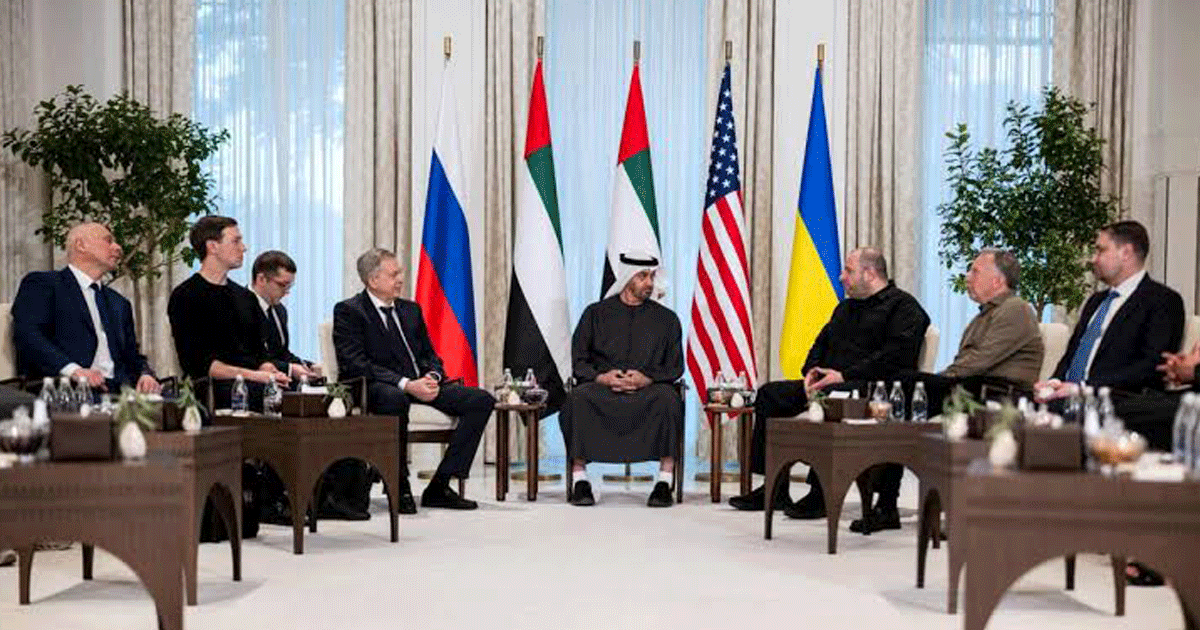
Abu Dhabi: Russia and Ukraine are set to resume high-stakes peace negotiations in Abu Dhabi on Tuesday in a renewed diplomatic push led by the United States to end the nearly five-year-long war. The two-day discussions mark another significant attempt to bring Moscow and Kyiv to the negotiating table, with territorial disputes, security guarantees and a possible ceasefire expected to dominate the agenda.
US President Donald Trump has stepped up efforts to broker an agreement between the two countries, hoping to secure a diplomatic breakthrough after months of stalled negotiations. The American administration is seeking to move beyond temporary ceasefire proposals and establish a framework for a comprehensive settlement.
The US delegation is expected to include special envoy Steve Witkoff and President Trump’s son-in-law Jared Kushner. Ukraine’s delegation is to be led by Rustem Umerov, while Russia’s negotiating team is expected to include Kremlin aide Vladimir Medinsky.
The discussions are expected to cover territorial arrangements, security guarantees for Ukraine, de-escalation measures, humanitarian issues and mechanisms for monitoring a potential ceasefire.
Lavrov: Talks in Abu Dhabi will address security issues concerning Russia and Ukraine, as well as the overall security situation in the region. https://t.co/uTpONOPSGg
— RussiaNews 🇷🇺 (@mog_russEN) November 9, 2026
Donbas Dispute Remains Biggest Obstacle
The territorial question remains the most contentious issue confronting negotiators. Russian President Vladimir Putin has continued to demand that Ukraine withdraw its forces from the entire Donbas region, comprising Donetsk and Luhansk, as part of any comprehensive peace settlement.
Moscow has also maintained its claims over four Ukrainian regions—Donetsk, Luhansk, Zaporizhzhia and Kherson—which it declared annexed in 2022 despite not exercising full control over them.
Ukrainian President Volodymyr Zelenskyy has consistently rejected surrendering territory defended by Ukrainian forces. Kyiv maintains that any peace agreement must respect Ukraine’s sovereignty and territorial integrity and must not reward territorial gains achieved through military aggression.
The disagreement over territory has repeatedly stalled diplomatic initiatives, with neither side willing to abandon its core position. The Abu Dhabi negotiations will test whether the two countries can identify a compromise acceptable to their respective political leaderships.
Security Guarantees Central to Ukraine’s Position
For Kyiv, security guarantees are as important as ending the fighting. Ukraine wants firm assurances that Russia will not launch another military offensive after a peace agreement is signed.
Negotiators are expected to examine possible post-war security arrangements, international monitoring mechanisms and the role of Western countries in ensuring Ukraine’s long-term security.
Ukraine has also pushed for a halt to attacks on energy infrastructure, protection of maritime trade routes in the Black Sea and progress on humanitarian issues, including prisoner exchanges.
A ceasefire arrangement that merely pauses the fighting without addressing the possibility of renewed Russian aggression is unlikely to satisfy Kyiv. Ukraine wants a settlement that provides lasting security rather than a temporary suspension of hostilities.
Europe Seeks a Greater Role
European participation is another sensitive aspect of the peace initiative. Several European governments believe that any agreement affecting the continent’s security architecture must involve them directly.
France, Germany, the United Kingdom and other European partners have been closely engaged in discussions over Ukraine’s future security. However, Moscow has opposed European involvement in the main trilateral negotiations, complicating efforts to build a broader diplomatic consensus.
Washington is also exploring the possibility of a wider European security arrangement that could address Russia’s longstanding objections to NATO’s military presence in Eastern Europe.
European leaders, however, remain concerned that an agreement negotiated primarily between Washington and Moscow could undermine Ukraine’s interests and leave the continent facing renewed security risks.
Fighting Continues Alongside Diplomatic Efforts
The renewed negotiations are taking place against the backdrop of continuing military confrontations. Russian missile and drone attacks have repeatedly targeted Ukrainian cities and energy infrastructure, raising concerns over electricity supplies and the country’s preparedness for winter.
Ukraine, meanwhile, has intensified its long-range drone operations against Russian oil refineries and other strategic facilities, seeking to disrupt Moscow’s military and economic capabilities.
The continuing attacks underline the fragile nature of diplomatic efforts. Neither side has demonstrated a willingness to suspend military operations without meaningful progress on the central issues separating them.
Will Abu Dhabi Deliver a Breakthrough?
Despite renewed diplomatic engagement, expectations of an immediate breakthrough remain cautious. Territorial claims, Ukraine’s demand for credible security guarantees and disagreements over the future European security framework remain formidable obstacles.
The resumption of talks nevertheless offers an opportunity to revive negotiations and establish common ground on a possible ceasefire and broader peace agreement.
For Ukraine, the challenge is to secure an end to the war without compromising its sovereignty. Russia, meanwhile, is seeking recognition of its territorial and strategic demands. The United States faces the difficult task of reconciling these fundamentally opposing positions.
Whether the Abu Dhabi negotiations can turn diplomatic engagement into a concrete peace framework will be closely watched by the international community. For millions of people affected by the conflict, the ultimate test will not be another round of talks but a durable agreement capable of ending the war.