Myanmar: A Troubled Nation and Millions of Sufferers
Myanmar’s humanitarian crisis continues to worsen as civil war, military rule, mass displacement and economic collapse leave millions struggling for survival.

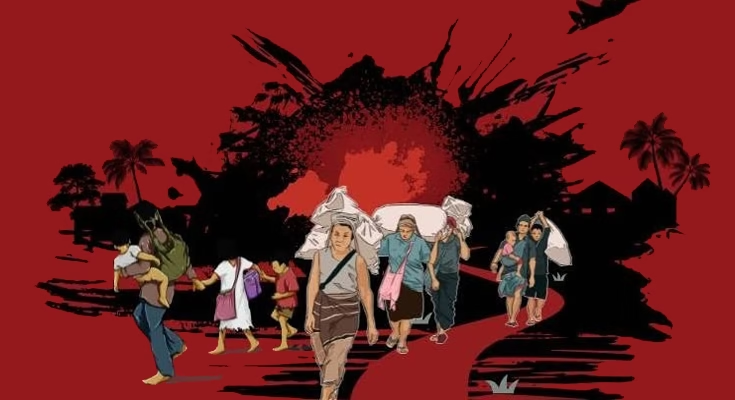
When the global community observed World Refugee Day on June 20, a grim reality emerged from Myanmar (also known as Burma or Brahmadesh), where the military-controlled regime in Naypyitaw has become one of the primary drivers of displacement in its own country. According to various international agencies, more than 5.3 million people in Myanmar are currently living in distress. The UN High Commissioner for Refugees (UNHCR) recently revealed that over one million people have fled to neighbouring countries, including Bangladesh, Thailand, and India, particularly the northeastern states of Manipur and Mizoram.
Meanwhile, around 3.7 million internally displaced persons continue to survive in border regions with little or no access to adequate food, healthcare, or shelter. Chronic poverty now affects nearly 80 percent of Myanmar’s population of approximately 55 million. The ruling military-backed regime has only worsened the humanitarian crisis through its nationwide campaign against its own civilians.
Since the military coup of February 1, 2021, when the democratically elected government led by pro-democracy icon Daw Aung San Suu Kyi was overthrown by then military chief Min Aung Hlaing, the situation has steadily deteriorated. Hundreds of villages have been abandoned as residents fled relentless airstrikes, arson attacks, and targeted killings carried out by the military.
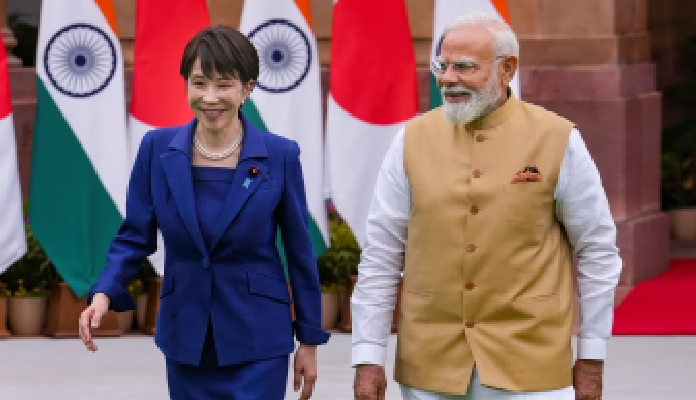
Following the controversial national elections held in December 2025 and January 2026, Hlaing assumed the presidency and has since projected himself as a leader committed to peace and development in the Buddhist-majority nation. His recent official visits to India and China have helped him gain some diplomatic legitimacy. Before travelling to Beijing, he received a warm welcome in New Delhi, reflecting India’s strategic and economic interests, particularly the Kaladan Multi-Modal Transit Transport Project and the India-Myanmar-Thailand Trilateral Highway. However, the ground reality under the junta-backed administration remains unchanged and deeply troubling.
At present, the military regime reportedly controls barely 30 percent of Myanmar’s territory. Ethnic resistance organisations and People’s Defence Forces administer roughly 40 percent of the country, while the remaining areas continue to witness intense fighting between junta troops and various armed groups.
Two years ago, anti-junta forces launched a coordinated nationwide offensive that pushed Myanmar deeper into political, economic, and humanitarian turmoil resembling a full-scale civil war. Among the strongest resistance groups, the Arakan Army (AA) now controls nearly 70 percent of Rakhine State. After capturing 14 of the state’s 17 townships, AA fighters are now focusing on seizing the state capital, Sittwe.
The prolonged conflict has resulted in enormous human suffering. Earlier, the United Nations estimated that more than 75,000 people had lost their lives during the past five years. More recently, the Armed Conflict Location & Event Data (ACLED), an independent conflict-monitoring organisation, reported that over 100,000 people have been killed since the 2021 military coup.
According to ACLED, more than 1,000 distinct armed groups are currently involved in the conflict, making Myanmar one of the world’s most fragmented war zones. The organisation ranked Myanmar as the second-most conflict-affected region globally last year, behind only the Palestinian territories.
The UN High Commissioner for Human Rights has repeatedly stated that Rakhine State and central Myanmar continue to bear the brunt of military atrocities, with civilians paying the highest price. Following battlefield setbacks, junta forces have frequently resorted to indiscriminate aerial attacks using fighter jets, drones, and paramotors to bomb civilian areas, including schools, hospitals, and refugee camps.
Children and students remain among the silent victims of the ongoing conflict and economic collapse. More than six million children and young people are expected to remain out of school during the 2026–27 academic year. As a result, nearly half of Myanmar’s estimated 13 million school-age children are being denied formal education.
The country’s healthcare system has also largely collapsed. Numerous doctors and healthcare workers have reportedly been killed in repeated airstrikes targeting medical facilities, while several private hospitals have been forced to shut down under pressure from the authorities.
Myanmar’s media has endured one of the darkest periods since the country’s independence. Alongside thousands of political prisoners, at least 215 media workers have been targeted over the past five years. According to the Geneva-based Press Emblem Campaign (PEC), more than 15 journalists remain behind bars.
PEC President Blaise Lempen recently disclosed that the operating licences of three news organisations—Myaelatt Athan, Red News Agency, and Asia Citizens—had been revoked, raising the number of media outlets facing legal persecution to 97. He urged the authorities to allow journalists and media organisations to operate freely and without intimidation.
The National Unity Government (NUG), formed after the coup by elected lawmakers primarily from Suu Kyi’s National League for Democracy (NLD), recently appealed to international investors operating in Myanmar to uphold transparency, accountability, and respect for local communities.
Functioning as a parallel civilian administration, the NUG continues to demand the unconditional release of Daw Aung San Suu Kyi and all other political prisoners. It has also warned that any economic or investment agreements signed with the military regime under Min Aung Hlaing lack democratic legitimacy and may expose investors to significant legal, financial, and operational risks.
Myanmar’s crisis remains far from over. With violence continuing, millions displaced, democratic institutions dismantled, and humanitarian conditions worsening by the day, it may take far longer than many expect before the dust finally settles over this deeply troubled nation.