
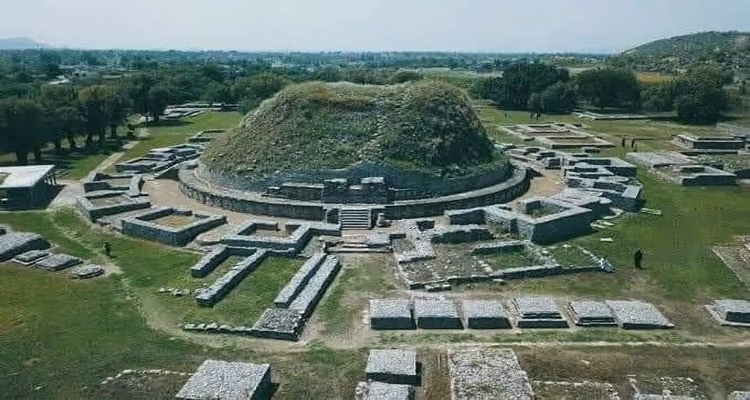
News Desk: The United Nations Educational, Scientific and Cultural Organization (UNESCO) has issued a stern warning to Pakistan over restoration work at the ancient archaeological city of Taxila, cautioning that the globally renowned heritage site could face inclusion on the List of World Heritage in Danger—and eventually lose its World Heritage status—if the disputed alterations are not reversed.
According to reports, UNESCO raised serious concerns over recent conservation work carried out at the Mohra Moradu Buddhist Monastery and the ancient city of Sirkap, saying the interventions may have compromised the site’s historical authenticity and integrity. The warning was conveyed during a recent meeting with senior Pakistani government officials, sources in Pakistan’s Ministry of National Heritage and Culture told local media.
UN warns Pakistan against ‘reconstructions’ at Taxila sites, says can ‘delist’ the historical sites
Source: WION#Pakistanhttps://t.co/g08YH3s1Zk
— Pak News – www.pak.news (@paknewsnow) July 2, 2026
What Triggered UNESCO’s Warning?
The controversy began earlier this year after photographs and details of the restoration work were submitted to Pakistan’s Permanent Delegate to UNESCO in Paris. The images allegedly showed fresh masonry and modern construction replacing sections of ancient walls, raising concerns among heritage experts that internationally accepted conservation norms had been violated.
UNESCO has reportedly warned that unless these “unnecessary interventions” are reversed, Taxila could first be placed on its danger list before facing the rare possibility of being delisted altogether. The agency is said to have reminded Pakistani authorities that it has previously removed a World Heritage Site in Germany over similar conservation concerns.
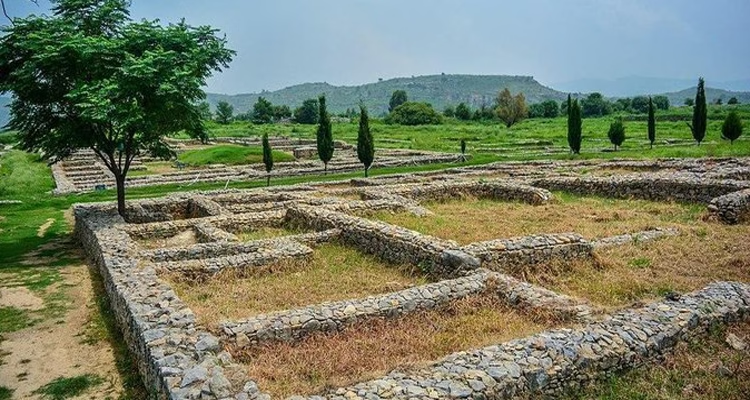
UNESCO Demands Technical Records
Following a joint inspection in June by UNESCO officials, Pakistan’s Department of Archaeology and Museums (DOAM), and the Ministry of National Heritage and Culture, UNESCO sought detailed documentation of the restoration work.
The organization has requested:
- Heritage Impact Assessment reports.
- Before-and-after photographic documentation.
- Technical drawings of all interventions carried out in the core and buffer zones.
- Conservation methodology used at Mohra Moradu and Sirkap.
Officials familiar with the matter have reportedly expressed concern over the alleged use of cement and modern materials, saying such practices violate UNESCO’s conservation guidelines for archaeological monuments and weaken Pakistan’s efforts to secure World Heritage recognition for several other historical sites.
Punjab Archaeology Department Defends the Work
Pakistan’s Punjab Archaeology Department has rejected allegations that it reconstructed the ancient monuments. Director General Malik Zaheer Abbas maintained that the work involved internationally accepted conservation measures aimed at stabilizing fragile archaeological remains, preventing further deterioration, and preserving the site’s authenticity rather than rebuilding it.
Why Taxila Matters
Located in Pakistan’s Punjab province near Rawalpindi, Taxila—historically known as Takshashila—is among South Asia’s oldest and most important archaeological sites. Believed to have been founded around the first millennium BCE, it flourished as a major centre of learning and trade on an important branch of the ancient Silk Road connecting South Asia with Central Asia and the West.
The UNESCO World Heritage Site includes the remains of ancient settlements, Buddhist monasteries, stupas, temples, and later Islamic monuments, reflecting centuries of cultural and religious history. Recognized as a UNESCO World Heritage Site in 1980, Taxila remains one of the region’s most significant archaeological treasures.
If UNESCO concludes that the site’s Outstanding Universal Value has been irreversibly compromised, Taxila could face one of the most serious penalties available under the World Heritage Convention—placement on the danger list and, in the worst-case scenario, removal from the prestigious World Heritage List.